Spokane
Train DreamsSpokane functions in the novel as a gateway between Robert Grainier’s isolated working life and the larger systems of rail transport, industrial labor, commerce, and public spectacle. Its importance is infrastructural rather than scenic. Grainier reaches it by train, leaves it by wagon or on foot, and repeatedly encounters there the institutions and technologies that draw the remote Idaho Panhandle into a wider regional economy.
Railroad and Corporate Geography
Spokane first enters Grainier’s life through the Spokane International Railway, whose company stores are the setting for the accusation that triggers the attempted killing of a Chinese laborer in the summer of 1917. The laborer is said to have stolen from the stores, and railroad workers drag him toward a bridge under construction above the Moyea River. Mr. Sears, identified as a member of the railway’s management, takes part in the struggle and later fires a four-shot black-powder revolver at the escaping man. Spokane is therefore present not simply as a distant city but as the corporate authority behind a violent labor landscape.
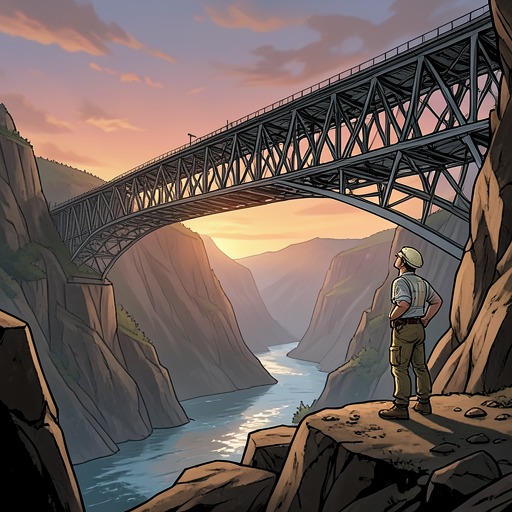
The railroad also gives Spokane a material reach extending far beyond the city itself. Forty-one days after the attempted killing, the first locomotive crosses the completed 112-foot span of the Eleven-Mile Cutoff Bridge over a gorge sixty feet deep. Mr. Sears raises his revolver to signal the crossing, and the locomotive proceeds slowly across the structure. The bridge eliminates a long curve and adjacent pass, saving the Spokane International Railway the expense of maintaining eleven miles of track and ties. The episode joins engineering achievement to corporate calculation: the bridge is a feat of construction, but its stated purpose is also to reduce the company’s obligations.
A City Reached Through Labor
Spokane becomes a destination for workers whose lives are otherwise organized around forests, bridges, and improvised settlements. After helping repair the Robinson Gorge Bridge in Washington and working in the woods for the Simpson Company, Grainier returns to Spokane by Great Northern Railway with nearly five hundred dollars in his pocket. The journey marks a turning point in his working life: his body is failing, his joints have deteriorated, and he is preparing to pay off his team and wagon rather than continue as a woodsman.
His stay in Spokane is brief and purposeless by comparison with the massive works that had previously absorbed him. He takes a room at the Riverside Hotel and visits the county fair, but the diversion lasts only half an hour. The city offers him leisure, yet he cannot settle into it. His first consequential decision at the fairgrounds is to pay four dollars for an airplane ride, a choice that reveals his continuing attraction to large machines and dangerous forms of movement even after industrial labor has damaged his body.
Air Travel and the Threshold of Departure
The airplane ride gives Spokane one of its clearest symbolic functions. Two men from Alberta have parked an airplane in the middle of a field and offer rides for four dollars a passenger. A young blond pilot in a brown oversuit gives Grainier goggles and helps him aboard, while the pilot’s father turns the propeller by hand. Grainier is frightened even when the aircraft is only six feet above the ground, and the still wings seem too frail to support flight.
Once airborne, the experience becomes a confused mixture of wonder and alarm. The pilot announces a nosedive, and Grainier thanks him after landing before leaving the field. The flight does not make Spokane a permanent home or transform Grainier into a modern urban traveler. Instead, it intensifies his estrangement from the city. He spends the afternoon on the porch of the Riverside Hotel, then finds a reason to head back up the Panhandle when he encounters Eddie Sauer, his childhood friend from Bonners Ferry, who has lost his summer wages in brothels and intends to walk home in shame.
Connections to the Wider Northwest
Spokane is linked to Grainier’s movements through a network of railways and roads that repeatedly convert distance into temporary passage. In 1920, after returning from the Robinson Gorge work, Grainier rides in a passenger car as far as Coeur d’Alene and then continues by wagon up the Panhandle. He arrives amid the Moyea Valley fire, which has driven residents from their homes and crowded Bonners Ferry with refugees. The journey shows how Spokane belongs to a regional circulation system even when Grainier’s destination lies in a remote valley: railway lines carry him toward the disaster, while local roads carry him into its aftermath.
The same network carries people and goods across boundaries of town, forest, and nation. Lumber from Robinson Gorge is placed on railroad flatcars and carried across the gorge toward connections with the railways of the American continent. Grainier’s movement between Spokane, Bonners Ferry, the Moyea Valley, and Washington’s logging country mirrors that infrastructure. He does not possess the institutions that build or manage these systems, but his life is repeatedly shaped by their schedules, routes, wages, accidents, and opportunities.
Narrative Significance
Spokane’s relative lack of descriptive detail is itself significant. The narrative gives the city a hotel, a fairground, a railway connection, and the dangerous novelty of an airplane, but its deepest identity remains functional. It is a place where labor becomes money, where a damaged woodsman briefly encounters spectacle, and where the machinery of regional expansion can be seen in concentrated form.
Against that urban and industrial network, Grainier repeatedly returns to the Moyea Valley and its altered wilderness. The railroad that makes Spokane accessible also passes through landscapes marked by racial violence, timber extraction, fire, and death. The city thus stands at the far end of the same infrastructure that reaches into remote forests and Native communities. Its narrative role is to make the wider world briefly visible before Grainier turns again toward the difficult solitude of the Panhandle.