Spokane International Railway
Train DreamsSpokane International Railway is the central infrastructure of Robert Grainier’s world, linking railroad villages, timber camps, river valleys, and distant towns while organizing the labor and violence that sustain regional expansion. It is not merely a background transportation company: its stores, tracks, bridges, trains, managers, crews, and schedules determine where people work, how goods move, who can escape disaster, and where lives are endangered.
Company, Territory, and Labor
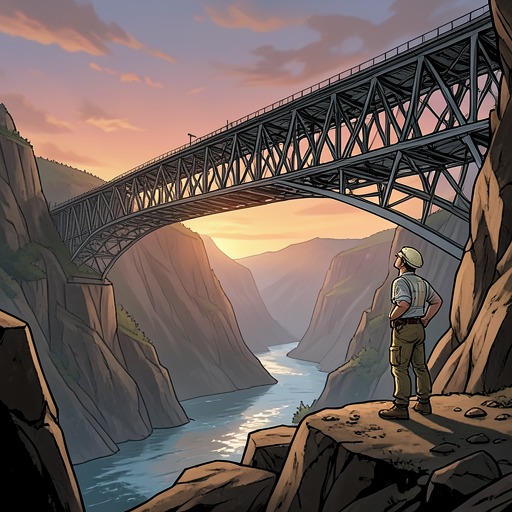
Spokane International Railway operates across the Idaho Panhandle and the Moyea Valley, with its line passing through places such as Meadow Creek and connecting outward toward larger railway systems. Its construction work transforms difficult terrain into a usable corridor. The railway’s bridge over the Moyea River replaces an eleven-mile curve around a gorge and adjacent pass, saving the company the expense of maintaining that stretch of rails and ties. The infrastructure therefore embodies both physical ingenuity and corporate calculation: the landscape is reorganized so that the railway can shorten its route and reduce its obligations.
The company’s expansion depends on strenuous and hazardous collective labor. Grainier’s experience on the Eleven-Mile Cutoff Bridge leads him to seek other massive undertakings, including repairs to the Robinson Gorge Bridge in northwestern Washington. There, timber is hauled through a system of temporary corduroy roads, six-horse teams bring logs within reach of the railway landing, and a huge wood-burning Steam donkey drags them by cable toward flatcars. The railway is thus the endpoint of a chain of bodily tasks performed by sawyers, limbers, buckers, chokers, teamsters, brakemen, and mechanics. Its apparent solidity rests on workers whose bodies absorb the danger of forests, machinery, height, weather, and exhaustion.
The company’s labor force is organized as a shifting industrial population. At the Moyea River, members of a Meadow Creek gang gather after work, and the distant northbound train becomes a recurring sound in the valley. In the Washington woods, crews of more than thirty-five and sometimes more than forty men fell and process giant spruce from sunrise until supper, producing timber for railway transport. The demand is intensified by the war in Europe, which makes spruce commercially urgent even after an armistice has been signed. The company’s timetable and production demands override mourning: after Arn Peeples dies, the captain says the men cannot take a day off because it is the company and the war.
Violence at the Bridge
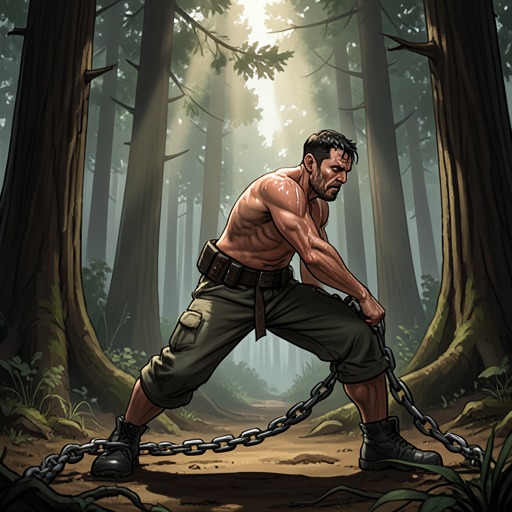
In the summer of 1917, the railway becomes the setting for the 1917 Chinese Railroad Worker Killing Attempt. A Chinese laborer accused of stealing from the Spokane International Railway company stores is seized by three railroad workers and dragged up the long bank toward a bridge under construction fifty feet above the Moyea River. Grainier comes upon the group while they are struggling and, seeing them in distress, helps by holding the prisoner’s bare foot. The company’s management is represented at the scene by Mr. Sears, who holds the laborer by the armpit and later uses a large four-shot black-powder revolver.
The attempted killing reveals how company property, racial prejudice, and group violence merge. The men begin by restraining someone accused of theft, but the physical struggle and the laborer’s resistance turn the act into a collective effort to throw him from the trestle. Other workers stop to watch, some shouting for the man to be stopped and others cheering his escape. One participant claims the assault was “just for fun,” while another cannot release his grip because he is holding the prisoner by the neck. The language of play does not lessen the violence; it exposes the ease with which a workplace crowd converts an accusation into entertainment and execution.
The laborer escapes across the unfinished bridge structure. After the group reaches the completed span sixty feet above the rapids, he clings to a beam, swings himself beneath it, and moves hand-over-hand along the skeleton of the next span. He drops from beam to beam through the crosshatched construction, while one of his pursuers balances above him and kicks at his fingers. When Sears fires all four shots, none takes effect, and the fugitive disappears. The bridge’s technological grandeur is therefore inseparable from its use as a potential site of racial terror; the same structure that promises connection briefly becomes a scaffold.
Bridges, Trains, and Corporate Progress
Forty-one days after the attempted killing, the first locomotive crosses the completed 112-foot interval over the sixty-foot-deep gorge. Sears stands beside the engine and raises his revolver as the signal to begin. At the sound of the gun, the engineer brakes and jumps out, and the men urge the single engine slowly across the tracks. A second man waits at the far side to board it and stop it before it runs out of rail. The workers cheer the inaugural crossing, while Grainier joins their shouting despite feeling inexplicably sad.
The occasion makes the railway’s progress visibly ceremonial. A gun that had failed to kill the Chinese laborer now authorizes the first locomotive crossing. The bridge is named Eleven-Mile Cutoff Bridge because it eliminates the longer route and reduces the company’s maintenance burden. Its achievement is celebrated as a triumph of engineering and coordinated labor, but the surrounding narrative keeps its human cost in view: the bridge has already witnessed attempted murder, fear, exhaustion, and the moral confusion of the men who built it.
The railway also carries timber from the remote forest toward the wider continental network. At Robinson Gorge, logs loaded onto flatcars cross an immense empty depth and descend the mountain toward a connection with all the railways of the American continent. The line therefore functions as a commercial artery, turning forest labor into transportable material and tying isolated camps to a much larger industrial system. What looks like wilderness from the ground is already threaded by routes of extraction.
Movement Through Disaster and Memory
The Spokane International Railway is also a measure of regional vulnerability. In the summer of 1920, when Grainier returns from the Robinson Gorge job with four hundred dollars, the Moyea Valley is burning. The northbound train is stopped in Bonners Ferry until the fire subsides and heavy rain has soaked the Panhandle. Grainier walks twenty miles along the Moyea River Road toward his home, but ten days later, when the railway is running again, he rides through the ruined valley on the line between Bonners Ferry and Creston, British Columbia. The train crosses a landscape gutted along its length, making a great noise through a world that remains utterly still.
The railway provides mobility without providing rescue. It carries Grainier toward his home and later through the burned valley, yet it cannot restore the cabin or reveal the fate of Gladys Grainier and Kate Grainier. In Creston, no survivors from the Moyea Valley fire have appeared. The train’s movement contrasts with the immobility of the ash-covered valley: industrial circulation continues even when homes, vegetation, animals, and community have been destroyed.
Its trains also become woven into Grainier’s inner life. As a child he first encounters the world through rail travel, arriving in Fry, Idaho, with his destination pinned to his chest on the back of a store receipt. His earliest memory includes the mass deportation of Chinese families from Fry, whose departure occurs at the Bonner Lumber Company railroad yard beside the Kootenai River. Decades later, when he has nearly helped kill a Chinese railroad worker, that childhood scene returns to him, connecting railway expansion and ethnic expulsion across his personal history.
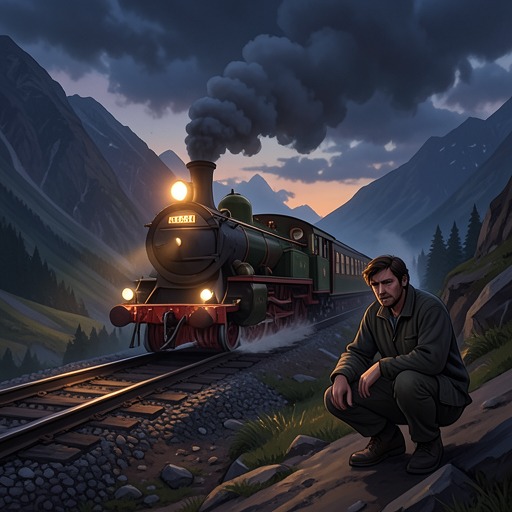
After the fire, the night train repeatedly interrupts Grainier’s dreams and grief. He dreams of trains, smells coal smoke, and sees a world pass before finding himself standing in it. Sometimes the sound he hears in sleep is the actual Spokane International locomotive fading up the valley. Even after Gladys’s spirit appears once and never returns, dreams of her death and the flames are commonly overtaken by the thunder of the railway. The line becomes both an external timetable and an internal rhythm, carrying the past through the nights of a man who remains physically near its route.
Connections, Exclusion, and Death
The railway’s promise of connection is shadowed by exclusion. Its company stores are the alleged source of the theft that triggers the attempted killing, and its construction site becomes a place where a Chinese laborer is treated as disposable. Grainier’s childhood recollection of Chinese families being forced onto flatcars shows that rail infrastructure can transport displaced people as efficiently as it transports timber and passengers. China Basin, where many of those families eventually settle west of Fry, exists within the same regional railway world shaped by movement, removal, and commercial expansion.
The tracks also serve as a lethal extension of the company’s system. In 1930, Kootenai Bob wanders onto the line after drinking heavily and lies unconscious across the ties. Four or five trains pass over him before the crows lead someone to investigate; his remains are scattered for a quarter mile along the right-of-way. His people later collect the fragments of flesh, bone, and cloth that the birds have missed and carry them away in painted leather pouches for burial. The railway is not presented as intentionally responsible for his death, but its tracks create the fixed corridor through which the fatal sequence becomes possible, and its traffic continues while the human body is reduced to debris.
Even in later practical life, the railway governs the possibilities available to workers. Grainier takes hauling jobs among communities without close access to railways, and he travels by train to places where work can be found. When he finally leaves the woods because his jaw, shoulder, knee, and other joints have deteriorated, the Great Northern carries him to Spokane, while the Spokane International remains the remembered sound and route near his cabin. The company’s infrastructure outlasts particular workers, families, and bodies, preserving a network whose benefits and dangers are distributed unevenly.
Spokane International Railway consequently stands for a form of modernity that is simultaneously connective and coercive. It shortens routes, moves timber, carries workers, and gives isolated settlements access to distant places, yet it also depends on extractive labor, intensifies environmental transformation, transports displaced populations, and repeatedly appears beside racial violence and death. In Grainier’s life, the railway is never only a machine for getting somewhere. It is the material system that builds his working world, carries him through catastrophe, returns as a sound in his dreams, and turns the landscape into a corridor where progress and loss travel on the same tracks.