Steam donkey
Train DreamsThe Steam donkey is the logging camp’s central hauling machine: an old wood-burning engine whose twin drums pull felled timber toward the railway landing. It is more than a piece of equipment in the forest economy. Its cables, drums, steam, and noise organize the work of horses and men, converting scattered trees into loads that can enter the railroad system, while its operation exposes how industrial production relies on strenuous human labor and constant physical risk.
Design and Operation
At the landing, the machine crouches like a giant presence. Its two tremendous iron drums perform opposite but simultaneous tasks: one pays out cable while the other winds it in, dragging logs toward the landing even as the hook is sent outward to the choker preparing the next log. The engine is an old wood-burning steam colossus, throbbing, booming, and groaning; its vapors roar like a waterfall. Against this mechanical tumult, the horses moving along the skid road seem almost silent, their sounds erased by the steam and machinery.
The Steam donkey therefore functions within a carefully divided chain of work rather than replacing the workers. Sawyers fell the spruce in pairs, limbers clear the branches with axes, buckers cut the trunks into eighteen-foot lengths, and chokers loop cable around them so the horses can haul them within reach of the railway landing. The machine then performs the concentrated pull that brings the logs in. The process joins forest craft, animal traction, cable technology, and rail transport in one continuous operation.
Labor and Industrial Scale
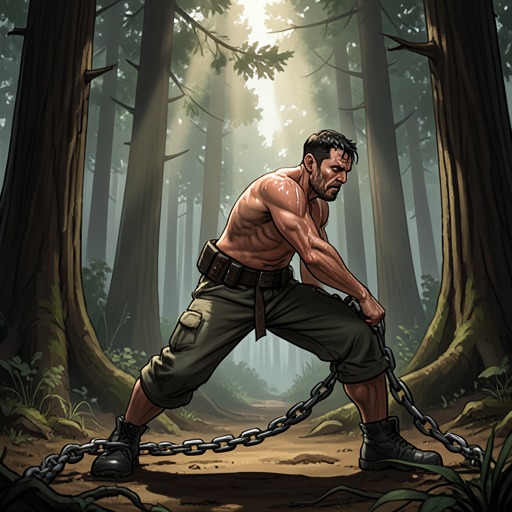
The logging gang, sometimes numbering more than forty men and never fewer than thirty-five, works from sunrise to suppertime, transforming giant spruce into pieces barely manageable in size. The men communicate by shouting through the forest and machinery, their beards sticky with pitch and their throats and eyes stung by its heavy odor. The Steam donkey makes this collective labor possible at a scale that exceeds individual strength, but it does not make the work easy. It gathers the force of many bodies, animals, cables, and engines into a single production system.
The logs leave the landing on railroad flatcars and cross the Robinson Gorge Bridge before descending the mountain toward the connection with the railways of the American continent. In this arrangement, the Steam donkey is the hinge between the living forest and the infrastructure of industrial distribution. It does not merely move timber a short distance; it helps convert mountainside labor into a commodity capable of traveling through a continental railway network.
Human Supervision and Risk
The machine’s apparently overwhelming power depends on close human attention. Old Billy tends the double drum’s engine, keeping it watered and lubricated and watching the cables for wear. His work is described as relatively easy, suitable for an older man, but the distinction between light and dangerous labor remains unstable. The cable system, the moving logs, and the teams of horses all require constant observation, and a moment of failure can turn a controlled operation into a fatal one.
The camp’s dangers are not confined to the machine itself. A twelve-year-old boy, Harold, serves as the outfit’s real grease monkey, moving ahead of the horses with a bucket of dogfish oil and spreading it over the skids with a burlap swab so enormous logs will slide. When Harold suffers a dizzy spell and collapses in the path of the horses, Robert Grainier pulls him clear by the leg of his pants just before the animals nearly trample him. The incident shows the machinery’s wider labor environment: steam, cables, lubricants, timber, animals, and human bodies are locked into a system whose efficiency always contains the possibility of mutilation or death.
Connection to Bridges and Railways
The Steam donkey belongs to the same world of large-scale construction that first draws Robert Grainier toward railroad work. On the Eleven-Mile Cutoff Bridge, he watches the first locomotive cross a 112-foot interval above a 60-foot-deep gorge. The bridge eliminates an eleven-mile curve of rails and ties, demonstrating how infrastructure saves distance and reorganizes the movement of goods. At the Robinson Gorge operation, the Steam donkey supplies the timber that sustains this network, while the bridge carries the resulting loads across an even greater engineered depth.
This relationship gives the machine a significance beyond the landing. The bridge and the engine are complementary forms of industrial power: one spans a chasm, the other gathers the forest into transportable units. Both transform difficult terrain into an avenue for circulation, but both also depend on workers whose bodies absorb the strain and danger that the finished structures conceal.
Breakdown, Illness, and Afterlife
The logging system closes abruptly when illness spreads through the camp. After Arn Peeples dies from a blow by a falling branch and Harold and Billy become feverish, the captain shuts the operation down, sends the men away, and distributes a four-dollar bonus. Billy’s duties around the double drum belong to the camp’s ordinary continuity, yet the epidemic interrupts that continuity as decisively as a mechanical failure would. The Steam donkey becomes part of a worksite abandoned under pressure from forces the machinery cannot control.
For Robert Grainier, the machine belongs to the period when he still relishes the strain and exhaustion of forest labor. Later injuries—a crooked jaw, failing joints, a shoulder that locks, and a knee that wobbles—make him recognize that he is finished as a woodsman. He turns instead to hauling with horses and a wagon along roads serving communities without close railway access. The change from Steam donkey and logging gang to freighting does not erase the earlier industrial world; it marks the point at which Grainier’s body can no longer remain inside it.
The Steam donkey thus embodies a material modernity built from coordinated forces rather than from machines alone. It amplifies cable, steam, animal strength, and human skill, carries timber toward bridges and railways, and makes the forest legible as an extractive system. At the same time, its violence is inseparable from the workers’ exhaustion, injuries, illness, and eventual removal. The machine’s power is real, but it is never autonomous: it depends on bodies that guide it, maintain it, and bear the costs of the world it helps construct.