There’s not a wolf alive that can’t tame a man
Train Dreams“There’s not a wolf alive that can’t tame a man” is a saying Kootenai Bob applies to Robert Grainier’s increasingly intimate relation with wolves. Its decisive force lies in reversing the usual hierarchy of domestication: rather than presenting the man as master and the animal as tame, it imagines the wolf as the agent that disciplines, claims, or changes the human being.
Origin and Immediate Context
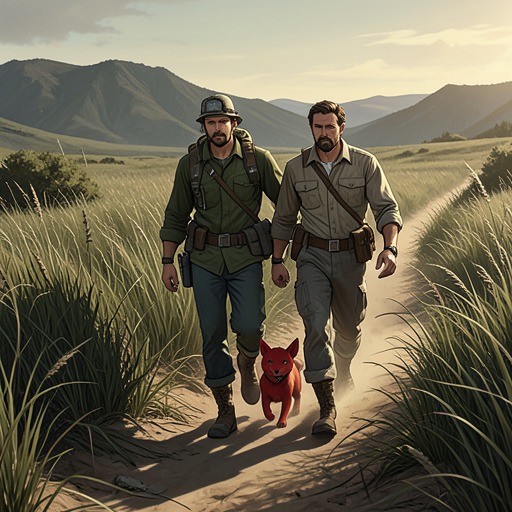
The expression arises after a red-haired female dog joins Robert Grainier in the burned Moyea Valley. She stays at his camp, while Grainier builds a lean-to, keeps a nanny goat, and makes a willow crate for four hens and a rooster. The dog’s pups appear unusually wolfish, and Kootenai Bob explains Kootenai wolf lore: only the chief male of a pack mates, and only the chosen she-wolf bears litters. When Grainier wonders whether the wandering dog might have encountered the king wolf, Bob allows that Grainier may have produced a dog-of-wolf and perhaps begun his own pack.
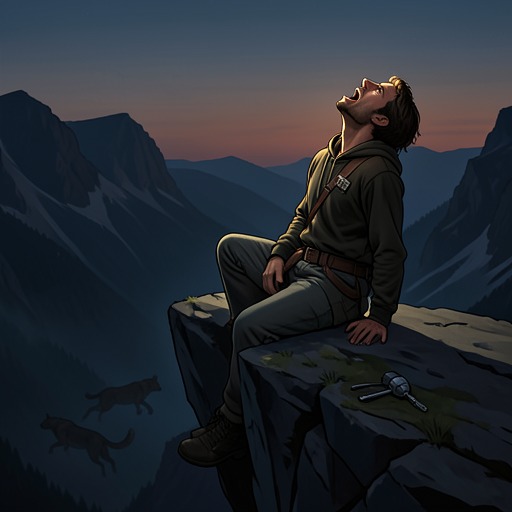
The saying is delivered when Grainier reports that he has taken to howling with the distant packs. He first tries to teach the silent mongrel to recognize its supposed nature by getting down beside it and howling. The pup merely sits without answering. Grainier then continues the practice alone whenever the wolves call at dusk. The act gives him relief: howling flushes out the heaviness that gathers in his heart, and he feels warm and buoyant afterward. Bob’s response, “There’s not a wolf alive that can’t tame a man,” therefore treats Grainier’s behavior not as a harmless imitation but as evidence that the wolves have begun to work upon him.
Meaning in Grainier’s Life
The expression names a reversal already taking place in Grainier’s solitary existence. After the great fire destroys his home and kills Gladys Grainier and Kate Grainier, he returns to the clearing, hears wolves answering one another across the peaks, and speaks aloud among the ashes. He sees impossible signs of the dead, including Gladys Grainier’s white bonnet passing overhead and imagined red-box chocolates scattered around the burn. His isolation is thus accompanied by a growing responsiveness to nonhuman presences.
The wolves provide more than background sound. Their evening chorus becomes a repeated social occasion for Grainier, a “choir” with which he participates. The expression suggests that this participation changes the direction of his desire: instead of seeking to restore the lost human household, he finds temporary steadiness through an animal community whose calls travel across the valley. The wolf does not merely symbolize his loneliness; it supplies a form of companionship and a bodily practice through which loneliness can be endured.
A Local Theory of Animal Power
Kootenai Bob’s statement belongs to the same world of local knowledge that explains the wolfish pups, the dog’s unusual behavior, and the many stories told along the Kootenai River about canine rescues, tricks, and humanlike intelligence. In this setting, animals are not passive possessions. A dog may save a prospector after a dynamite accident by forcing people at a saloon to follow it home; another dog may shoot its own master, according to Peterson’s account, after disappearing into the woods and allegedly confabulating with the wolf-girl.
The expression provides a compact rule for these stories. Dogs and wolves occupy an unstable border between domestic service and independent agency. They rescue, evade, attack, communicate, and perhaps join other species. Grainier’s own red dog wanders for days at a time, and the wolfish pup eventually disappears, perhaps crossing into Canada to join its brothers, though Grainier must also imagine that it became food for a hawk or coyotes. The saying keeps both possibilities alive: the animal may be companion, mystery, danger, or power capable of reorganizing human conduct.
Recurrence and Ecological Change
The saying gains broader significance as the Moyea Valley changes after the fire. Animals return to the blackened landscape: bears travel the muddy road in greater numbers than people, butterflies rise from bear sign, and huckleberries begin to reappear. Later, however, the ecological balance shifts. Spruce gives way largely to scraggly jack pine, wolves are heard less often and from farther away, coyotes become numerous, rabbits grow scarce, and trout disappear from long stretches of the Moyea River.
Against this altered ecology, the phrase becomes almost elegiac. The wolves that once answered Grainier across the peaks gradually retreat, while the human survivor remains attached to the burned valley. Years later, after Kootenai Bob is killed beneath a train, an enormous nocturnal chorus of coyotes, wolves, and other creatures surrounds Grainier’s cabin. He hears the cries as a vast pronouncement and as if every animal in the surrounding mountains were unable to find relief. The wolf-girl then appears in his clearing, making the old saying feel less like a proverb about training than a statement about the power of the wild to enter and transform human life.
Narrative and Thematic Significance
The expression condenses the book’s challenge to human mastery. Grainier owns land, horses, a wagon, hens, a goat, and dogs, yet his most sustaining relationship with the natural world is not one of control. His labor rebuilds a cabin, but the recovering forest threatens to reclaim his clearing; his dog offers company but wanders away; his attempted instruction of the mongrel fails; and his own howling becomes the practice that changes him.
Its irony is especially sharp because Grainier later acquires a large male sled dog that remains his friend for many years, while the valley’s wolves become increasingly distant. The saying does not mean that every animal literally domesticates its human companion. Rather, it establishes an interpretive principle: contact with animals can unsettle the boundaries by which a man defines himself. Grainier is neither fully absorbed into the wolf world nor securely separated from it. He remains a human figure whose grief, solitude, habits, and sense of belonging have been permanently shaped by the voices of wolves.