World War I
Train DreamsWorld War I enters Robert Grainier’s life less as a battlefield than as an economic pressure transmitted through timber, railways, and the labor camps of the Pacific Northwest. The war’s demand for spruce accelerates the remaking of forests and mountain infrastructure, placing Grainier inside a vast industrial undertaking whose consequences reach from bridge construction and logging to the later devastation of the Moyea Valley.
Wartime Demand and the Timber Economy
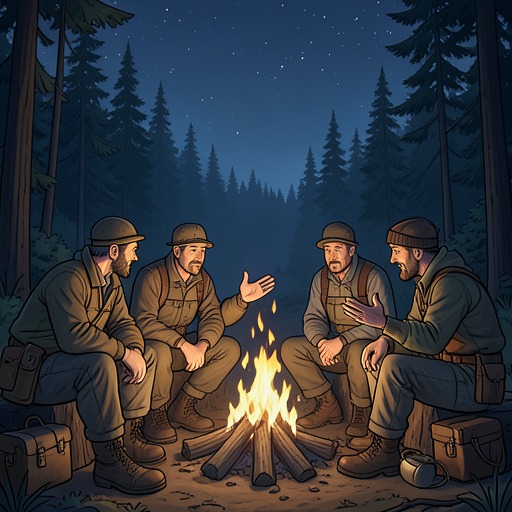
The logging camp where Grainier works is explicitly governed by wartime demand. After Arn Peeples dies, the captain says that the men cannot even take a day off because “it’s the company, and it’s the war.” Although an armistice had been signed eighteen months earlier, he believes the fighting may resume until one side massacres the other. His mistaken expectation captures how the war remains present in the camp even when it is geographically distant: spruce is being cut not merely for local use but because military conditions have created an exceptional market for timber.
The work itself makes that economic history physical. Grainier joins a gang that sometimes numbers more than forty and never fewer than thirty-five men. From sunrise until suppertime, the workers fell and buck giant spruce, bucking the trunks into barely manageable lengths and changing the face of the mountainsides. Pitch clings to their beards, sweat cakes dust into the creases of their bodies, and the smell of resin abrades their throats and stings their eyes. The scale of the labor appears almost monumental to Grainier, who compares it to the pyramids, but its immediate purpose is industrial production under wartime pressure.
Railways, Bridges, and Industrial Expansion
Before moving into timber extraction, Grainier works on the Eleven-Mile Cutoff Bridge. Forty-one days after the bridge work begins, he watches its first locomotive cross a 112-foot interval above a 60-foot-deep gorge. The engine proceeds slowly over the tracks while the men cheer, and the bridge eliminates a long curve around the gorge and an eleven-mile stretch of rails and ties that the Spokane International would otherwise have to maintain. The inaugural crossing therefore joins engineering achievement to administrative efficiency: the landscape is being reorganized so that rail transport can move more directly and cheaply.
The spectacle leaves Grainier unexpectedly sad even as he cheers with the others. He becomes hungry to participate in more undertakings of the same kind, where swarms of men erase portions of the forest and assemble structures across apparently impassable spaces. In 1920 he travels to northwestern Washington to repair the Robinson Gorge Bridge, a much larger and more frightening structure spanning a gorge 208 feet deep and 804 feet wide. The railway can support an engine and two flatcars of logs, yet the bridge is so wobbly that neither engineers nor riders cross on the cars; the brakeman catches them at the far end.
Once the repairs are finished, Grainier moves higher into the forest with the Simpson Company. The railway in this region exists primarily to carry timber outward. More than forty workers use six-horse teams to bring logs along temporary corduroy roads until they are within reach of the railway landing. There, an old wood-burning Steam donkey pays out and winds in cable while a choker loops the next log, and flatcars carry the timber across Robinson Gorge and down the mountain toward the continental railway network. World War I is thus present in a chain of machinery and movement: war creates demand, demand intensifies logging, and logging requires bridges, rails, horses, cables, and disciplined labor.
Labor, Danger, and Wartime Discipline
The camp’s industrial power is inseparable from danger. Arn Peeples warns that even a skilled sawyer can judge a tree’s fall correctly ninety-nine times and be killed on the hundredth. After a blade enters the trunk, he says, the worker is effectively at war with the tree. This language turns logging into a local version of organized conflict, while the actual war in Europe supplies the reason the men must continue despite exhaustion, accidents, illness, and death.
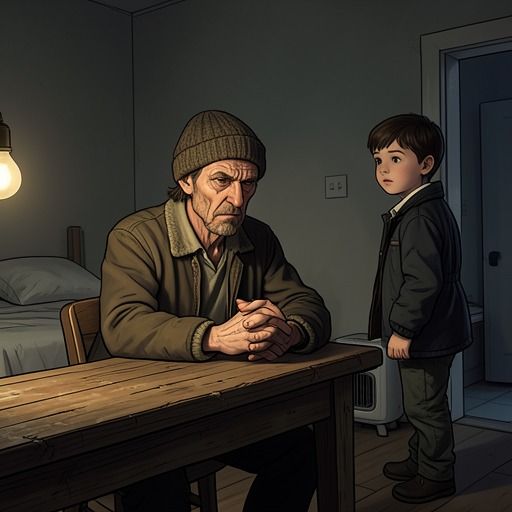
Peeples’s own death exposes the contradiction. He is not killed by dynamite, although he sometimes enters a tunnel after a dud charge while the entire camp waits in tense silence. He is struck across the back of the head by a dead branch from a tall larch, a “widowmaker.” The injury leaves him dizzy, feverish, dreamy, and forgetful; after several days he is found dead in bed, still tucked comfortably beneath the covers. At his grave, Billy praises his honesty, but the captain says the company and the war prevent the men from laying off for a day. Personal mourning is subordinated to production, and the dead man’s body is absorbed into the schedule of wartime labor.
The same atmosphere continues immediately after Peeples’s burial. Two days later, twelve-year-old Harold, the captain’s son and the camp’s young grease monkey, suffers a dizzy spell while oiling the skids ahead of the horses. Grainier pulls him clear by the leg of his pants before the animals can trample him. Harold’s fever reveals that the camp’s hazards are not limited to falling trees and machinery: disease also moves through the labor system, while work continues around it.
From Wartime Labor to Regional Ruin
The war’s effects extend beyond the camp into the broader transformation of the region. In the summer of 1920, Grainier returns from the Robinson Gorge job with four hundred dollars, traveling toward his home in the Moyea Valley, only to find that fire is consuming the valley. Bonners Ferry is crowded with displaced residents who have lost their homes, while families who fled north have disappeared. Grainier searches desperately for Gladys Grainier and Kate Grainier, finding no information about either of them.
The burned landscape makes industrial time look helpless. The fire has gutted the valley along its length, leaving ash, smoke, collapsed buildings, and a blackened silence. Ten days later, when the Spokane International is running again, Grainier rides through the valley by train and sees the ridges burned and the valley dead beneath a beautiful evening sky. The train makes a great noise but cannot awaken the ruined world below it. The railway can cross gorges, transport timber, and resume service after disaster, yet it cannot restore the homes and family life destroyed in the fire.
Historical Memory and Ordinary Lives
World War I is remembered through the voices of ordinary people rather than through military scenes. The logging captain treats the armistice as provisional, Billy offers a grave-side moral judgment, and Arn Peeples fills camp life with stories of Arizona mines, famous lawmen, impossible wagers, and dangerous work. Such accounts preserve a worker’s sense of history in fragments: war is understood through wages, timber demand, company orders, and the expectation that labor cannot pause.
The wider chronology is equally unstable in Grainier’s memory. He recalls the bridge work, the 1920 fire, later freighting along Highway 2, and other spectacles as pieces of a life whose dates and sequence he sometimes confuses. He remembers the railway beginning and ending his life story, while the war survives as one of the forces that shaped the working world between those trains. The result is not a conventional history of World War I but an account of how a global conflict becomes legible in one man’s body, in the forests he helps remove, in the bridges that redirect transportation, and in the communities vulnerable to the altered environment left behind.