Death of Billy Bones
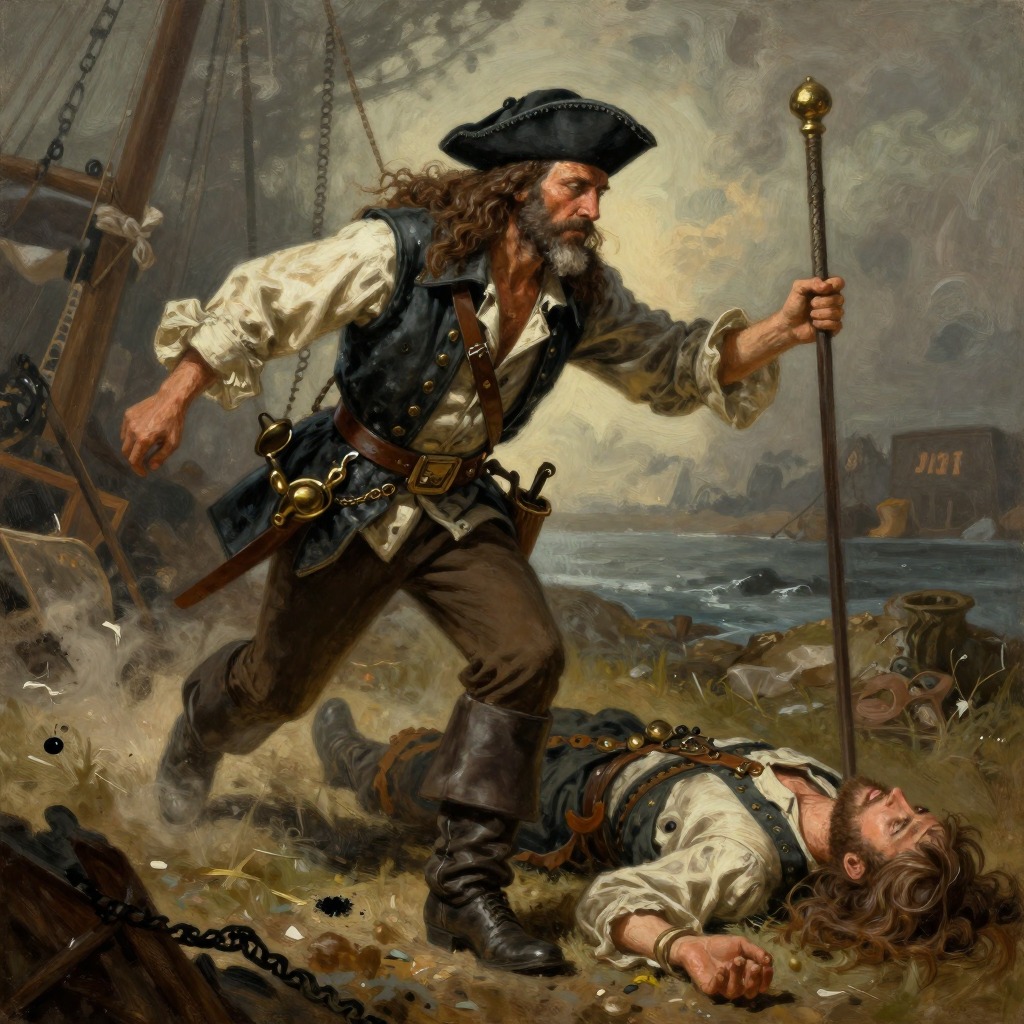
Treasure IslandThe death of Billy Bones is the hinge on which the whole of Treasure Island turns. It is the moment the buried past of the buccaneers breaks into the quiet life of the Admiral Benbow Inn, transforming a boy's fearful fascination with a lodger into the beginning of a real adventure. The event is not merely a death; it is the delivery of a summons, the failure of a man to escape his former life, and the unlocking of a sea-chest that contains the map to Flint's treasure. From this single stroke of apoplexy flow the voyage of the Hispaniola, the mutiny, and the long hunt for gold that costs seventeen lives before it is done.
The Old Sea-dog and His Vigil
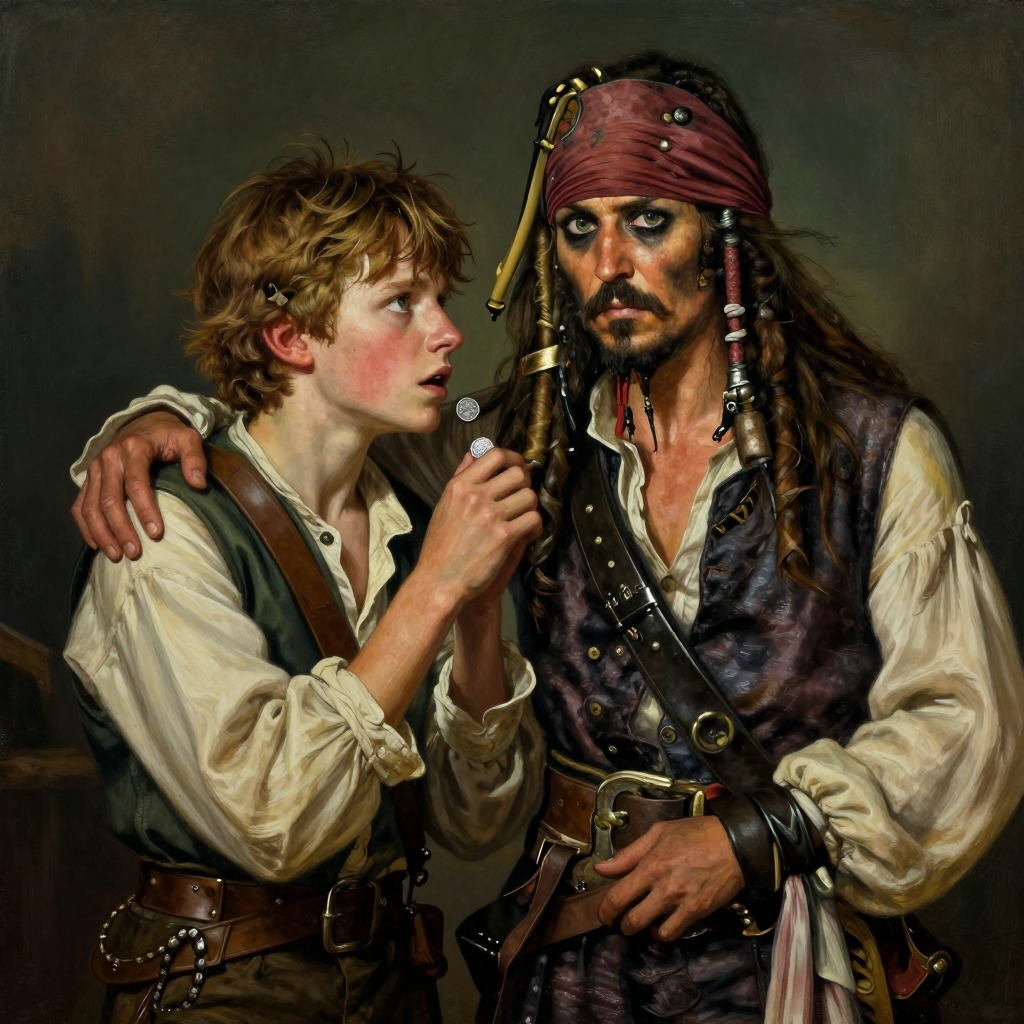
Billy Bones, known only as 'the captain' to the Hawkins family, had taken up lodging at the Admiral Benbow Inn after being set down by the mail the morning before at the Royal George. He was a tall, strong, heavy, nut-brown man with a tarry pigtail, ragged scarred hands, and a livid sabre cut across one cheek. He paid for his room with gold pieces thrown on the threshold and demanded rum and bacon and eggs, watching ships from the cliffs with a brass telescope. He was a silent man by custom, but when drunk on rum he would sing his wicked old sea-songs and force the trembling company to listen to dreadful stories of hanging, walking the plank, and the Spanish Main. He had taken Jim Hawkins aside and promised him a silver fourpenny on the first of every month if the boy would keep his 'weather-eye open for a seafaring man with one leg.' This promise haunted Jim's dreams with nightmares of a monstrous one-legged creature. The captain never wrote or received a letter, and his great sea-chest was never seen open. He was only once crossed, when Dr. Livesey, visiting Jim's dying father, told him that if he kept on drinking rum, the world would soon be quit of a very dirty scoundrel. The captain sprang up with a sailor's clasp-knife, but the doctor, a magistrate, threatened him with the assizes, and the old buccaneer knuckled under like a beaten dog.
The Black Spot Delivered
On a bitter, foggy, frosty afternoon, the day after Jim's father's funeral, a blind beggar appeared at the inn. He wore a great green shade over his eyes and nose, was hunched as if with age or weakness, and carried a huge old tattered sea-cloak. He gripped Jim's hand like a vise and forced the boy to lead him to the captain, threatening to break his arm. When Jim cried out the words the blind man ordered—'Here's a friend for you, Bill'—the captain raised his eyes, and the rum went out of him, leaving him staring sober with a face of mortal sickness. The blind man, who was Pew, ordered Jim to bring the captain's left hand to his right, and passed something from the hollow of his hand into the captain's palm. Then he skipped out of the parlour with incredible nimbleness, his stick tap-tap-tapping into the distance. The captain looked sharply into his palm and cried, 'Ten o'clock! Six hours. We'll do them yet,' and sprang to his feet. Even as he did so, he reeled, put his hand to his throat, stood swaying for a moment, and then, with a peculiar sound, fell from his whole height face foremost to the floor. He had been struck dead by thundering apoplexy.
The Summons and the Death
The object Pew delivered was the Black Spot, a little round of paper blackened on one side. When Jim picked it up from the floor close to the captain's hand, he found written on the other side, in a very good, clear hand, the short message: 'You have till ten tonight.' The old clock in the inn was striking six when Jim read it, so the captain had been given only four hours' warning. The death was sudden and complete. Jim, who had never liked the man but had begun to pity him, burst into a flood of tears at the sight of the body. It was the second death he had known, and the sorrow of the first—his father's—was still fresh in his heart. The captain's death left his affairs in a dangerous tangle, for his shipmates, Black Dog and the blind beggar, were not likely to give up their booty in payment of the dead man's debts.
The Sea-chest and the Map
Jim and his mother, determined to recover the money owed to them, returned to the inn and opened the captain's sea-chest. It was like any other seaman's chest on the outside, with the initial 'B' burned on the top with a hot iron and the corners smashed by long, rough usage. Inside, under a suit of good clothes and a miscellany of quadrant, pistols, bar silver, and West Indian shells, they found a bundle tied up in oilcloth containing papers and a canvas bag that jingled with gold. While Mrs. Hawkins counted out her lawful dues, Jim heard the tap-tapping of the blind man's stick on the frozen road and urged his mother to take the whole and flee. She would not take a fraction more than was due, but when a low whistle sounded from the hill, she took what she had and Jim picked up the oilskin packet to square the count. They fled to the bridge, where Mrs. Hawkins fainted, and hid beneath the arch while the pirates ransacked the inn. The packet, when opened by Dr. Livesey, contained a book and a sealed paper. The book was Billy Bones's account-book, with dates and sums of money and crosses standing for the names of ships or towns that the pirates had plundered. The sealed paper was the map of an island, about nine miles long and five across, shaped like a fat dragon, with two land-locked harbours, a hill in the centre marked 'The Spy-glass,' and three red crosses. Beside the last cross, in a small, neat hand, were the words: 'Bulk of treasure here.'
Aftermath and Significance
The death of Billy Bones set in motion the entire adventure. The map found in his chest led Squire Trelawney to fit out the Hispaniola in Bristol, with Long John Silver as ship's cook. The old buccaneer's death also revealed the reach of Flint's old crew, for Black Dog and Pew were among those who came seeking the chart. The captain's own body bore the marks of his past: his arm was tattooed with 'Here's luck,' 'A fair wind,' and 'Billy Bones his fancy,' and near the shoulder there was a sketch of a gallows and a man hanging from it, which Dr. Livesey called 'Prophetic.' The parrot Captain Flint, who belonged to Long John Silver, had learned to cry 'Pieces of eight' from the wrecked plate ships, and the old sea-song 'Fifteen Men on the Dead Man's Chest' that Billy Bones sang so often became the anthem of the voyage. The death was the first of many, and it set the pattern of sudden violence and hidden treasure that would claim the lives of seventeen men from the Hispaniola before the gold was finally secured.