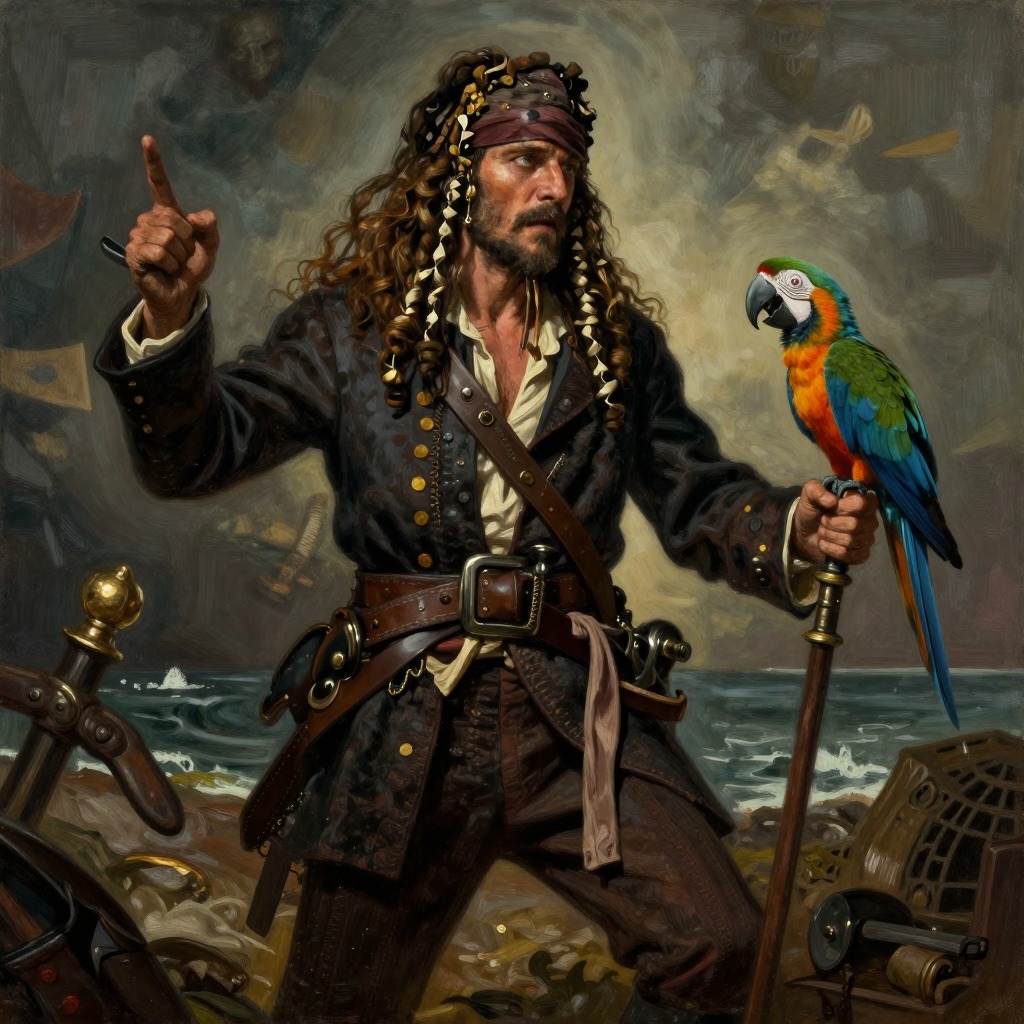
Fifteen Men on the Dead Man's Chest
Treasure IslandFifteen Men on the Dead Man's Chest is the most famous sea song in Robert Louis Stevenson's Treasure Island, a recurring chant that binds together the novel's themes of piracy, mortality, and the intoxicating pull of rum and gold. First heard from the lips of the old buccaneer Billy Bones as he takes up lodging at the Admiral Benbow Inn, the song's refrain, "Yo-ho-ho, and a bottle of rum," becomes a leitmotif that marks the presence of danger, the memory of Captain Flint, and the ever-present threat of death. It is sung by the mutineers aboard the Hispaniola, heard in the island's haunted woods, and finally echoes in Jim Hawkins's nightmares, cementing its place as the novel's most potent auditory symbol of the pirate life.
Origins and First Appearance
The song makes its debut in the opening chapter, "The Old Sea-dog at the Admiral Benbow," when Billy Bones, the brown old seaman with the sabre cut, first arrives at the inn. As he looks around the cove, he breaks into the song in a "high, old tottering voice that seemed to have been tuned and broken at the capstan bars." The full verse he sings is: "Fifteen men on the dead man's chest-- / Yo-ho-ho, and a bottle of rum!" This initial performance establishes the song as Bones's signature, a wild and wicked tune that he repeats often, especially when drunk. The song's title refers to a "dead man's chest," which Jim Hawkins initially mistakes for the captain's own sea-chest, mingling the image with his nightmares of the one-legged seafaring man. This confusion underscores the song's association with hidden treasure and mortal danger from the very start.
The Song as a Marker of Piracy and Terror
At the Admiral Benbow, the song becomes a tool of terror. On nights when the captain drinks heavily, he forces the trembling company to listen to his stories and join in the chorus, the house shaking with "Yo-ho-ho, and a bottle of rum" as neighbours sing louder to avoid his wrath. The song is thus linked to the captain's tyranny and the fear he instils in the quiet country folk. Later, when Dr. Livesey confronts the captain about his drinking, the captain pipes up the song again, and the doctor's angry reaction foreshadows the clash between civilized order and lawless piracy. The song's refrain, with its cheerful invitation to rum, masks the grim reality of death and violence that the pirates embrace.
Adoption by Long John Silver and the Mutineers
The song crosses from the old buccaneer to the new generation of pirates when Long John Silver leads the crew in it during the voyage of the Hispaniola. As the men man the capstan bars, Silver breaks into "Fifteen men on the dead man's chest," and the whole crew bears chorus with "Yo-ho-ho, and a bottle of rum," driving the bars with a will. For Jim, this moment carries him back to the Admiral Benbow, hearing the captain's voice in the chorus, and it signals the mutiny that is brewing. The song becomes the anthem of the mutineers, sung around campfires and in the island's woods, a reminder of their shared criminal past and their hopes for treasure.
The Song in the Island's Haunted Woods
On Treasure Island, the song takes on a supernatural dimension. When the treasure-hunters, led by Silver, approach the tall tree where the treasure is supposedly buried, a thin, high, trembling voice from the trees sings the first lines: "Fifteen men on the dead man's chest-- / Yo-ho-ho, and a bottle of rum!" The pirates are struck with terror, believing it to be the ghost of Captain Flint, for the song was his favourite. The voice, which is actually Ben Gunn's, uses the song to exploit the pirates' superstitions, and it works: the men are paralyzed with fear, and only Silver's courage keeps them going. The song thus becomes a weapon, a means of psychological warfare, and a reminder of Flint's bloody legacy.
The Song's Final Echo and Legacy
After the treasure is found and the survivors leave the island, the song lingers in Jim Hawkins's memory. In the final chapter, he confesses that his worst dreams are of hearing the surf booming around the island's coasts or starting upright in bed with the sharp voice of Captain Flint (the parrot) ringing in his ears: "Pieces of eight! Pieces of eight!" But the song itself is also part of that haunting, as it was the parrot's master's song. The novel ends with Jim's hope that Silver may live in comfort with his old Negress and the parrot, but the song's refrain, "Yo-ho-ho, and a bottle of rum," remains a symbol of the adventure's dark allure and the cost of treasure. It is a tune that encapsulates the romance and the horror of the pirate life, and it has become one of the most enduring cultural artifacts of pirate lore, echoing far beyond the pages of the book.