Flag of truce
Treasure IslandIn Robert Louis Stevenson's Treasure Island, the flag of truce emerges as a fragile but potent instrument of communication between mortal enemies. It is a white cloth, waved or carried, that momentarily suspends the violence of the island and allows adversaries to parley. Its most significant deployment occurs when Long John Silver, now styling himself "Cap'n Silver," approaches the stockade with a flag of truce to negotiate terms with Captain Smollett. This act transforms the battlefield into a diplomatic arena, where words become as sharp as cutlasses and the outcome of the treasure hunt hangs on the exchange of promises and threats.
The Flag as a Diplomatic Tool
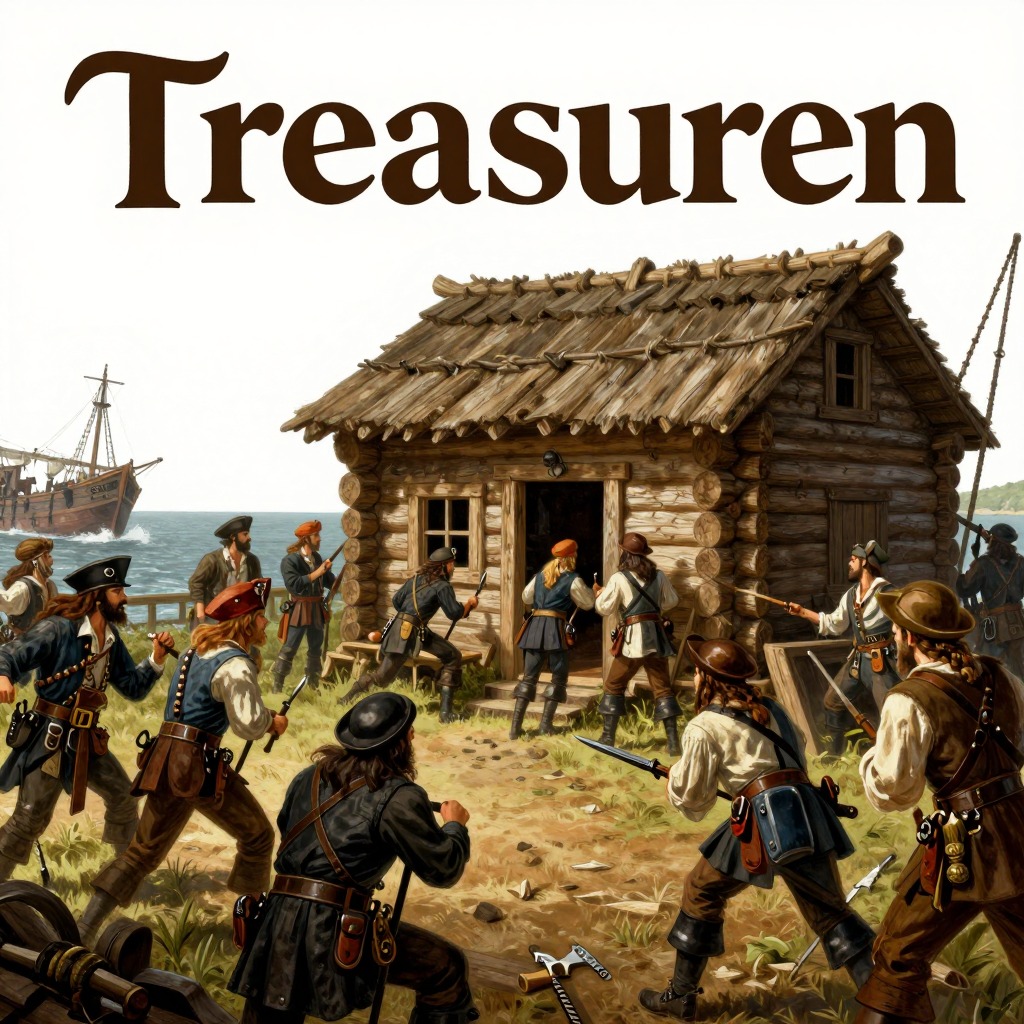
The flag of truce first appears in the narrative when Silver and his lieutenant approach the stockade, one waving a white cloth. Captain Smollett, wary of treachery, orders his men to keep indoors, suspecting a trick. Yet he honors the convention, hailing the approaching party with "Who goes? Stand, or we fire." Silver's response, "Flag of truce," is enough to stay the captain's hand, demonstrating that even in this lawless enterprise, the white flag carries a recognized, if precarious, authority. The captain's caution is evident as he positions himself in the porch, "keeping himself carefully out of the way of a treacherous shot," yet he allows Silver to approach, acknowledging the flag's power to create a temporary ceasefire.
The Negotiation Under the Flag
Under the protection of the flag, Silver presents his terms: he demands the treasure chart in exchange for the lives of the loyal party, offering either safe passage aboard the ship or to be left with stores until rescue. Captain Smollett, however, refuses to bargain, countering with his own ultimatum: the mutineers must surrender one by one, unarmed, to face trial in England, or face destruction. The exchange is a masterclass in rhetorical combat, with Silver's oily persuasion met by Smollett's unyielding resolve. The flag does not guarantee peace; it merely provides a stage for the clash of wills. When the negotiation fails, Silver departs with a curse, vowing to "stove in your old block house like a rum puncheon," and the truce dissolves into renewed hostility.
The Flag's Role in Later Parleys
The flag of truce reappears in a different form when Dr. Livesey, seeking to treat the wounded mutineers, approaches the block house. Although he does not carry a white flag, his role as a physician grants him a similar immunity, and he is allowed to enter the enemy camp. This second parley, conducted under an implicit truce, proves even more consequential. Livesey reveals that the ship is gone, a blow that shatters the mutineers' hopes and forces Silver to reconsider his position. The doctor's visit, like the earlier flag of truce, creates a space for negotiation, but it also sows discord among the pirates, as Silver's authority is challenged by the revelation of their dire circumstances.
The Fragility and Irony of the Truce
The flag of truce in Treasure Island is a double-edged sword. It is a symbol of civilization's codes, yet it is wielded by men who have rejected those codes. Silver, the arch-manipulator, uses the flag to buy time and gather intelligence, while Smollett uses it to assert his moral superiority. The truce is never truly honored in spirit; it is a tactical pause, a breath before the next strike. This irony is underscored when Silver, after the failed negotiation, spits into the spring, a gesture of contempt that reveals the hollowness of the convention. The flag, like the pirate code itself, is a rule that is observed only when it serves the interests of the powerful, and broken when it does not.
The Flag's Legacy in the Narrative
The flag of truce ultimately shapes the course of the treasure hunt. It is under its auspices that Silver learns of the ship's loss, a revelation that drives him to ally with Jim Hawkins and seek a way to save his own neck. The truce, though broken, sets in motion the chain of events that leads to the ambush at the treasure pit and the final defeat of the mutineers. In the end, the flag of truce is a testament to the thin veneer of order that separates civilization from savagery, and the ease with which that veneer can be shattered. It is a reminder that even in the most desperate circumstances, men cling to the forms of honor, even as they plot each other's destruction.