Flint's treasure
Treasure IslandFlint's treasure is the vast accumulation of gold, silver, and jewels buried by the infamous pirate Captain Flint on Treasure Island, and it serves as the ultimate prize that motivates the novel's entire adventure. Its existence is first hinted at through the dying words and possessions of Billy Bones, the old sea-captain who lodges at the Admiral Benbow Inn, and its discovery sets in motion a chain of events that leads to mutiny, murder, and a desperate struggle for survival. The treasure's immense worth—later estimated at seven hundred thousand pounds—transforms it from a mere fortune into a symbol of greed, betrayal, and the corrupting power of wealth, ultimately costing the lives of seventeen men from the Hispaniola alone.
Origins and the Map
The treasure's origins lie with Captain Flint, the bloodthirstiest buccaneer that ever sailed, as Squire Trelawney describes him, a man so feared that even the Spaniards were terrified of him. Flint buried his hoard on the island, and the only clue to its location was a map, which he gave to his first mate, Billy Bones, as he lay dying in Savannah. This map, sealed in an oilskin packet, was hidden in Billy Bones's sea-chest, along with his account book and other personal effects. When Billy Bones dies at the Admiral Benbow, Jim Hawkins and his mother open the chest and find the packet, which contains both the map and a book of accounts. The map, drawn with latitude and longitude, soundings, and the names of hills and bays, shows the island shaped like a fat dragon, with three red crosses marking potential treasure sites, and the words "Bulk of treasure here" beside the southwest cross. The back of the map bears further instructions, including references to a tall tree on Spy-glass shoulder, Skeleton Island, and ten feet, as well as notes on the bar silver and arms. This map becomes the catalyst for the expedition, as Squire Trelawney, Dr. Livesey, and Jim Hawkins decide to fit out a ship and sail to the island to recover the treasure.
The Voyage and the Mutiny
The promise of Flint's treasure corrupts the crew of the Hispaniola, many of whom are former pirates who served under Flint. Long John Silver, the ship's cook, secretly leads a mutiny, intending to seize the treasure for himself and his fellow buccaneers. Jim Hawkins, hiding in an apple barrel, overhears Silver's plans and learns that the crew is plotting to kill the loyal party once the treasure is found. The mutiny erupts after the ship reaches the island, and the loyal party, including Captain Smollett, Dr. Livesey, and the squire, are forced to take refuge in a stockade. The treasure becomes the focal point of the conflict, with both sides willing to kill for it. Silver's negotiations with Captain Smollett, under a flag of truce, center on the chart, which Silver demands in exchange for sparing the loyal party's lives. The doctor, however, has already given Silver the chart, knowing it is useless, as the treasure has already been removed.
The Empty Pit and the Final Twist
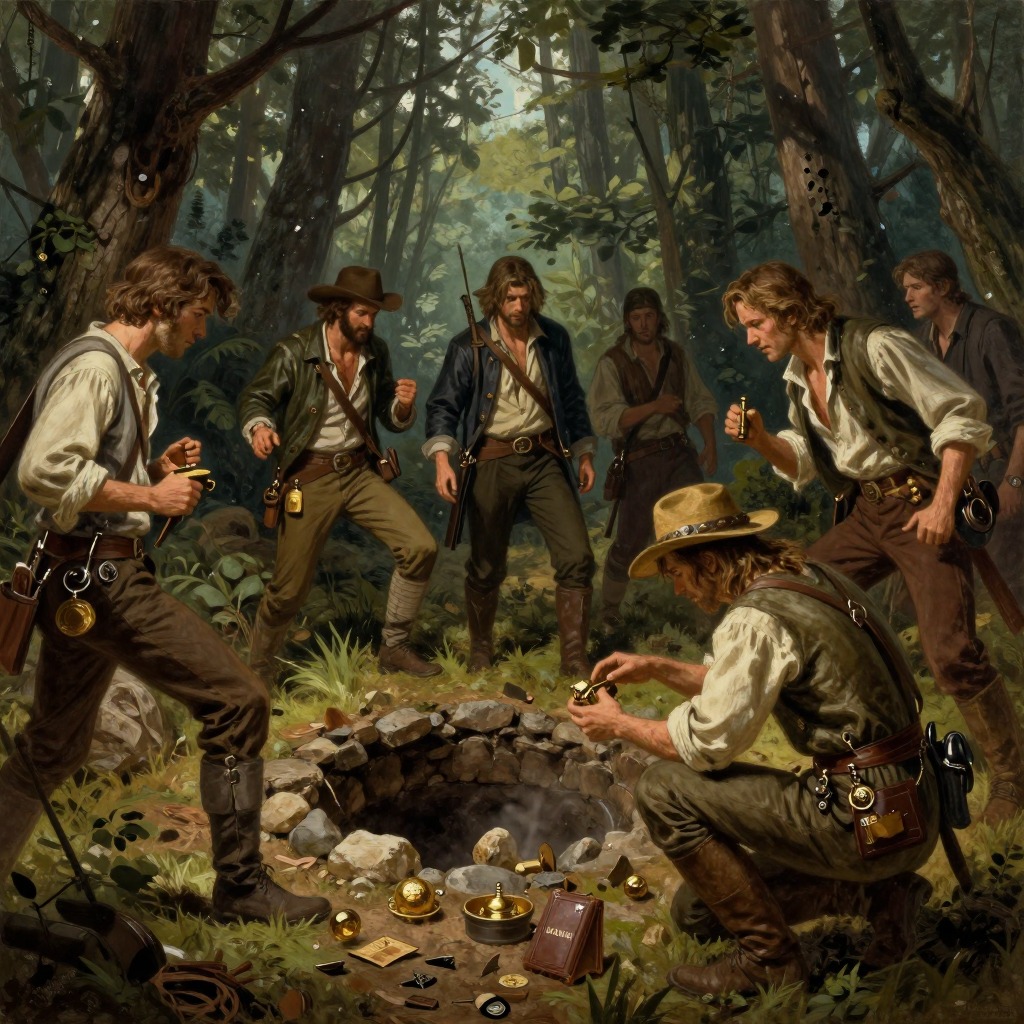
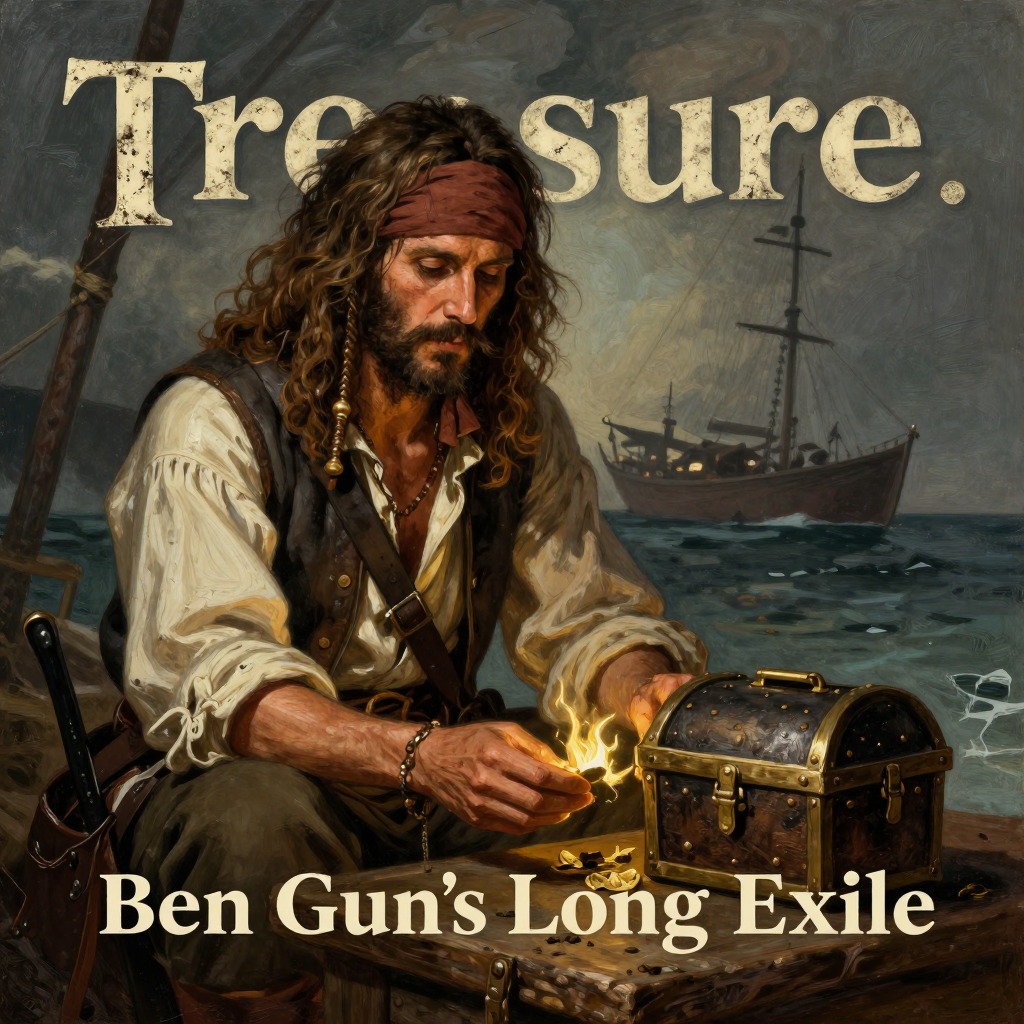
The climax of the treasure hunt occurs when Silver and his men, with Jim Hawkins as a hostage, follow the map to the marked spot. They find a great excavation, with the shaft of a broken pick and the boards of packing-cases strewn around, one branded with the name WALRUS, Flint's ship. The cache has been found and rifled; the seven hundred thousand pounds are gone. The mutineers, enraged by their disappointment, turn on Silver, but they are ambushed by Dr. Livesey, Abraham Gray, and Ben Gunn, who have been watching from the woods. The treasure, it is revealed, had been dug up months earlier by Ben Gunn, the marooned sailor, who had discovered it during his three years on the island and carried it to a cave on the two-pointed hill. Ben Gunn's actions, motivated by his desire for a share of the wealth and a passage home, ultimately save the loyal party and seal the fate of the mutineers.
The Treasure's Aftermath and Legacy
The recovered treasure is transported to the Hispaniola, and the survivors sail home, leaving the three remaining mutineers marooned on the island. The treasure is divided among the loyal party, with each receiving an ample share. Ben Gunn, who receives a thousand pounds, squanders it in nineteen days and is reduced to begging, eventually becoming a lodge-keeper. Long John Silver escapes with a sack of coins worth three or four hundred guineas, and his fate remains unknown. The treasure's legacy is one of blood and sorrow, as the narrator reflects on the lives it has cost: "what blood and sorrow, what good ships scuttled on the deep, what brave men walking the plank blindfold, what shot of cannon, what shame and lies and cruelty, perhaps no man alive could tell." The treasure, though found, leaves a trail of destruction, and its allure proves as dangerous as it is alluring, a testament to the novel's exploration of greed and morality.
The treasure's cultural footprint extends far beyond the novel itself, appearing in numerous adaptations across media. In television, the hoard has been sought in BBC serials from 1951 to 1977, an Italian miniseries in 1959, a German-French co-production in 1966, and a 2012 two-part series starring Eddie Izzard. Animated versions include the Japanese series Takarajima (1978) and the animal-themed The Legends of Treasure Island (1993–1995). The treasure also features in video games: a 1984 graphic adventure by Mr. Micro, a 1985 text adventure by Windham Classics, a 1999 point-and-click game from Barcelona Multimedia, and a 2010 hidden-object game by Anuman Interactive. The LucasArts Monkey Island series borrows heavily from the novel's treasure-hunting plot, while the arcade game Captain Silver sends its protagonist on a similar quest. Disney's animated film Treasure Planet and its video game adaptation, Battle at Procyon, also reimagine the treasure in a science-fiction setting.