Pieces of Eight
Treasure IslandPieces of Eight is the distinctive, repetitive cry of Captain Flint, the green parrot that belongs to Long John Silver, and a Spanish silver coin that gives the phrase its name. In Treasure Island, the expression functions as a sonic emblem of piracy, greed, and the inescapable legacy of the buccaneer world. It is first heard aboard the Hispaniola, where Silver presents the bird as a living relic of his criminal past, and it later becomes the unwitting signal that exposes Jim Hawkins's presence in the enemy camp. The phrase ultimately binds together the novel's central themes: the seductive promise of treasure, the moral corruption it breeds, and the haunting persistence of the past. Its final appearance in Jim's nightmares confirms that the parrot's cry has become an enduring symbol of the adventure's dark undercurrents.
The Parrot and Its Cry
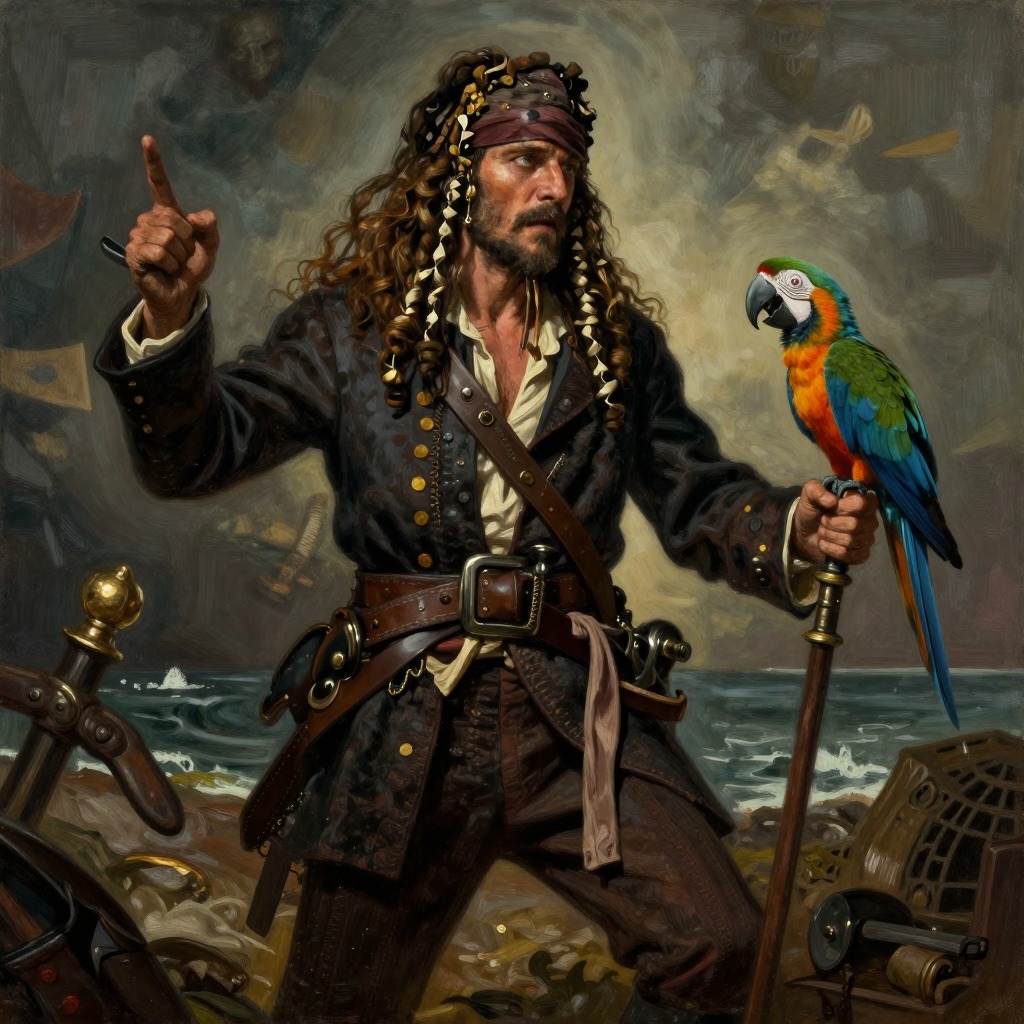
Captain Flint the parrot is introduced during the voyage to Treasure Island, when Silver invites Jim Hawkins into the galley to hear the bird speak. The parrot, which Silver claims is "maybe, two hundred years old," has supposedly sailed with the pirate Captain England and visited Madagascar, Malabar, Surinam, Providence, and Portobello. Silver explains that the bird learned the phrase "Pieces of eight" while present at the fishing up of wrecked plate ships, where "three hundred and fifty thousand of 'em" were recovered. The parrot's cry is described as rapid and relentless, repeating "Pieces of eight! Pieces of eight! Pieces of eight!" until Silver throws his handkerchief over the cage to silence it. The bird also screams "Stand by to go about," a nautical command, and swears "passing belief for wickedness," which Silver attributes to its exposure to evil company. The parrot's name, Captain Flint, deliberately echoes the infamous pirate, and Silver uses the bird to entertain the crew and to project an image of harmless eccentricity, even as he plots mutiny.
The cry itself is a form of verbal currency, a phrase that carries the weight of the treasure that drives the entire narrative. The parrot's refrain is not merely a random sound but a coded reference to the Spanish dollar, a coin that was widely used in the Caribbean and the Americas. In the context of the novel, "pieces of eight" evokes the vast wealth that Flint buried on Treasure Island, wealth that Silver and his fellow mutineers are willing to kill for. The parrot's cry thus becomes a verbal talisman, a reminder of the treasure's allure and the violence it inspires.
The Cry as Alarm
The most dramatic use of the parrot's cry occurs when Jim Hawkins, having recaptured the Hispaniola and killed Israel Hands, returns to the stockade at night. Unaware that the mutineers have taken possession of the block house, Jim creeps inside, expecting to find his friends asleep. Instead, the parrot, perched on Silver's shoulder, announces his arrival with its shrill refrain: "Pieces of eight! Pieces of eight! Pieces of eight!" The cry, which Jim describes as "like the clacking of a tiny mill," wakes the sleeping pirates, and Silver's voice rings out, "Who goes?" Jim is immediately captured and brought before the enemy. The parrot, which Silver had earlier used to charm and deceive, now serves as an unwitting sentinel, its cry a betrayal that seals Jim's fate. This moment underscores the parrot's role as a creature of the pirate world, instinctively aligned with its master's interests, even as it remains oblivious to the significance of its words.
The incident also highlights the parrot's function as a narrative device. The cry is a sudden, jarring intrusion that shifts the story's direction, plunging Jim into the heart of the enemy camp. It is a moment of high tension, where the familiar refrain, once a source of amusement, becomes a signal of danger. The parrot's cry thus operates as a kind of auditory motif, its meaning transformed by context: what was once a playful imitation of pirate speech becomes a deadly alarm.
The Phrase as Symbol
Beyond its literal function, "Pieces of Eight" carries a symbolic weight that resonates throughout the novel. The phrase is a metonym for the treasure itself, the object of desire that motivates every character. It appears in the context of the parrot's history, linking the bird to the plunder of Spanish ships and the brutal world of piracy. The parrot's cry is a constant reminder of the wealth that lies buried on the island, a wealth that has already cost many lives and will cost more. The phrase also evokes the colonial and economic systems that produced such treasure: the Spanish silver mined in the Americas, the slave labor that extracted it, and the pirates who seized it from the galleons. In this sense, "Pieces of Eight" is not merely a pirate's catchphrase but a symbol of the global trade in precious metals and the violence that accompanied it.
The parrot's cry also serves as a link between the past and the present. Silver's parrot is a living relic of the buccaneer era, a creature that has witnessed the crimes of Captain Flint and his ilk. Its cry, learned in the midst of plunder, carries the memory of that world into the present, haunting the narrative like a ghost. When Jim hears the cry in his nightmares at the end of the novel, it is a reminder that the adventure, with all its moral ambiguities, has left an indelible mark on his psyche. The phrase "Pieces of Eight" thus becomes a symbol of the inescapable past, a verbal echo of the violence and greed that defined the pirate age.
The Echo in Memory
The novel's final chapter reveals the lasting impact of the parrot's cry. Jim, now safely home, confesses that his worst dreams are those in which he hears "the surf booming about its coasts or start upright in bed with the sharp voice of Captain Flint still ringing in my ears: 'Pieces of eight! Pieces of eight!'" This admission transforms the phrase from a mere plot device into a psychological emblem. The cry, once a source of amusement and later a signal of danger, has become a haunting refrain that follows Jim into adulthood. It represents the adventure's enduring hold on his imagination, a reminder of the excitement and terror he experienced. The parrot's cry, like the treasure itself, is something Jim can never fully escape. It is a verbal ghost, a remnant of the pirate world that continues to speak from the depths of memory.
The phrase also serves as a commentary on the nature of treasure and its pursuit. The parrot's cry is a constant, almost mechanical repetition, suggesting the obsessive quality of greed. The pirates, like the parrot, are trapped in a cycle of desire and violence, unable to break free from the allure of gold. Jim, by contrast, is able to leave the island and the treasure behind, but the cry remains, a reminder of the moral complexities he encountered. In this way, "Pieces of Eight" encapsulates the novel's central tension: the thrill of adventure is inseparable from the cost of bloodshed, and the memory of that cost lingers long after the treasure is won.