The Stockade
Treasure IslandThe Stockade is a fortified log-house on Treasure Island, built years earlier by the pirate Captain Flint and later used by the loyal party as their defensive stronghold during the mutiny. It becomes the central site of the siege, the negotiations with Long John Silver, and the final battle that decides the fate of the treasure hunt.
Location and Construction
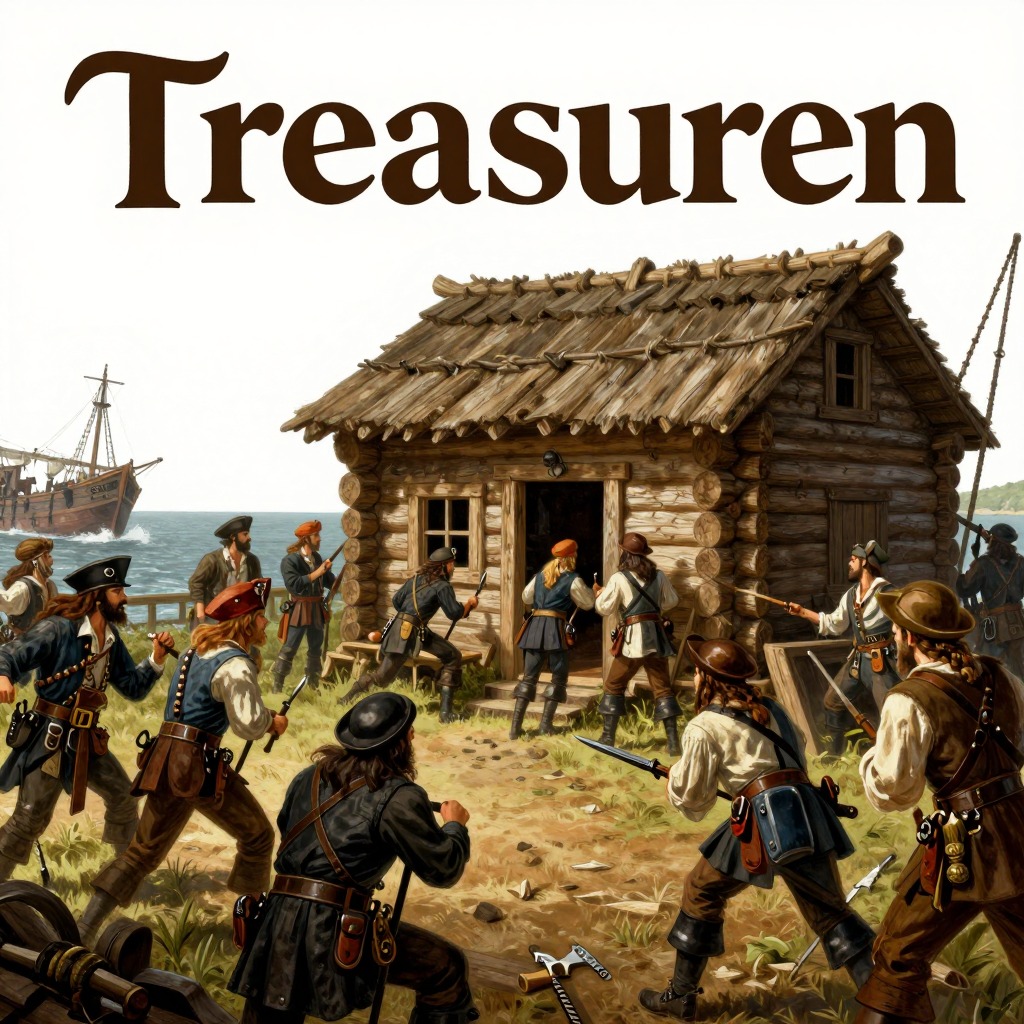
The Stockade stood on a knoll near a spring of clear water, about a hundred yards from the shore. It was a stout log-house, fit to hold two score of people on a pinch, and loopholed for musketry on either side. Around it the builders had cleared a wide space, and the whole was completed by a paling six feet high, without door or opening, too strong to pull down without time and labour and too open to shelter the besiegers. The log-house itself was made of unsquared trunks of pine—roof, walls, and floor—and the floor stood in several places as much as a foot or a foot and a half above the surface of the sand. There was a porch at the door, and under this porch the little spring welled up into an artificial basin of a rather odd kind: a great ship's kettle of iron, with the bottom knocked out, and sunk among the sand. The interior was little more than a framework, but in one corner a stone slab served as a hearth and an old rusty iron basket contained the fire. The slopes of the knoll and all the inside of the stockade had been cleared of timber to build the house, and the stumps showed what a fine and lofty grove had been destroyed. Most of the soil had been washed away or buried in drift after the removal of the trees; only where the streamlet ran down from the kettle a thick bed of moss and some ferns and little creeping bushes were still green among the sand. Very close around the stockade—too close for defence—the wood still flourished high and dense, all of fir on the land side, but towards the sea with a large admixture of live-oaks.
Occupation and Defence
Dr. Livesey, the first of the loyal party to reach the Stockade, found it exactly as described on the chart and immediately recognized its strategic value. The people in the log-house had every advantage: they stood quiet in shelter and could shoot the others like partridges. All they wanted was a good watch and food; short of a complete surprise, they might have held the place against a regiment. The spring of clear water was a particular asset, for the cabin of the Hispaniola, though well supplied with arms and provisions, had no water. After the abandonment of the ship, the loyal party—Captain Smollett, Dr. Livesey, Squire Trelawney, Abraham Gray, John Hunter, Richard Joyce, and Jim Hawkins—took possession of the Stockade. They flew the British colours, which Captain Smollett himself bent and run up on a fir-tree he had set up at the corner of the log-house. The captain divided the men into watches, set them to gathering firewood, digging a grave for Tom Redruth, and cooking, and kept up their spirits by lending a hand wherever it was wanted. The Stockade was soon provisioned with stores from the ship, though the loss of a second boatload left them with rations for only ten days at short allowance.
Siege and Battle
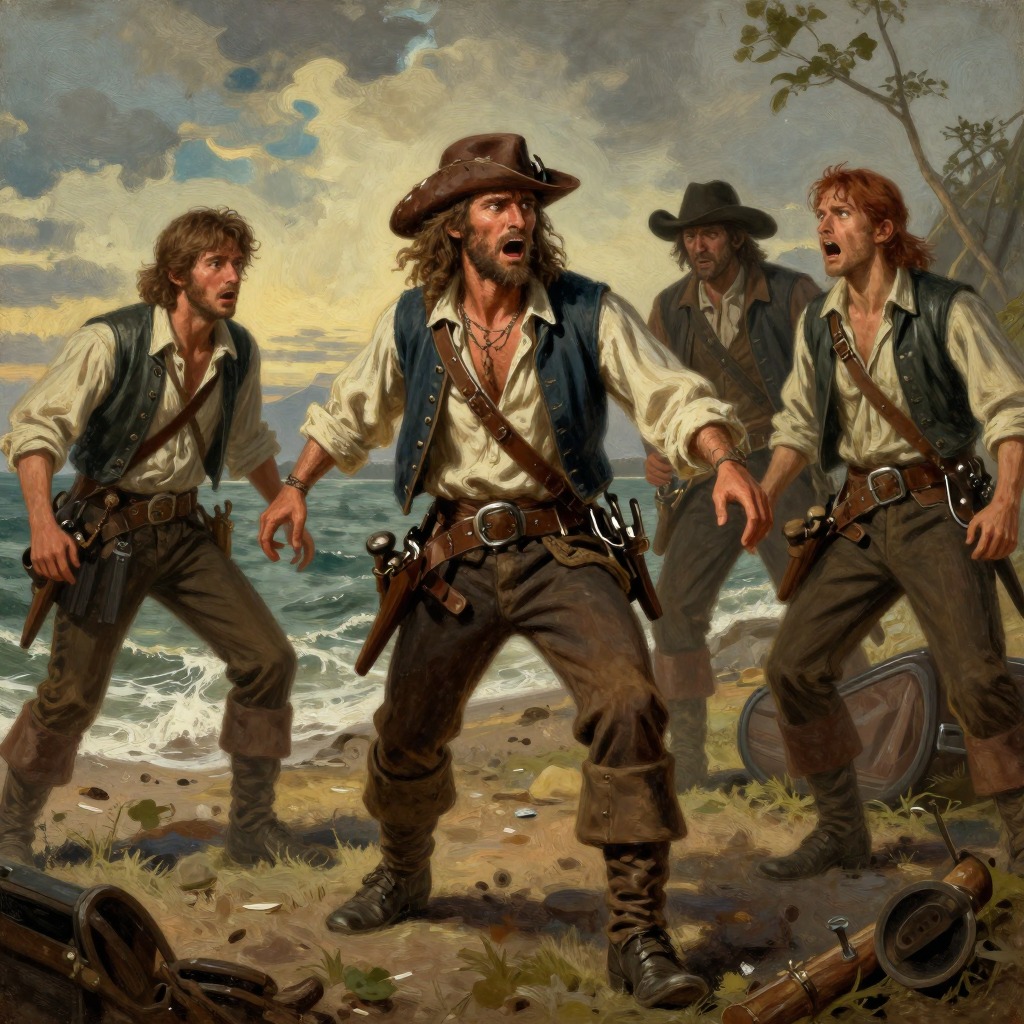
The mutineers, having landed and established their camp in the swamp, began a cannonade from the Hispaniola, aiming at the flag. Ball after ball flew over or fell short or kicked up the sand in the enclosure, but the shot fell dead and buried itself in the soft sand; one popped in through the roof of the log-house and out again through the floor, but the defenders soon got used to it. The bombardment was followed by a direct assault. Seven mutineers, led by Job Anderson, the boatswain, appeared at the southwestern corner of the stockade. The defenders fired a scattering volley that dropped one man and sent the rest plunging into the trees. But a pistol shot from the bush struck Tom Redruth, who died soon after. The main attack came from the north side, where the mutineers swarmed over the fence like monkeys. Four made good their footing inside the defences, and the fight became a hand-to-hand melee in and around the log-house. The defenders, though outnumbered, fought with discipline and courage. Gray cut down the big boatswain, Dr. Livesey beat down his assailant with a great slash across the face, and the last boarder clambered out again with the fear of death upon him. The victory cost the lives of Hunter and Joyce, and Captain Smollett was wounded, but the Stockade remained in loyal hands.
Negotiations and Surrender
The day after the battle, Long John Silver appeared outside the stockade with a flag of truce. He was admitted, and the two men sat on the sand, smoking their pipes, while Silver offered terms: the chart in exchange for the treasure, and a choice of being set ashore or left on the island with stores. Captain Smollett refused, telling Silver that if he and his men came up one by one, unarmed, he would clap them in irons and take them home to a fair trial in England; otherwise, he would see them all to Davy Jones. Silver left in a fury, vowing to stove in the block house like a rum puncheon. But the Stockade held, and the mutineers, having lost their ship and their best men, were eventually forced to negotiate. Dr. Livesey, having learned from Ben Gunn that the treasure had already been moved, gave Silver the now-useless chart and the stores, and the loyal party abandoned the Stockade to move to Ben Gunn's cave on the two-pointed hill. The Stockade, once a symbol of resistance, was left to the mutineers, who soon found themselves trapped on the island without a ship.
Narrative Significance
The Stockade functions as a spatial and symbolic anchor for the loyal party's resistance. It is a place of safety, discipline, and British authority, contrasting with the chaotic, disease-ridden camp of the mutineers in the swamp. Its construction by Flint, the dead pirate, and its reuse by the honest men, illustrates the theme of reclaimed order. The Stockade is also the site of the story's most intense physical conflict, the battle that decides the balance of power on the island. Its eventual abandonment, after the treasure has been secretly moved, marks a strategic shift from defence to deception, and leads directly to the final ambush at the treasure pit.