Tom Redruth
Treasure IslandTom Redruth, the old gamekeeper in the service of Squire Trelawney, is one of the quiet pillars of the loyal party in Robert Louis Stevenson's Treasure Island. Though he appears only in the early and middle portions of the narrative, his role is decisive: he is the first of the squire's men to fall in the fight against the mutineers, and his death crystallizes the human cost of the voyage. Redruth embodies the virtues of the old-fashioned, unquestioning servant—silent, dogged, and utterly reliable—and his loss is felt as a personal blow by the squire, who had brought him along as part of his household retinue.
Identity and Background
Redruth is introduced as the squire's gamekeeper, a man of the estate rather than of the sea. When Squire Trelawney and Dr. Livesey plan the expedition to Treasure Island, the squire names Redruth among the four servants he will take: "We'll take Redruth, Joyce, and Hunter." Redruth is thus part of the small cadre of trusted landsmen who are meant to counterbalance the potentially unreliable sailors hired in Bristol. He is described as old—"the oldest of our party by a score of years"—and his age is emphasized when the doctor later reflects on his death. He is also notably poor at reading, as Jim Hawkins observes when a letter arrives from the squire: "the gamekeeper was a poor hand at reading anything but print." This detail marks him as a man of humble station, dependent on others for written communication, yet his loyalty is never in question.
During the weeks of preparation, while the squire is in Bristol and the doctor in London, Jim Hawkins lives at the hall under Redruth's charge, "almost a prisoner, but full of sea-dreams." Redruth grumbles at the squire's absence and at the doctor's caution, but he obeys orders without complaint. When the letter from the squire arrives, it is Redruth who helps Jim decipher it, and he accompanies the boy on the journey to Bristol, serving as his guardian on the road.
Role in the Voyage and the Mutiny
Once aboard the Hispaniola, Redruth is one of the few men the loyal party can count on. When Captain Smollett warns of possible treachery and insists on moving the powder and arms to the cabin, Redruth is among those assigned to the new berths. The captain's plan to create a "garrison of the stern part of the ship" includes Redruth, who is to be berthed with the other loyal men. During the voyage, Redruth remains in the background, but his presence is part of the fragile security of the cabin party.
When the mutiny breaks out and the loyal party decides to abandon the ship, Redruth is given a crucial post. The doctor's narrative records: "We put old Redruth in the gallery between the cabin and the forecastle, with three or four loaded muskets and a mattress for protection." This position is meant to block the mutineers from attacking from the rear while the others load the jolly-boat. Redruth performs this duty with the same silent efficiency that marks his whole service. When the six mutineers left aboard try to rush the cabin, they find Redruth waiting in the sparred gallery and immediately retreat. The doctor later notes that Redruth "had lain like a Trojan behind his mattress in the gallery; he had followed every order silently, doggedly, and well."
Death at the Stockade
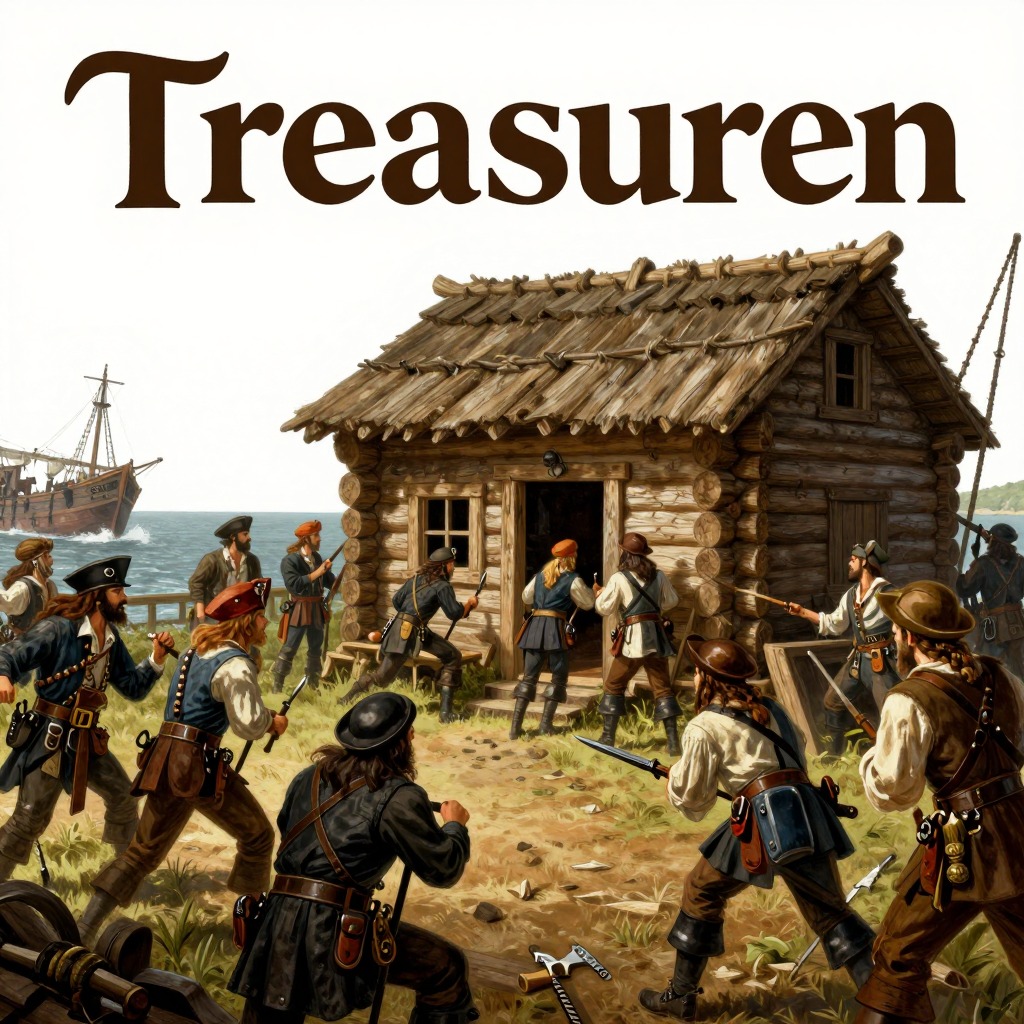
Redruth's death comes during the first day's fighting at the stockade. After the loyal party has taken possession of the log-house and repelled the initial assault, the mutineers retreat into the woods. As the defenders walk outside the palisade to examine the fallen enemy, a pistol shot rings out from the bush. The doctor records: "a ball whistled close past my ear, and poor Tom Redruth stumbled and fell his length on the ground." The shot is fired by a hidden mutineer, and Redruth is struck down almost immediately. The squire and the doctor return fire, but to no avail; they can only watch as the old gamekeeper dies.
The death scene is one of the most poignant in the book. Redruth is carried, "groaning and bleeding," into the log-house, where he lies under the Union Jack. The squire, who had brought Redruth from his estate, kneels beside him and kisses his hand, "crying like a child." Redruth, true to his character, shows no fear or complaint. When the squire asks for forgiveness, Redruth replies, "Would that be respectful like, from me to you, squire? Howsoever, so be it, amen!" He asks only that someone read a prayer, saying, "It's the custom, sir," and then passes away without another word. The doctor's narrative emphasizes the old man's stoicism: "he had not uttered one word of surprise, complaint, fear, or even acquiescence from the very beginning of our troubles till now."
Aftermath and Significance
Redruth's death has immediate and lasting consequences. The captain, who had been observing the fight, notes that the loss of Redruth reduces the loyal party's numbers and strains their already limited resources. He points to the dead body and remarks, "we're perhaps as well without that extra mouth," a cold calculation that underscores the grim arithmetic of survival. The doctor, however, mourns Redruth as a man who "was the oldest of our party by a score of years" and who had served with uncomplaining fidelity. The captain later enters Redruth's name in the log-book as one of the faithful: "Thomas Redruth, owner's servant, landsman, shot by the mutineers."
Redruth's death also serves as a moral touchstone for the squire. The squire's grief is profound, and his guilt is evident when he later confronts Long John Silver, saying, "the dead men, sir, hang about your neck like mill-stones." Redruth is one of those dead men, and his sacrifice is part of the price paid for the treasure. In the larger narrative, Redruth represents the loyal servant whose quiet devotion is taken for granted until it is too late. His death, coming so early in the island conflict, foreshadows the heavier losses to come and reminds the reader that the adventure is not merely a game but a deadly serious enterprise. Redruth's name is recorded among the fallen, and his memory lingers as a symbol of the old order of service and duty that the pirate world threatens to destroy.