
The Host and the Parasite
Turtles All the Way DownThis flow tracks how parasite imagery moves from Aza's fear of bodily contamination to a wider reflection on power and identity.
increasing Bearing strength in each event
 decreasing
Bearing strength in each eventdecreasingA Colony Within
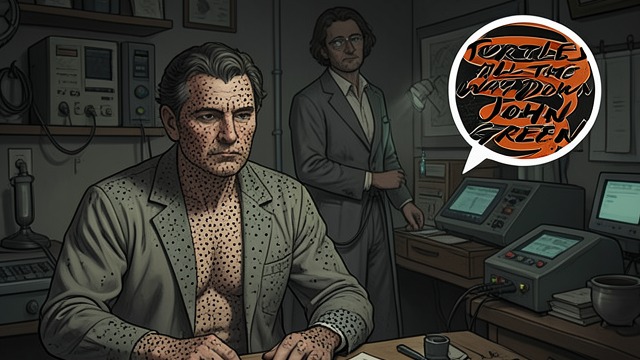
A Colony Within
A body shared with microbes
Aza Holmes considers the bacteria inside her and fears that they undermine the idea of a unified person.
Her biological knowledge becomes fuel for obsessive alarm.
The boundary problem
The image of a human as a microbial colony raises questions about where the self begins and ends.
The Fish's Story
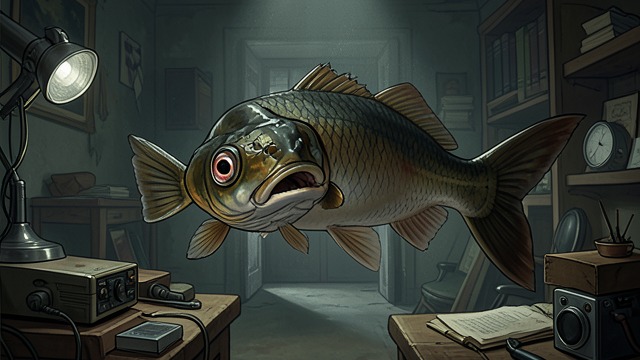
The Fish's Story
An organism under another's influence
Aza tells Davis Pickett about Diplostomum pseudospathaceum, which alters a fish's behavior to reach its next host.
She fears that her own life may be directed by forces outside her awareness.
A metaphor without reassurance
The example makes her fear intelligible but does not establish that her thoughts are literally controlled by an organism.
Who Is the Person?

Who Is the Person?
Presence beyond thought
Davis Pickett recalls his father dismissing his mother's hand squeeze as a reflex during her illness.
He insists that she remained a person even when she could not communicate normally.
A challenge to Aza's fear
The memory suggests that personhood is not reducible to conscious control, perfect communication, or an untouched body.
The Host's Reversal

The Host's Reversal
Power appears to act on people
Davis Pickett describes adults as shaped and hollowed by what they worship, rather than fully controlling it.
Aza answers that the parasite may believe itself to be the host.
A shared image
The metaphor links obsession, wealth, and power without pretending that they are the same kind of force.
The Dragon Is Also Herself
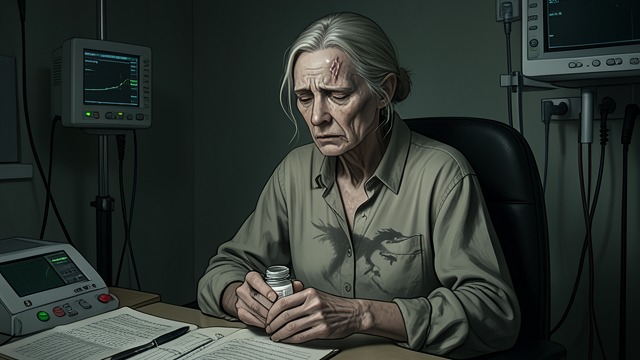
The Dragon Is Also Herself
No clean separation
Aza Holmes realizes that she may never entirely separate her illness from her sense of self.
The disease is not an external villain she can simply slay.
Persistence over victory
She keeps going with treatment and support, accepting that improvement can matter even without complete escape.
Early September, during the cafeteria spiral
Late September, during Aza and Davis's first long conversation
The same night, while discussing Davis's mother
After Davis speaks about power and his father
Early January, after the body is found
