Aza Holmes and her late father’s relationship
Turtles All the Way DownAza Holmes and her late father’s relationship continues after his death through the objects, images, and habits of attention he left behind. His old phone is more than an archive: because it still works, and because its photographs preserve what caught his eye, it offers Aza a material way to revisit a father she remembers vividly but cannot bring back. The bond it sustains carries comfort and grief together, especially in the images of broken sky and in her recollection of the day he died.
Loss and the difficulty of speaking
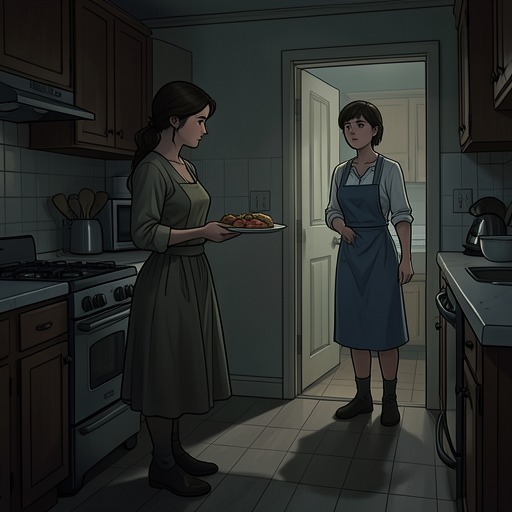
Aza and her mother have never been good at talking about Aza’s father. Their silence is not evidence that he has become unimportant; rather, his absence is so present that even a conversation about what he might have been like can turn toward the pain of losing him. When Aza’s mother wonders whether Aza and her father would have clashed, she imagines that he would have understood Aza’s persistent questions, though his worrying might also have exhausted her. Aza offers little response to this picture of a relationship that can now only be imagined.
The exchange also makes their bond legible through resemblance. Aza calls worry a correct view of life because life is worrisome. Her mother smiles and says Aza sounds just like him. The likeness is not presented as a simple inheritance that repairs the loss: it connects them, but it also brings the dead father into an ordinary conversation in which he cannot answer. Her mother then says she still cannot believe he left them, phrasing his death as if it had been a choice. Aza recognizes the painful mismatch between that wording and what happened; he did not decide to leave.
The phone as a continuing connection
Aza keeps her father’s phone and its charging cord hidden in Harold’s trunk beside the spare tire. The secrecy and care of that storage make the device a private possession, not merely an old electronic object. Her mother has already backed up his photographs and emails to a computer and several hard drives, so the phone is not the only place his records survive. Aza nevertheless prefers to swipe through the pictures on his own device: the familiar way of looking matters, and so does the fact that the phone continues to function eight years after his body stopped working.
The phone’s home screen shows Aza and her mother at Juan Solomon Park, with seven-year-old Aza leaning back on a playground swing. Her mother has told her that she remembers the pictures rather than what was happening when they were taken. Aza still feels she can remember her father pushing her: his hand broad against her back, and the assurance that swinging away from him also meant swinging back. The image becomes more than proof that the family was together. It gives Aza a physical pattern for the security she associates with him, while leaving room for uncertainty about how much of the remembered scene comes from the photograph itself.
His way of seeing
Most of the photographs on the phone were taken by Aza’s father. As Aza moves through them, she sees her younger self and her mother, but also the world as it drew his attention: especially the sky divided by tree branches. In a river scene, a leafless tree’s crossing branches fracture the blue above her. The sight recalls the same kind of pictures on his phone, and Aza wonders what he saw in that split-apart sky. The resemblance lets her recognize a recurring feature of his attention without claiming to know fully what it meant to him.
The family photographs preserve ordinary movement as well as striking compositions: her mother on a tiny tricycle, Aza on her shoulders, and Aza eating breakfast with cinnamon sugar across her face. Her father rarely appears except in selfies. Because the phones he used had no front-facing camera, he had to guess at the framing; the resulting pictures are crooked, sometimes cutting people partly out, though Aza remains visible, curled toward her mother. Aza remembers that she was a mama’s girl, but the photographs also record her father as the person arranging the view and keeping these moments.
Aza’s mother looks young in the pictures, and her father sometimes took five or six shots in the hope that one would come out right. Swiped rapidly, they form a small flipbook: her mother’s smile grows and shrinks, Aza squirms, and her father’s face does not change. Aza’s favorite photograph of him is one of the few in which he is out of focus, a selfie with a friend at a Pacers game and the court behind them. She chooses it in part because the blur feels true to people: not perfectly fixed or fully knowable. The image keeps him present while acknowledging the incompleteness of any image of him.
The memory of his death
The photographs do not displace Aza’s memory of her father’s death. She remembers that his headphones were still playing an old soul song when he fell beside the stopped lawn mower. His body was on its side, near the single tree in the front yard, while the music continued tinny and incongruous through his earbuds. At her mother’s instruction, Aza called 911 and told the operator that her father had fallen. Asked whether he was breathing, she asked her mother, who said he was not.
Her mother continued CPR until the ambulance arrived. They did not know for sure that he was dead until a doctor opened the door of the windowless hospital family room where they were waiting and asked whether her husband had a heart condition. The shift into the past tense made the loss definite. Aza’s recollection retains the sequence of the call, the CPR, and the doctor’s question, alongside the strangely ordinary song. Years later, looking through the phone brings her back to her father through images, but the remembered circumstances of his death remain another part of the relationship she carries.
Remembering him in the present
At Applebee’s, Aza retrieves a tote containing money, her father’s phone, and its car charger from Harold’s trunk. After the device starts, she swipes through the family pictures and settles on the blurred photograph of her father at the game. She then speaks to him, telling him she came into some money by chance, that she will try to do right by it, and that she misses him. The act turns looking into an address: the phone cannot answer, but it gives Aza a familiar place from which to tell him what is happening in her life.
She returns to the photographs on another night after Davis has driven her home. Having said she is tired and gone to her room, she retrieves the phone from Harold’s trunk, plugs it into an old wall charger, and studies the images of sky split by branches. Her mother quietly points out that the same photographs are on the computer. The distinction is not about whether the pictures can be accessed elsewhere; Aza wants the experience of looking through them on his device. Over the following months, she continues to miss her father even as she gets better without ever quite getting well. The relationship endures not as a resolution of grief, but as a continuing practice of remembering, looking, and speaking to someone whose absence remains part of her present.