Aza Holmes and her mother’s relationship
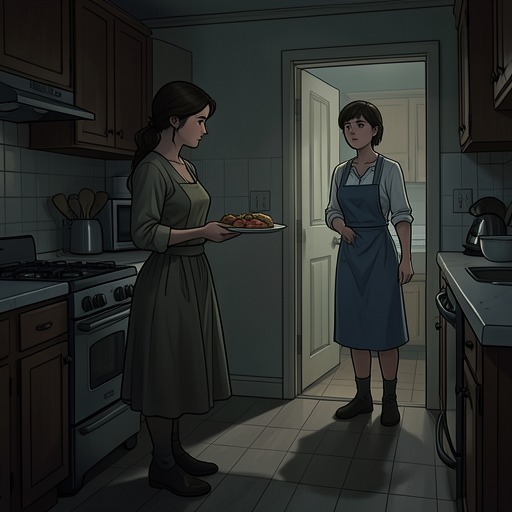
Turtles All the Way DownAza Holmes and Aza’s mother share a vigilant, loving relationship shaped by Aza’s anxiety, the difficulty of describing psychic pain, and their different ways of responding to it. Aza’s mother watches closely and tries to protect her daughter, while Aza often answers with reassurance or withdrawal rather than a full account of what is happening. Their bond is neither a simple cure for Aza’s distress nor a failure of care: it is a continuing negotiation between a parent’s fear and a daughter’s need to own an experience that even she struggles to put into words.
Daily Care and the Signs of Distress
Aza’s mother is both a parent and a presence in Aza’s school day. She teaches mathematics, loves reading, and can be found behind her classroom desk during lunch. When Aza walks from the cafeteria toward history class while rereading an online article about the human microbiota, Aza’s mother calls her in from the hallway, where phones are not allowed. With only four minutes left in lunch, she notices something in Aza’s eyes and checks whether she is all right. Her attention is immediate, but the exchange also shows how much of their communication depends on Aza’s brief answers: Aza says she is fine, then says she is taking her medication.
Aza’s mother has adjusted how she asks about anxiety after Dr. Karen Singh advised her not to pose it as a direct question. Instead, she uses statements to check on Aza, including when she asks about medication. Aza’s assurance is broadly true but incomplete: after a serious breakdown in her freshman year, she was prescribed a daily white pill, yet at that point took it, on average, about three times a week. The gap between prescribed routine and actual practice is not simply a secret about medication; it exposes the limits of what Aza’s mother can know from a short answer, even when she is actively trying to notice what her daughter needs.
Pain, Language, and What They Cannot Easily Share
Aza’s experience is difficult for both mother and daughter to discuss because it resists ordinary description. In therapy, Dr. Karen Singh observes that Aza reaches for metaphors such as a demon, a bus, a prison cell, a spiral, or a whirlpool to approach her inner life. She explains that physical and psychic pain can be approached through metaphor but cannot be represented like a table or a body, and shares Virginia Woolf’s reflections on how language fails to describe suffering. That idea illuminates the strain at home: Aza’s mother can see signs of pain without being able to enter or adequately name it.
When Aza’s mother visits her bedroom and asks whether she is scared, Aza can only explain that the fear has no particular object; she is simply scared. Her mother admits that she does not know what to say and wants to take the pain away. She runs her fingers through Aza’s hair and repeats that Aza is all right and that she is staying. Aza stiffens as the touch continues, showing that comfort, however sincerely offered, does not necessarily match what Aza can tolerate in that moment. Her mother eventually suggests that she may need a good night’s sleep, a reassurance Aza recognizes as the same kind of untrue simplification she had offered Noah Pickett. The scene makes their closeness physical while leaving the underlying fear unresolved.
Grief and Protective Intimacy
Their care for one another is bound up with the death of Aza’s father, although they have never been good at talking about him. When Aza’s mother asks how Davis Pickett is doing without his father, the conversation turns toward their own loss. Sitting close, with her shoulder against Aza’s, Aza’s mother wonders whether Aza and her father would have clashed. She believes he would have understood Aza’s questions better than she does, but also remembers him as such a worrier that his worry could be exhausting. Aza replies that worrying is the correct worldview because life is worrisome. Her mother recognizes her late husband in that answer, then speaks of his death as though he had chosen to leave them. The exchange shows how grief remains present in the family without becoming an easy topic of shared conversation.
Aza’s mother’s protectiveness also shapes her response to Aza’s relationship with Davis. When she learns Aza is seeing him, she gestures for Aza to sit beside her on the couch and puts an arm around her. She warns Aza to be careful around Davis because wealth can make people careless; Aza answers that Davis is a person, not wealth, and her mother replies that people can be careless too. She squeezes Aza so tightly that Aza feels her breath being pressed out. The warning is grounded in concern, but it also shows the friction between a mother who sees risk in Davis’s wealth and a daughter who wants him treated as an individual. Aza’s mother’s care can protect and constrict at once.
Crisis and the Work of Care
Aza’s mother repeatedly tries to learn what is happening without making her daughter feel interrogated. After Aza’s phone call with Daisy Ramirez, Aza notices her mother standing in the doorway and asking whether everything is okay; the conversation quickly turns to Aza’s date with Davis. On another evening, Aza says she needs to read rather than make dinner. Her mother comes into the bedroom, sits on the edge of the bed, and asks whether she feels scared. When Aza cannot give the fear an object, her mother names her own helplessness: she sees pain on Aza’s face and wants to take it away. Aza hates both hurting her and making her feel helpless, yet cannot offer words that would settle her mother’s worry.
That helplessness becomes more acute after Aza’s accident and hospitalization for a lacerated liver. In the hospital, Dr. Karen Singh explains that Aza has not been taking medication as prescribed and that drinking hand sanitizer is dangerous, then recommends a different medication that Aza can tolerate and take consistently. Aza’s mother’s role after discharge is practical and sustained: Dr. Karen Singh visits twice a week, Aza changes medication, and her mother makes sure she takes it every morning. Aza is not allowed to get up except to use the bathroom, because further strain could reopen the liver injury. She misses two weeks of school and describes the days as continuously painful and difficult to express. Daisy Ramirez and Davis try to visit, but Aza wants to be alone; meanwhile, her mother stays near, asking a succession of questions phrased as statements about whether each day is better and whether Aza is improving.
Autonomy and a Changed Conversation
When Aza returns to school, she visits her mother’s classroom for the last few minutes of lunch. The exact limits of the visit matter: the clock reads 1:08, Aza has six minutes, and she does not want more. Her mother has a cold and has already spent all her sick days while Aza was ill. Their conversation turns to money Aza has kept. Aza’s mother says that Aza’s life is hers, but raises concern about the effect the past couple of months have had on her mental health. Aza answers that the money did not cause her illness and that she has been sick for a long time; her mother replies that it has not been like this before.
The argument brings their central difficulty into the open. Aza’s mother says she needs Aza to be well and begins to say she cannot lose her. Aza asks her to stop framing the situation that way, explaining that although she knows her mother does not mean to create pressure, the words make Aza feel as if she is hurting her. She insists that she cannot stay sane for someone else. In response, Aza’s mother recalls carrying Aza to and from the bathroom when she first came home from the accident and tucking the covers to her chin. She realized then that she would probably never pick Aza up again. She acknowledges that Aza is right: her daughter is not her, and must make her own choices. The bell interrupts before she finishes, so the scene offers no complete reconciliation or promise that the worry will disappear. Its change is more modest and more consequential: Aza’s mother begins to recognize that loving Aza cannot mean controlling her choices or asking her to manage her mother’s fear.