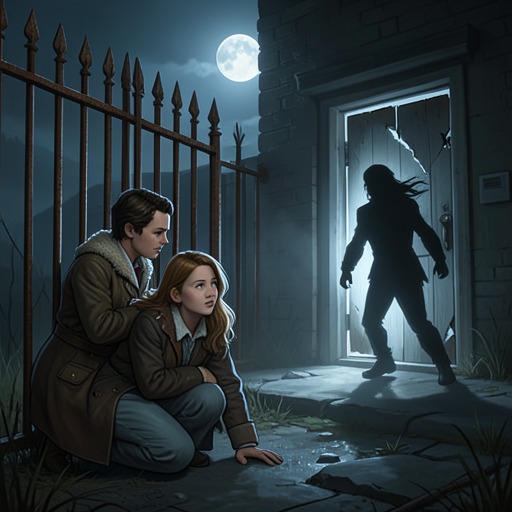
Aza and Daisy discover the night-vision photograph
Turtles All the Way DownAza Holmes and Daisy Ramirez discover the night-vision photograph while searching the woods beside the Pickett estate, turning an unnoticed camera into evidence that places a man in a striped nightshirt at the estate after Russell Pickett disappeared. The image gives the girls a timeline the police report lacks, but their discovery is made under pressure: as a golf cart approaches, Aza stays to retrieve one more photograph while Daisy urges her to hurry.
Setting and Discovery
After wading through the White River, Aza and Daisy climb the floodwall and reach woods bordered by the manicured lawns of the Pickett golf course and the glass-and-steel mansion. Daisy spots a small black camera mounted about four feet above the ground on a tree. Its unobtrusive size helps explain why the girls would not have noticed it without knowing to look.
Aza connects to the camera with her phone; it has no password protection, and its stored photographs begin downloading within seconds. She deletes the first two images, which show the girls themselves, then passes through a dozen photographs taken during the preceding week. Most depict deer, coyotes, raccoons, and possums, either in daylight or as green night-vision silhouettes with bright eyes. Among these ordinary records of wildlife is the image that changes the significance of their search.
The Photograph and Its Timeline
Aza scrolls back to September 9 and finds a night-vision image of the back of a stocky man wearing a striped nightshirt. The timestamp reads 1:01 a.m. She screenshots the image, preserving a record of the moment captured by the camera. The photograph does not show the man’s face, but its date, time, and clothing make it potentially significant to the investigation of Russell Pickett’s disappearance.
The police report contains no mention of this night-vision photograph. That omission means Aza and Daisy have evidence the police do not: a timeline anchored to a specific image and timestamp. The discovery’s importance lies not simply in seeing someone at the estate, but in having a precise record against which the account of Pickett’s disappearance can be considered.
Flight from the Estate
The discovery takes place as a golf cart heads in the girls’ general direction. Daisy warns Aza quietly that it is coming and then says the driver has spotted them. Aza is not initially unnerved by the approaching man; she remains focused on loading the next image, which takes an unusually long time to appear.
Daisy runs ahead while Aza waits for the photograph to finish loading. It turns out to show a coyote. When Aza looks up and sees the man in the golf cart looking at her, she bolts. The sequence gives the evidence-gathering a narrow margin: the image is secured, but the girls have been seen on the property and must escape.
Evidence, Memory, and Aftermath
The camera’s image becomes part of a larger pattern of looking and recording. Aza’s father had taken many photographs of leafless branches dividing the sky, a view that recalls the broken-up sky she sees while floating down the river. His old phone, kept with a charging cord hidden in Harold’s trunk, preserves those photographs in the form in which Aza has always encountered them: through his phone. The camera’s downloadable files serve a different purpose, supplying a dated record of another person’s presence, but both kinds of images make an absent person or moment available to be revisited.
Later, before meeting Daisy at Applebee’s, Aza retrieves her father’s phone and charger from the trunk. Although her mother had backed up his pictures and emails, Aza values swiping through them on the device itself, which still works eight years after his death. She tells her father that she has come into money, hopes to do right by it, and misses him. After a movie with Davis, she again takes out the phone and returns to the photographs of sky split by branches. These later scenes do not resolve the missing-man mystery; they show how the evidence from the camera sits within Aza’s continuing attachments to the past. In the months that follow, she and Daisy start two school clubs and spend much of their time together, while Aza gradually understands that Davis belongs to her past. The girls’ discovery is one concrete gain in an unresolved search, set within a life that continues to hold both uncertainty and loss.