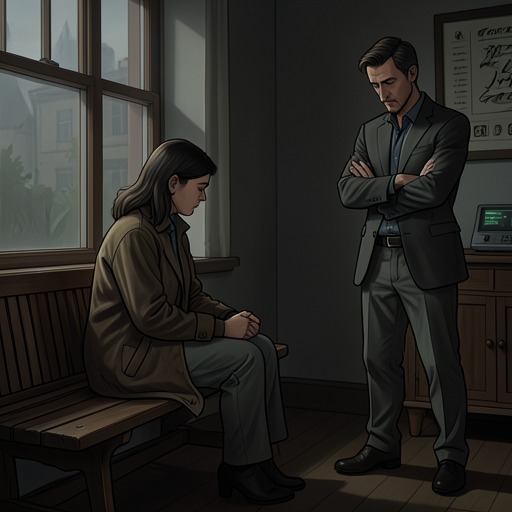
Aza and Davis’s breakup over differing needs for intimacy
Turtles All the Way DownAza and Davis’s breakup over differing needs for intimacy is not a rejection grounded in indifference: Aza insists that she likes Davis and wants to kiss him, but her obsessive fear of contamination turns touch into a perceived threat. The relationship ends because her distress makes closeness feel unsafe while Davis needs to be liked at close range. Their separation exposes the distance between wanting intimacy and being able to experience it without terror.
Circumstances and the problem of choice
Aza approaches the breakup with an understanding of herself already unsettled by questions about agency. Earlier, she wonders whether there is a self independent of circumstances—one unchanged by money, a boyfriend, or school—or whether she is only the conditions surrounding her. She also doubts that her thoughts and body belong to her when she cannot choose her thoughts or control what her body does. In that account, a relationship cannot be separated neatly from the forces acting on her: desire may be present, but it does not give her command over the fears that interrupt it.
The conflict also sits beside Aza’s ambivalence about medication. She fears that a pill might change the person she is, even as she hates the “demon” she associates with her condition. That unease makes the expectation of getting better more complicated than a simple return to ordinary couplehood. Aza does not present recovery as a switch she can throw to become ready for touch. The familiar advice that a person can choose one thought over another is especially distant from her experience: she says she cannot choose her thoughts any more than her name. Her difficulty is not merely deciding what she wants, but living with thoughts and bodily alarms that do not yield to decision.
The conversation at the table
When Aza asks Davis to sit across from her, the change of seat briefly makes her feel better. She then says, “I can’t do this,” and explains that she does not know whether she will ever be able to do it. She appreciates his texts and recognizes the care in them, but tells him that what he is seeing may be what getting better looks like for her. The statement refuses the tidy progress story in which illness gives way to wellness and a person becomes whole in a predictable sequence. Aza can acknowledge Davis’s support without promising that it will produce the kind of relationship he hopes for.
Davis tells her, “I like this you.” Aza answers by naming the ordinary forms of couplehood she believes he wants: making out, sitting together on the same side of the table, and other familiar kinds of physical closeness. She does not claim that she dislikes kissing or does not want Davis. Instead, she explains that her brain treats kissing as one of many things that might kill her. Even imagining a final kiss, she says, would bring her attention to the microbes they had exchanged. She knows that touching Davis probably did not give her a disease, but cannot make herself certain, and describes the fear as something she cannot even name more specifically than “it.”
That distinction matters to the breakup. Aza is not asking Davis to interpret her fear as a lack of affection, but neither can affection dissolve the fear. The scene gives the bodily scale of the obstruction: a kiss is not just a gesture of love for her, but an occasion for thoughts about microbes and possible illness. Davis can hear that the experience is frightening, yet the exchange does not make the fear comprehensible to him or make intimacy feel safe to Aza.
From partners to people catching up
Aza can see that she is hurting Davis in the way he keeps blinking. She does not blame him for failing to understand what she herself describes as making no sense. When he asks whether she feels she is getting better, she recognizes the story others want her to tell: movement from darkness to light, weakness to strength, brokenness to wholeness. She wants that story too, but wanting it does not settle whether it describes her actual condition. The painful gap between a hoped-for recovery and the life she can manage now becomes part of the separation.
The conversation gradually loses momentum. They begin speaking like people who used to be close, exchanging news about their lives instead of sharing those lives together. By the time Davis pays the bill, Aza understands that whatever they had, they no longer have it in the same form. The change is quiet rather than a dramatic quarrel: their talk itself shifts from the intimacy of a couple to the distance of former partners.
The unanswered message and the terms of the ending
At home, under the covers, Aza texts Davis to ask whether he is around. His reply makes the incompatibility plain: “You can’t do it the other way,” he writes, “And I can’t do it this way.” Aza asks why. Davis says the arrangement makes him feel that she likes him only at a distance, and that he needs to be liked close up. His words do not dispute her account of contamination fears; they state what the relationship feels like from his side and what he cannot accept indefinitely.
Aza types and deletes a response repeatedly but never sends one. That silence is the final action the breakup records. Davis has articulated a need that Aza cannot meet, while Aza has described a fear she cannot simply decide away. The ending therefore offers neither a negotiated compromise nor a promise that the relationship will resume after a clean recovery. It leaves the two accounts side by side: Aza’s constrained capacity for closeness and Davis’s need for closeness to feel loved.
The separation echoes the novel’s wider uncertainty about whether a person authors a life or is shaped by forces beyond individual control. Aza’s thoughts do not feel like freely chosen possessions, but the breakup is not presented as though her experience makes her feelings unreal. She wants Davis and is frightened of what physical intimacy might mean; both are true at once. The relationship ends not because one truth cancels the other, but because the two cannot be made to fit the same way of being together.