Aza’s father’s phone
Turtles All the Way DownAza’s father’s phone is more than a container for photographs: it is a handled, breakable remnant of the father Aza has lost. Its passage from the trunk of Harold to her bedroom, and later back out of the trunk after the crash, gives grief a physical object to gather around. The pictures can be copied; the phone, which her father held and used, cannot be made equivalent to its copies.
Retrieval and use
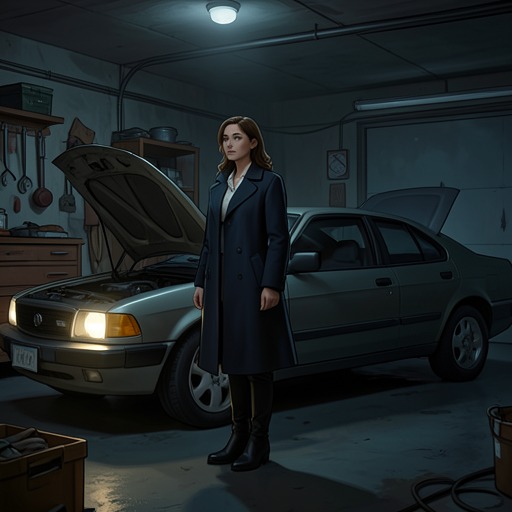
After a movie with Davis, Aza tells him she is tired so she can be alone in bed. Once he has driven her home and left, she goes into the garage, opens Harold’s trunk, and takes out her father’s phone because she wants to look at his pictures. The object has been stored out of sight in the car, but Aza’s choice to retrieve it makes it the focus of a private act of remembrance.
She slips past Aza’s mother, who is asleep on the couch in front of the television, finds an old wall charger in her desk, and plugs the phone in. For a long time she swipes through the photographs: images of the sky, divided by tree branches. The scene is made of small, deliberate actions—finding the charger, powering the phone, moving through the images—and its duration matters. Aza is not merely looking at a single keepsake; she spends time with the device and the pictures it holds.
Aza’s mother appears behind her without Aza hearing her get up. She gently points out that the same pictures are on the computer, then asks whether Aza was talking to her father. Aza does not answer that question in the passage. Instead, she unplugs the phone and shuts it off. The exchange distinguishes the photographs as information available elsewhere from the phone as the object Aza has chosen to be with: the computer may hold the images, but it is not the device her father used.
The phone after the crash
The phone returns to the center of Aza’s attention after the car accident, when she tries to retrieve it from Harold’s trunk. The latch is visible but will not give; as she struggles, pain in her ribs clouds her vision. She pounds on the trunk until Harold’s license plate slides off, then eventually gets it open just far enough to reach inside and fumble for the phone. The damaged car and Aza’s injured body turn recovering the object into a difficult physical effort.
When she finds it, the screen is shattered. She holds down the power button, but beneath the broken glass it glows only a cloudy gray. The familiar action of turning the phone on no longer leads to the photographs she had browsed before. The physical break has made the device unusable to her in that moment, even as it makes its material condition impossible to ignore.
A firefighter named Franklin reaches her and tells her to try not to move while an ambulance is on its way. Aza says she is not hurt, though the preceding struggle has already shown the pain in her ribs. When she explains that the phone belongs to her father, Franklin interprets her distress as worry that her father will be angry about the car and reassures her that he is relieved she is safe. Aza’s unfinished explanation does not resolve that misunderstanding; the scene instead leaves the phone’s importance visible in her insistence that it is his.
Copies and presence
Aza knows that the pictures have been backed up and that nothing in them has actually been lost. That knowledge does not console her about the broken phone. Her distinction is between the photographs as recoverable images and the handset as an object her father touched: he held it, spoke into it, and used it to take her picture. The phone’s significance rests not on unique data but on its particular history of contact.
That difference sharpens the contrast between the two episodes. At home, Aza can charge the phone and move through its stored images; after the crash, the same object yields only a gray glow through shattered glass. In both scenes, her attention settles on the device itself, but its condition has changed from usable to broken. The backed-up photographs survive that change, while the physical link Aza values has been damaged.
Narrative significance
The phone gives Aza’s grief a recurring material form without making the loss interchangeable with a problem of storage or recovery. Her mother’s reminder that the pictures are on the computer is factually correct, and Aza herself knows the images are safe; neither fact can replace the handset’s association with her father’s hands, voice, and photographs of her. The object therefore holds two kinds of memory together: images that can be copied and a specific, damaged thing whose history cannot.
The movement from a quiet visit to the photographs to Aza’s effort to recover the shattered phone also changes the terms of remembrance. First she can choose the phone, charger, and pictures as part of a private ritual. After the accident, pain, broken glass, and Franklin’s attempt to comfort her interrupt that access. Her crying as she touches the shattered screen makes the distinction concrete: the pictures may remain elsewhere, but the object that carried her father’s presence has been broken.