Aza’s liver laceration
Turtles All the Way DownAza Holmes’s liver laceration is medically described as mild, but its consequences are neither brief nor simple. Sustained in a car accident, the injury leaves her hospitalized for eight days and out of school for two weeks; recovery confines her to bed and brings pain she cannot adequately put into words. The laceration becomes the bodily center of an aftermath shaped by trauma, medication, and the distance between a clinical prognosis and the experience of living through pain.
Injury and Diagnosis
At the accident scene, Aza Holmes insists that she is not hurt. A firefighter named Franklin tells her not to move while an ambulance is on its way, and she is taken for medical care. The initial diagnosis overturns her own assessment: she has a lacerated liver. The injury is classified as mild, but the doctors cannot simply dismiss it. They plan to watch her for a couple of days to ensure that the bleeding does not worsen, and warn that surgery would become necessary if it did.
The prognosis offers cautious reassurance rather than an instant resolution. The doctor considers surgery very unlikely and describes Aza Holmes as lucky given the range of possible liver lacerations. Her mother repeats that she will be all right, then breaks into tears of gratitude. The doctor estimates that Aza Holmes will be sore for several weeks and, within roughly six weeks, should be back to her former condition. That forecast establishes an expected recovery, but it cannot convey what the intervening weeks will feel like to the patient.
Hospital Treatment and Complications
The injury entails an eight-day hospital stay. Aza Holmes’s ribs hurt, and so do her brain and thoughts; pain is not confined to the damaged organ. The account refuses a dramatic recovery scene in favor of the unrelenting routine of lying in a hospital bed, hurting, and being unable to go home. The bodily trauma and the psychological distress remain together in the same span of time rather than resolving into separate problems.
One specific medical decision brings relief: the doctor says antibiotics are not needed unless surgery becomes necessary. Aza Holmes has been afraid of an increased risk of Clostridioides difficile infection, so the decision removes one immediate source of anxiety even as the liver injury keeps her under observation. The prospect of avoiding antibiotics does not end her hospitalization or the pain; it narrows one danger within a situation that still feels difficult to control.
The hospital staff initially interpret her ingestion of hand sanitizer as evidence that she was seeking alcohol. The explanation is instead connected to her mental-health crisis and her inconsistent medication use. When Dr. Karen Singh comes to the hospital, she identifies two issues: Aza Holmes has not been taking her medication as prescribed, and the accident has been a serious trauma. Aza Holmes says that she felt the medication was making her worse, but Dr. Singh rejects the idea that drinking hand sanitizer while hospitalized for a liver laceration represents progress. She stresses that ingestion is dangerous because the product contains chemicals that can kill, and recommends a different medication that Aza Holmes can tolerate and take consistently. The injury therefore prompts care for both immediate physical danger and the mental-health circumstances surrounding it.
Recovery at Home
After discharge, recovery remains restrictive. Dr. Karen Singh visits Aza Holmes at home twice a week to check her progress, while her mother makes sure she takes the new medication each morning. Aza Holmes is not allowed to get up except to use the bathroom, because movement could reopen the liver laceration. The medical concern about renewed bleeding structures ordinary life around caution: even leaving bed is treated as a risk to the healing injury.
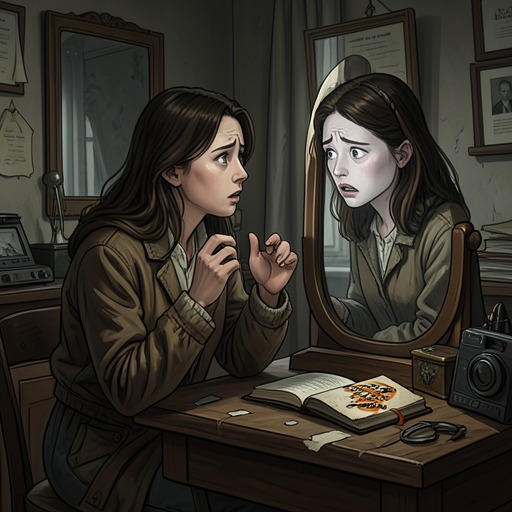
Aza Holmes misses two weeks of school. She describes those fourteen days as difficult to recount, not because they contain a succession of dramatic incidents, but because pain and inactivity flatten them into an almost indistinguishable stretch. She does not read or watch television, finding neither an adequate distraction. Her mother stays near and repeatedly asks whether each day is a little better, whether Aza Holmes feels all right, and whether she is improving. Daisy Ramirez and Davis Pickett try to visit, but Aza Holmes wants to remain alone in bed. The visitors’ concern cannot make her ready for company, and her mother’s constant presence cannot make the days feel less repetitive.
The injury’s recovery period thus exceeds the hospital’s forecast of monitoring followed by rest. The doctor predicts weeks of soreness and an eventual return to her previous condition; Aza Holmes experiences a continuous, difficult-to-mark interval in which even small improvements are hard to translate into a clear account. Her mother’s questions seek signs of progress, while Aza Holmes’s description emphasizes how little the days distinguish themselves from one another.
Pain, Language, and the Limits of Prognosis
The book connects the liver injury to a broader problem of representing pain. Dr. Karen Singh observes that physical and psychic pain can be approached only through metaphor, unlike an object that can simply be pointed out and represented. In her account, ordinary language runs dry when a sufferer tries to describe a headache to a doctor; broad labels such as chronic pain fail to convey hurt that is grinding, constant, and inescapable. The hospital experience gives that argument a concrete form: a diagnosis names the laceration, and a treatment plan sets out what clinicians will monitor, but neither measures the lived duration of hurting.
Aza Holmes’s own account stresses this gap. The recovery is easy enough to label as painful and boring, yet she finds its actual character impossible to communicate fully. She compares it to moving through a maze known to have no solution, an image that conveys repetition and confinement without pretending to reproduce the sensation itself. The injury is therefore not merely a plot complication that is solved when bleeding stabilizes. Its significance lies also in how it makes the limits of description bodily immediate: prognosis can estimate a timeline, and treatment can impose precautions, but neither can make the experience of pain fully available to another person.
The laceration also complicates the idea of returning to an unchanged former self. The doctor’s estimate that Aza Holmes should be back to her old self within six weeks is reassuring as a forecast, yet the phrase catches her attention while she is still injured and uncertain. Her recovery does not arrive as a sudden declaration of mastery over her thoughts or body. It proceeds through observation, medication, enforced rest, and gradual improvement, while the pain remains stubbornly resistant to neat narrative closure.