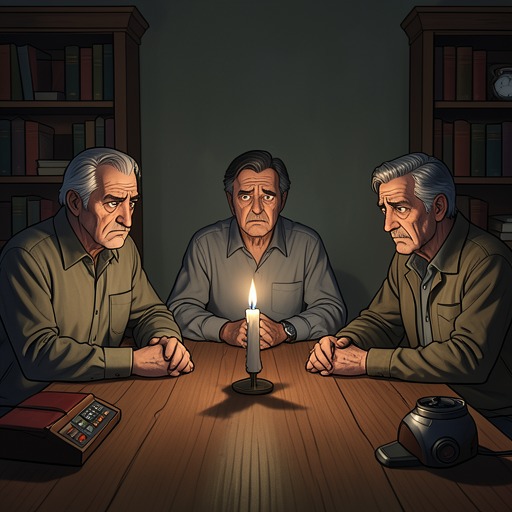
Davis Pickett and Russell Pickett’s father-son relationship
Turtles All the Way DownDavis Pickett and Russell Pickett’s father-son relationship shapes the family left behind by Russell’s disappearance: Davis is at once an angry son, an unwilling witness to his father’s choices, and the guardian who must absorb their consequences for Noah Pickett. Russell’s flight turns a relationship already marked by distance and conflict into a question of what a father owes his children—and what a son must do when the person he misses may also be guilty.
Family life and the last ordinary evening
Before Russell vanished, family life could still take the form of familiar routines. Noah later described playing Battlefront with Davis, eating pizza for dinner, and spending part of the evening with their father, who talked about how the Cubs were doing. Russell told Davis to do a better job of looking after Noah. Davis replied that he was not Noah’s father. Noah understood this exchange as part of the brothers’ usual sniping, but the disagreement already contained a central strain in the family: Russell assigned Davis responsibility for his younger brother even as Davis resisted being placed in a parental role.
Noah also remembered Russell putting a hand on his shoulder before going upstairs. The touch felt unusually firm, almost painful, and then Russell let go and left. Noah did not see him again after his father said good night. In retrospect, the ordinary details of that evening—the game, the pizza, the Cubs, the brief physical contact—acquire the weight of a final family scene. There was no visible farewell that Noah could recognize as one.
Davis later connected the moment of Russell’s disappearance to hearing his father’s full name on the news. Hearing the broadcasters identify Russell Davis Pickett as missing made Davis acutely aware of the shared name: his father’s name was also his own, and the name was being spoken publicly while Davis himself was still at home. That strange proximity between the news story and his private life prompted him to think of Aza Holmes and the significance of having a name of one’s own.
Abandonment, anger, and the missing father
Davis speaks of Russell with open contempt. He describes his father as a coward who left before he could be arrested, and says that Russell has a history of getting away with things. Davis believes the reward for information about his father—one hundred thousand dollars—cannot compete with the larger sums Russell could offer people to keep quiet. His calculation makes the disappearance feel less like a mystery detached from family life than an extension of Russell’s power: even absent, he can shape what people say and what they risk by saying it.
That anger does not mean Davis has stopped wanting his father back. He says he wishes Russell were there, but has wished for that for a long time. In his view, his father had disappeared emotionally well before he disappeared in fact. Russell’s physical flight therefore confirms an older loss rather than creating it from nothing. Davis can describe his father as selfish and still register the ache of his absence; the two responses remain side by side rather than resolving into either forgiveness or indifference.
Davis also understands the disappearance through its effect on Noah. He fears that learning the truth while still young would make the experience of his father’s arrest harder for his brother. He would rather Noah be older—sixteen, fourteen, or eighteen—if Russell were eventually caught. At the same time, Davis says that if his father were found because he tried to contact his sons, that would be bearable. What he fears most is Russell being caught without having reached out: Noah still believes their father loves them, and Davis anticipates how devastating it would be for that belief to collapse without even the evidence of an attempted return.
A father’s failures and a son’s unwanted care
Russell’s absence makes Davis responsible for Noah in both law and daily life. Davis has been declared an emancipated minor and is Noah’s legal guardian; there are no relatives with whom the Pickett family has a good relationship. The family’s affairs are formally managed—the estate’s financial administration and the house’s operations have designated oversight—but those legal arrangements do not themselves provide a parent in the home. Davis is left with the practical and emotional work of caring for a younger brother while still being a teenager himself.
That work becomes increasingly difficult as Noah struggles. Davis describes his brother as isolated, falling behind on homework, and not reliably taking showers. When Noah is suspended from school again after bringing marijuana at thirteen, Davis sees the behavior as possibly inviting trouble, but has no clear way to reach him. He says Noah needs a father, even a bad one, and admits that neither he nor Lyle can fill that role. When Noah climbs into bed with Davis and cries, Davis lends him his Iron Man action figure. The small act of comfort sits beside Davis’s larger helplessness: he can stay with Noah, but cannot restore the father Noah still expects to come home.
Davis recognizes the painful change in Noah’s picture of Russell. Noah once thought of the person responsible for him as a protector; now he is beginning to suspect that the man he imagined as a hero may instead be a villain. Noah continues hoping that Russell will return and prove his innocence, while Davis knows that his father is not innocent. The brothers therefore inhabit different stages of the same loss: Davis has already reached a judgment that Noah is only beginning to face.
Inheritance, silence, and the choice to tell
Russell’s will compounds the family rupture. He has arranged for his estate to benefit Tua, his pet tuatara, and ultimately a trust supporting tuatara, rather than leaving the fortune to his sons. Davis says that he and Noah have enough for college, though they will not inherit the larger wealth. He does not claim that his father owes them money; what he wishes for instead is the ordinary work of fatherhood—taking Noah to school, making sure he does his homework, and not disappearing in the middle of the night to escape prosecution. The contrast is stark: Russell makes provision for an animal and a scientific legacy while leaving his sons to manage the everyday consequences of his absence.
For a time, Davis withholds what he knows about the photograph that could help locate his father. He does not want Russell brought to trial while Noah is still young, and he does not want his brother exposed to the spectacle of the case at school. He also says that he would not have stopped Russell from leaving if his father had told him he was going. This is not a claim that the flight was harmless; it is an admission of how little control Davis believes he had over Russell, and how much he prefers the father’s absence to the public return of a father in disgrace.
When Aza eventually tells Davis that the clue points to the mouth of Pogue’s Run, near the company’s unfinished tunnel project, Davis is frightened but listens. He later explains that the uncertainty was consuming Noah. He decides that his brother needs to know why their father has not contacted him more than he needs the money, and that he has to act as Noah’s big brother. Davis and Noah report Russell’s location to the police. News reports subsequently identify a body found in an offshoot of the Pogue’s Run tunnel as likely Russell’s; authorities believe he died of exposure within days of disappearing. The report confirms the loss without undoing the long period in which the sons had to live without knowing.
What remains between them
Russell’s disappearance and presumed death do not produce a simple reconciliation or a clean severing of the bond. Davis grieves a father he condemns, and resents the way Russell’s choices have made him responsible for Noah. Yet when Noah needs an answer, Davis chooses the truth over the protection that silence and inherited money might have offered. His decision marks a change in his understanding of his role: he cannot make Russell act as a father, but he can take responsibility as a brother.
The relationship is thus remembered through contradictions rather than a single final judgment. Russell could talk baseball, place a hand on Noah’s shoulder, and tell Davis to look after his brother; he could also flee prosecution, leave Noah hoping for his return, and make Davis perform the care he had assigned but never consistently supplied. Davis’s eventual disclosure does not repair that history. It gives Noah an explanation, and gives the brothers a way to face their father’s absence together.