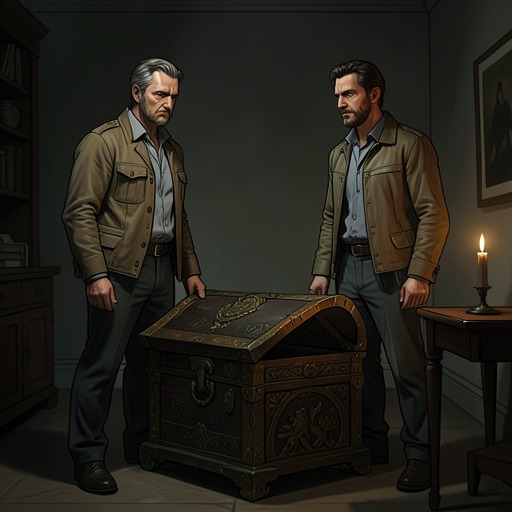
Davis offers $100,000 for their silence
Turtles All the Way DownDavis Pickett offers Aza Holmes $100,000 in exchange for keeping a night-vision photograph from the police, turning evidence about his missing father into both a secret and a test of trust. The offer is not made in a boardroom or through a formal negotiation: Davis retrieves hidden cash from cereal boxes in a family cabin, gathers it into a blue tote, and gives it to Aza himself. Her acceptance carries the bargain beyond the two of them, implicating Daisy Ramirez and altering how the friends think about money, loyalty, and the possibility of reporting what they know.
The photograph and Davis’s stakes
The offer follows Davis’s discovery that Aza and Daisy have seen a night-vision picture. He understands its importance more clearly than Aza initially lets on: it gives investigators a time and a place connected to Russell Pickett’s disappearance. Aza says that she and Daisy will not give it to the police, though Daisy wants to. Davis does not take reassurance as proof. He asks whether they have turned it over and presses on how he could ever know what Aza’s intentions are, including whether she is approaching him because of a possible reward.
Davis explains why he wants the photograph withheld. He fears the consequences for Noah Pickett if Russell is put on trial, and he does not want the brothers’ school lives to become entangled in the case. He wants things to be as they were; in his view, his father’s continued absence is closer to that familiar arrangement than his father’s return to face prosecution. He also acknowledges that Russell never told him he was leaving, but says he would not have stopped him if he had. His reasoning makes the secrecy more than a calculation about money: it reflects a son’s wish to preserve an imperfect status quo, even while recognizing the hurt and uncertainty within it.
Cash hidden in the cabin
After explaining his concern, Davis abruptly gets up and heads for the cottage, calling the problem solvable. Inside the rustic cabin, amid wood paneling, a large fireplace, and animal heads on the walls, he opens a cupboard above the sink and shakes cereal from a box of Honey Nut Cheerios. Along with the cereal, a paper-banded bundle of bills falls into the sink. Its wrapper says $10,000. Davis finds more bundles in that box and in a box of shredded wheat puffs, brushing cereal dust from the hundred-dollar bills as he stacks them beside the sink.
The small size of each bundle makes the total feel startlingly unreal: Davis says the stacks amount to $100,000, a sum that fits in one hand. He explains that Russell hides cash throughout the house, including a bundle Davis recently found inside the living-room couch. The hidden money makes the offer possible, but also gives it a particular family context: Davis is using wealth accumulated and concealed by the father whose disappearance has left him and Noah to manage the aftermath.
Davis says authorities found about $2 million while executing a warrant, but he believes they did not find even half of the cash Russell had hidden. For Russell, Davis says, this offer is a rounding error. He calls it a reward for not sharing the photograph and says the family lawyer can contact Aza. The language is transactional, and the transaction is explicit: Aza is being given money in return for silence about evidence that might help locate Russell.
A gift that is also a test
The cash does not resolve Davis’s anxiety about why Aza might remain in contact with him. He tells her that if she still calls or texts, he will know that the relationship is not about the reward—and that she will know it too. He makes clear that even continued contact cannot give him certainty, yet offers that uncertainty as part of the bargain. The money is therefore not only payment for withholding the photograph. It becomes a test of whether a friendship can continue after a large financial transfer has made its motives newly open to question.
Davis puts the bills in a blue tote bag and offers it to Aza. She resists, saying she cannot take it, but eventually accepts. At that moment, the narration describes Davis as looking like a child, with watery brown eyes and fear and fatigue in his face. The contrast between the immense sum and his vulnerable appearance complicates the exchange: he can draw on his father’s hidden fortune, but he is still a teenager trying to keep his brother’s life and his own from being overtaken by the disappearance.
Aza promises that she will call. Davis answers cautiously. His hesitation leaves the scene without a settled guarantee that money can buy trust; what it has done is place trust under pressure. Aza carries the bag away, and the private decision between them immediately becomes a decision affecting Daisy as well.
Daisy, the money, and its consequences
When Aza later tells Daisy there is a bag beneath the car seat, Daisy opens it and reacts with disbelief. She cries—an unfamiliar sight to Aza—and asks whether the money is real. Aza explains that Davis would rather give them the reward than have them snooping around. They understand the $100,000 as $50,000 apiece and decide to keep it. Daisy rejects the idea that refusing the money would be morally superior simply because accepting it is uncomfortable. She also points out that Davis’s wealth came through his father, a connection that makes the distribution feel less like an ordinary payment for work than an unequal transfer within an already unequal social world.
Aza remains troubled by the possibility that the cash is dirty or that she is exploiting Davis. Daisy’s response does not make those misgivings disappear so much as challenge the assumption that turning down money is inherently noble. Their discussion shows the offer changing the terms of their friendship as well as their investigation: the two friends now share both the secret and its financial benefit. Months later, Aza tells her mother that Davis gave her about $50,000, that she has not spent it, and that she is saving it for college. Her mother asks when she received it; Aza says it was a couple of months earlier and describes it as a gift.
The secrecy also has consequences beyond the cash. When Aza later considers telling Davis where Russell may be, she says she will tell Davis but not the police. Her stated fear is that, if Russell is dead, the Pickett home would cease to belong to the family and pass to a tuatara under the terms of his estate. Russell had publicly announced that his estate would benefit Tua during the animal’s life and then a trust for tuataras; the extraordinary provision makes the brothers’ home and security part of the stakes surrounding what the photograph and other evidence might reveal. The novel distinguishes this practical concern from the legal status of the disappearance: Indiana law treats a missing person as legally alive until evidence of death emerges or seven years pass, while Davis has been declared an emancipated minor and is Noah’s legal guardian.
The later news that authorities have found a body in an offshoot of the Pogue’s Run tunnel does not establish that Aza or Daisy broke their promise. The report says the body has not been positively identified, though investigators believe it is Russell’s, and says police found it after an anonymous tip. Aza immediately texts Davis that she is sorry and assures him that neither she nor Daisy gave the police information. The offer’s meaning thus outlasts the handoff: it binds the friends to a secret, leaves Davis unsure whether affection can be separated from money, and makes the eventual discovery of Russell’s likely death a further test of what they promised one another.