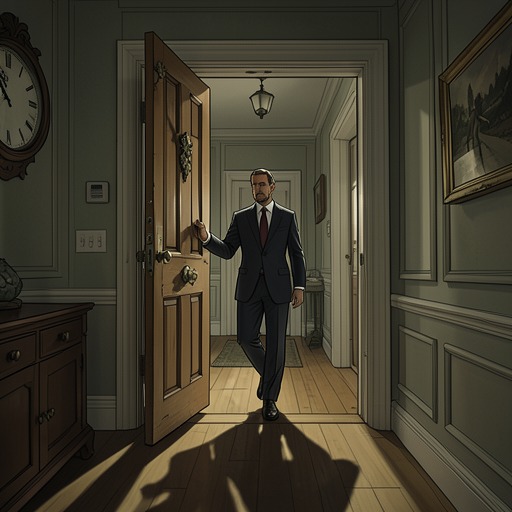
Pogue’s Run tunnel
Turtles All the Way DownPogue’s Run tunnel is an unfinished construction project whose neglected watercourse leads Aza Holmes and Daisy Ramirez to identify the “jogger’s mouth,” a location tied to Russell Pickett’s disappearance. The tunnel first draws them underground for a one-night art exhibition; its unfinished outlet then changes the visit into a consequential clue. The place joins the book’s civic and personal mysteries in a single physical space: a public work left incomplete, an improvised gallery, and a possible hiding place whose significance Aza carries back to Davis Pickett.
Setting and unfinished project
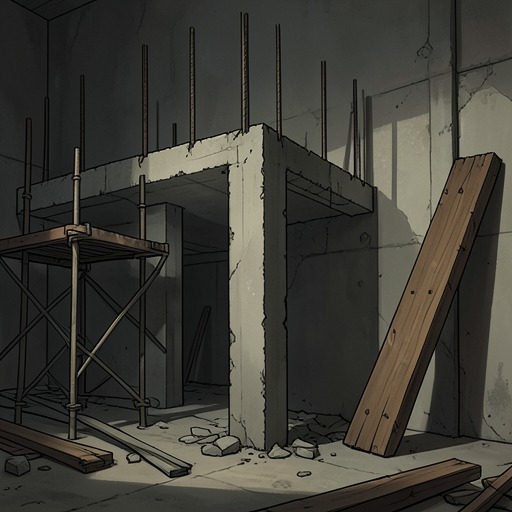
Pogue’s Run tunnel is a concrete channel associated with the stream that empties into the White River. Pickett Engineering had been hired to expand it, but the work was never finished. At its far end, the tunnel remains open rather than delivering the expected result of the project: a small flow that was supposed to be diverted from the White River instead drips into it from two stories above. The unfinished infrastructure is not merely background. Its incomplete course and exposed outlet provide the physical basis for Aza and Daisy’s later recognition of the place as the mouth of Pogue’s Run.
The approach makes the tunnel feel remote even though the group has gathered nearby. From a parking lot, Aza and Daisy see a flashlight moving through the trees, then follow it down a small hill to a wide concrete basin. A tiny stream runs across the basin’s bottom. A bearded guide named Kip gives them hard hats fitted with lanterns, along with a flashlight, and directs them two hundred yards into the tunnel before the first left turn. Near the culvert entrance, an overturned shopping cart is wedged against a moss-covered boulder; above it, leafless maple trees cut dark shapes against the sky. The route descends from an ordinary parking area into a piece of infrastructure that is at once accessible and out of sight.
The underground gallery
The tunnel hosts Underground Art, a one-night exhibition organized by the arts collective Known City with permission to use part of the site. Daisy urges Aza to attend because Mychal Turner has submitted a photographic montage to the show. She frames the invitation as a chance to support her friend’s work, while Aza is reluctant to spend Friday night at an underground gallery. The distinction between illegal and underground matters: the exhibition is authorized, even as its literal location gives it the atmosphere of an event hidden beneath the city.
Inside, the creek runs along the tunnel’s left side, while visitors walk on a raised concrete sidewalk to the right. The air smells of sewage and rot, and the smell does not fade as Aza expects. Daisy remarks on the surroundings; Aza thinks of the watercourse as belonging to the place and the people moving through it as invaders. Their headlamps and flashlights make the visitors appear as moving beams of light, gathering in small groups in the darkness. To enter the gallery proper, they jump across the trickling creek and pass a sign identifying the site as a Pickett Engineering project before turning into a square side tunnel about eight feet high.
The works are visible only where the portable lights fall, so the wall-mounted photographs and paintings seem to emerge and recede from view. Mychal’s image, Prisoner 101, is assembled from pieces of one hundred mugshots of men convicted of murder and later exonerated. A visitor must stand against the opposite wall to see the whole picture; even close up, Aza cannot distinguish the composite from a real person. The exhibition also includes large geometric abstract paintings, old wooden chairs stacked precariously toward the ceiling, and a large photograph of a child jumping alone on a trampoline in a harvested cornfield. The setting makes viewing itself dependent on movement and distance: the image resolves only from across the narrow tunnel, under shifting beams of light.
From the gallery to the outlet
After leaving the exhibition, Aza and Daisy continue through the tunnel rather than turning back at an offshoot. The worsening smell—like rotting garbage and unflushed toilets—makes Daisy want to return, but Aza sees a pinprick of gray light ahead and wants to find what lies beyond it. As they approach, sounds from the city grow louder and the air improves. The gray opening expands into the unfinished end of the tunnel, where the trickle falls toward the White River below.
The opening gives them an unexpected view over Indianapolis at night. From the elevated edge, Aza can see moss on the river boulders, froth at the base of the falling water, trees bent over the river, sagging power lines, a grain mill, and the distant neon signs of Speedway and Chase Bank. The city is usually too flat to offer a view from above; here, an abandoned piece of infrastructure creates one. The scene’s beauty is inseparable from the project’s failure: the light and height that make the view striking are encountered at the unfinished outlet of a work meant to alter the water’s course.
The jogger’s mouth and its consequence
At the outlet, Aza asks where Pogue’s Run begins, then recognizes that a river’s mouth is where it ends. Daisy makes the connection: this is the mouth of Pogue’s Run, and therefore the location they have been trying to identify as the jogger’s mouth. The realization changes the tunnel’s meaning at once. It is no longer only the strange venue for Mychal’s exhibition or the terminus of an abandoned engineering project; it is a possible location connected to Russell Pickett. Aza feels uneasy at the exposed edge and imagines that Pickett might be behind them, but the scene does not establish that he is there.
Aza later tells Davis Pickett that she knows where the jogger’s mouth is: at the mouth of Pogue’s Run, where his father’s company had the unfinished project. Davis winces and asks whether she is sure. Aza answers that she is pretty sure and says she thinks Russell may be down there, explaining that she and Daisy visited the previous night. Her report carries the discovery out of the tunnel and into the Pickett family’s search, while preserving the uncertainty of what the location proves. The tunnel’s significance rests on that distinction: its geography gives Aza a concrete lead, but the unfinished, open end is not itself confirmation of Russell Pickett’s whereabouts.