Police report on Russell Pickett’s disappearance
Turtles All the Way DownThe Police report on Russell Pickett’s disappearance is an official record that seems, at first, to describe an ordinary evening and an orderly house. Its witness statements, photographs, and missing-person details help Aza Holmes and Daisy Ramirez reconstruct the night Russell disappeared; its omissions matter just as much. The report shows what the police had gathered, but also what they did not know, giving Aza and Daisy a partial timeline that shapes their investigation and their decisions about what to tell authorities.
Acquisition and reading
Daisy obtains the report through an impersonation rather than a technical breach. After identifying the Indianapolis Star article about the disappearance and its reporters, she creates an email address resembling that of Sandra Oliveros, then writes to Adam Bitterley, the reporter she judges to be junior to Oliveros. When Bitterley says he cannot send the file from his home computer, Daisy insists that he go into the office and do his job despite it being Friday night. He eventually emails her scans. The episode establishes the report as information that can be reached through social pressure and a false identity, not only through formal access or computer hacking.
Aza reads the missing-person report on her phone during biology class, returning to it whenever Ms. Park turns to the blackboard. The document is only a few pages long, and she finishes it over the course of the school day. Its bureaucratic compression contrasts with the gravity of the disappearance: personal habits, physical identifying marks, and other household details are condensed into a file that Aza and Daisy will scrutinize for clues.
Description of Russell and the night he vanished
The report describes Russell as fifty-three years old, male, gray-haired, and blue-eyed, six feet tall and approximately 220 pounds. It records a tattoo on his left shoulder blade reading Nolite te bastardes carborundorum, three small abdominal scars from gallbladder surgery, and the clothes he usually slept in: a horizontally striped navy-and-white nightshirt and light-blue boxer shorts. Police discovered him missing at 5:35 A.M., when they raided his house in connection with a corruption investigation. The report’s account thus places the disappearance at the intersection of a personal absence and an active investigation into Russell’s business affairs.
The witness material offers no direct account of Russell leaving. The report mostly consists of statements from people who did not witness the disappearance; according to Aza’s reading, only Noah Pickett and Davis Pickett were in the house that night. The entrance camera recorded two groundskeepers driving away at 5:40 P.M. Malik the Zoologist left at 5:52, followed by Lyle at 6:02 and Rosa at 6:04. These times support Lyle’s earlier assertion that no staff remained in the house at night, narrowing the apparent pool of witnesses without explaining what happened after the household settled in.
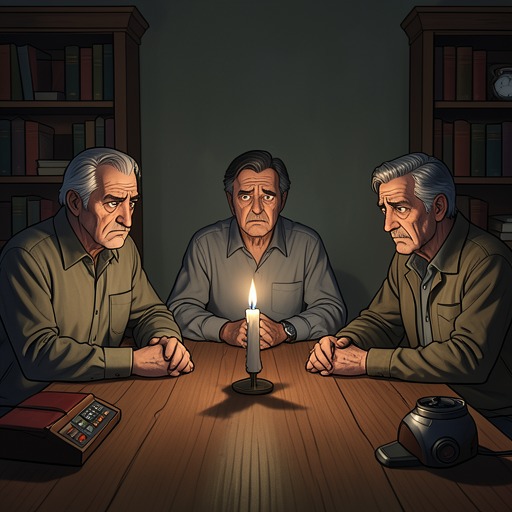
Davis’s statement describes a routine evening. Rosa had left pizza; Davis and Noah ate while playing a video game, and Russell came downstairs briefly to eat with them before returning upstairs. Davis said his father had not seemed anxious and that nothing about the day appeared unusual. After dinner, the brothers put their dishes in the sink; Davis helped Noah with homework, then read on the couch while Noah played. Davis went upstairs around ten, did homework, looked through his telescope at Vega and Epsilon Lyrae, and went to bed around eleven. He reported seeing nothing unusual through the telescope, explaining that it was made for viewing the sky, not the ground.
Noah’s account also begins with Battlefront and pizza, but it includes a more uneasy moment. Russell discussed the Cubs, told Davis to do a better job of looking after Noah, and drew a sharp reply from Davis that he was not Noah’s father. As Russell left, he put a hand on Noah’s shoulder and held it tightly enough that Noah felt it almost hurt; then he let go and went upstairs. Noah played for a few more hours, went upstairs around midnight, and did not see his father again. The detail does not establish what Russell intended, but it makes the apparently ordinary evening harder to read as wholly unremarkable.
Photographs, omissions, and an investigative timeline
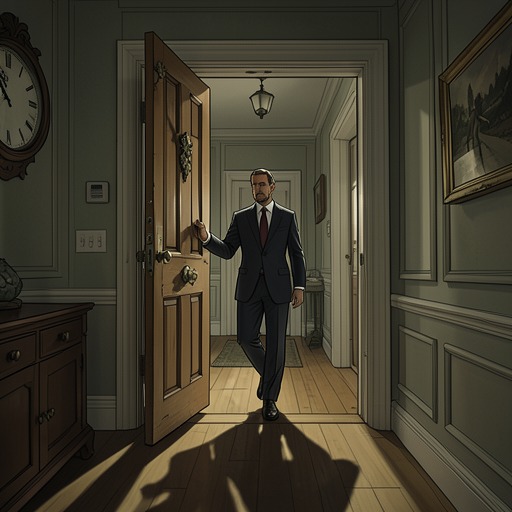
The report includes almost a hundred photographs of the house’s rooms. They depict little visible disruption. In Russell’s office, stacks of papers look as if they have been left for an evening rather than abandoned for good; a cell phone remains on his bedside table. A single set of footprints leads to his desk and another leads away. His suits remain arranged in the closets from lightest gray to darkest black, and a kitchen photograph shows three dirty dishes marked with pizza grease and tomato sauce. These ordinary objects make the disappearance feel less like a departure prepared in advance than an absence imposed upon a still-in-use home.
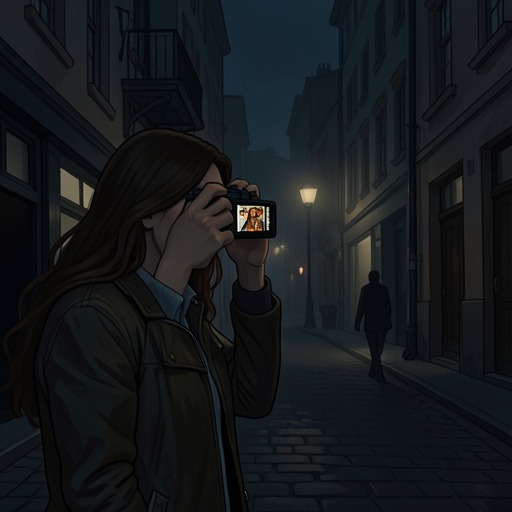
Most consequentially for Aza and Daisy, the police report does not mention the night-vision photograph they already possess. That absence means their evidence provides a timeline the police file lacks. The report is therefore not a complete account against which the girls can simply check their suspicions: its silence marks a difference between what the authorities have collected and what the two friends know. When Daisy asks whether Aza noticed anything, Aza concludes that the police seem to know slightly less than they do. Daisy then connects that gap to the reward, reasoning that information helping authorities find Russell’s whereabouts could be valuable even if they do not know his exact location.
Legal stakes and later significance
The missing-person report sits within a legal situation that makes the question of Russell’s fate consequential for his sons. Davis has been declared an emancipated minor and is Noah’s legal guardian; no other relative is described as having a good relationship with the family. Russell’s legal status also remains distinct from proof of biological death: the legal explanation given to Aza is that Indiana considers a missing person alive until evidence of death emerges or seven years pass from the last evidence of life. In the meantime, financial affairs, the house, and guardianship are handled through separate legal and administrative roles, a structure that does not answer Aza’s more immediate concern about who will actually care for Noah.
The inheritance makes that legal uncertainty especially stark. A newspaper article reports that Russell intended his estate to benefit Tua, his tuatara, until her death, and then a trust for tuatara everywhere. Later, when Aza tells Daisy she will inform Davis but not the police, she explains that if Russell is dead in the tunnel, Davis and Noah could lose the house to a tuatara. The report itself does not resolve the inheritance or establish Russell’s fate, but it belongs to the chain of information that makes the girls’ choice about disclosure carry consequences beyond the search.
A month after Christmas vacation ends, a television report says that a body found in an offshoot of the Pogue’s Run tunnel is believed to be Russell’s, though he has not been positively identified. Sources say he likely died of exposure within a few days of disappearing and that police found him after an anonymous tip. Aza texts Davis her condolences and insists that neither she nor Daisy informed anyone. In retrospect, the police report’s decisive role is not that it solves the disappearance: it records a routine evening, preserves a few unnerving details, and leaves out the image that gave Aza and Daisy their separate timeline. Its documented facts and missing evidence together make the file a measure of how much remains unknown.