The host-and-parasite metaphor
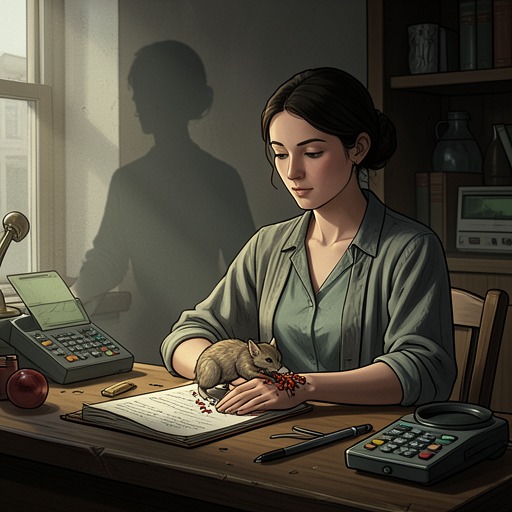
Turtles All the Way DownThe host-and-parasite metaphor gives physical form to Aza Holmes’s fear that the self may not be singular, pure, or fully in command of its own story. It begins with the microorganisms she imagines living inside her, but expands through a parasite’s control of a fish into a question about agency: if an organism can mistake its own interests for its host’s, how can a person be certain that their thoughts and choices are truly their own?
The body as a crowded home
At lunch in the White River High School cafeteria, Daisy Ramirez asks Aza whether she is listening. Aza is preoccupied instead by the cacophony of her digestive tract and by the fact that the human body is, by cell count, approximately half microbial. She thinks of the microbes in her own biome as an immense population, greater in number than the people on Earth, living, breeding, and dying in and on her. This is not a detached scientific observation for her: it makes the boundary between person and organism feel unstable and invasive.
That bodily unease draws Aza away from the conversation around her. She searches online for information about the human microbiome and Clostridioides difficile, focusing on abdominal noise as a possible symptom even though she has none of the other symptoms she reads about. Her attention moves from an ordinary bodily sensation to a feared infection, then to the disturbing thought that half the cells composing a person are not human. The metaphor’s first pressure, then, comes from the difficulty of locating a self that is separate from the life inside its body.
Aza connects this problem of bodily boundaries to the idea of a soul. In a conversation with Dr. Karen Singh, she describes feeling less like a human person than a teeming mass of bacteria, with no clean or untouched inner place where a soul might reside. If the self cannot be separated from its microbial inhabitants, she reasons, perhaps it has no greater claim to a soul than they do. The fear is not simply that the body is dirty; it is that there may be no hidden, uncontaminated core behind the body at all.
From microbes to authorship
The cafeteria thought develops into a recursive challenge to personal identity. If so much of a person’s body consists of organisms that are not conventionally considered part of the human self, Aza wonders whether the singular pronoun me can describe a unified person, much less an author of her own fate. The thought carries her out of the sensory world of the cafeteria and into an inward loop from which she struggles to return. Biological interdependence becomes an argument against the easy assumption that a person is a self-contained unit.
The metaphor becomes more frightening when Aza tells Davis Pickett about Diplostomum pseudospathaceum. The parasite matures in the eyes of fish but can reproduce only in a bird’s stomach. While immature, it causes infected fish to swim in deep water, away from birds; when it is ready to reproduce, the fish instead move near the surface, where birds can spot and eat them. The parasite thereby redirects the fish’s behavior toward a destination that serves the parasite’s life cycle. After reaching a bird, it reproduces, and its offspring return to the water in bird droppings, where they can encounter fish and begin the cycle again.
For Aza, the force of this example lies in the gap between the fish’s apparent actions and the interests those actions serve. She identifies with the fish and fears that her own life story, too, might be authored by something other than herself. She knows she is not explaining the concern clearly, and recognizes that the conversation has wandered from a moment of closeness with Davis to a discussion of parasite-infected bird feces. Yet the digression is itself telling: the fear is so urgent that she cannot simply put it aside in order to preserve the intimacy of the moment.
Pain, reality, and uncertainty
Aza also confides in Davis something she has not told Daisy Ramirez or Dr. Singh: as a child, she pressed her thumbnail into her fingertip to reassure herself that she was real. Her mother had told her that pinching oneself and remaining asleep could show that one was not dreaming. When Aza doubted her reality, she used pain as evidence that she existed. The small gesture offered a momentary answer, but the fish analogy unsettles that answer: a fish can feel pain too, and pain alone cannot prove that the one experiencing it is directing its own life.
The physical gesture also persists into Aza’s present as a source of distress. She has pressed her right thumbnail into the pad of her middle finger for so many years that a callus has formed over her fingerprint. She worries that the resulting crack in the skin may be infected, covers it with a Band-Aid, and can feel compelled to reopen the wound and press out blood. Dr. Singh has suggested exposure response therapy, including touching the callused finger to a dirty surface without cleaning it or covering it, but Aza is afraid to try again. The metaphor therefore remains attached to concrete routines of fear and bodily care; it does not replace those experiences with an abstract philosophical puzzle.
The metaphor beyond the body
In speaking with Davis, Aza links the parasite’s reversal of roles to a broader observation about power. Davis says that many adults are hollowed out by what they try to use to fill themselves, naming money, alcohol, God, and fame; he describes his father, Russell Pickett, as having disappeared long before his actual disappearance. Aza answers with the idea that the parasite believes itself to be the host. In this exchange, the image reaches beyond microbes: something that appears to possess or control power may instead be governed by the very force it thinks it commands.
Davis’s brief agreement does not resolve Aza’s fear, but the exchange places the metaphor within a relationship rather than leaving it as a private spiral of thought. She risks telling him about the parasite, her fear that another force may be authoring her story, and the childhood ritual by which she tried to establish her reality. Across these scenes, the host-and-parasite metaphor does not establish that Aza lacks agency. It gives language to her uncertainty about where agency begins, how a self can be distinguished from what lives within it, and whether feeling real is the same as being in control.