Unfinished Pogue’s Run tunnel
Turtles All the Way DownThe Unfinished Pogue’s Run tunnel is a failed water-management project that becomes an underground art gallery, an unexpected vantage point over Indianapolis, and the location of a crucial realization about the jogger’s mouth. Its unfinished passage makes the consequences of Pickett Engineering’s work physically visible: water still follows an improvised course through a polluted tunnel, while the opening at its end leads Aza Holmes and Daisy Ramirez to connect the site with Russell Pickett’s disappearance.
Project and Setting
Pogue’s Run was the tunnel that emptied into the White River. Pickett Engineering had been hired to expand it, but the work was never completed. The incomplete project is not simply background to the events in the tunnel: the construction sign and the exposed, still-functioning watercourse place the Pickett company’s abandoned work directly in the characters’ path.
The tunnel also occupies a boundary between the city and the river. On the route to the gallery, a small stream bubbles along the bottom of a concrete basin. The entrance is a square opening in a hillside; just outside it, an overturned shopping cart is trapped against a moss-covered boulder. Inside, the creek runs along the left side while Aza and Daisy walk on a slightly raised concrete sidewalk to the right. The passage smells of sewage and rot, and the smell persists as they move farther in. These details make the tunnel an inhabited, deteriorating urban space rather than an abstract engineering project.
The Tunnel as Gallery
The unfinished passage is used as the setting for Underground Art, a one-night exhibition organized by Known City. The event is described as underground in both its location and its cultural character, but it has permission to take place there. A bearded guide named Kip meets visitors in the basin, hands Aza and Daisy hard hats fitted with lanterns along with a flashlight, and directs them two hundred yards into the tunnel before their first left turn.
That route brings the visitors across the creek and past a sign identifying the site as a Pickett Engineering project. They enter an approximately eight-foot-high square side tunnel, where the artwork is visible only in the shifting beams of headlamps and flashlights. Mychal Turner’s Prisoner 101, assembled from pieces of one hundred mugshots of men convicted of murder and later exonerated, must be viewed from across the passage to come together as a whole. In the unstable light, Aza finds it convincingly lifelike. The exhibition also includes large geometric paintings, wooden chairs stacked precariously toward the ceiling, and a photograph of a child jumping alone on a trampoline in a harvested cornfield. The gallery briefly gives the failed infrastructure another use: instead of concealing its roughness, the artworks are encountered within it.
The Unfinished Opening
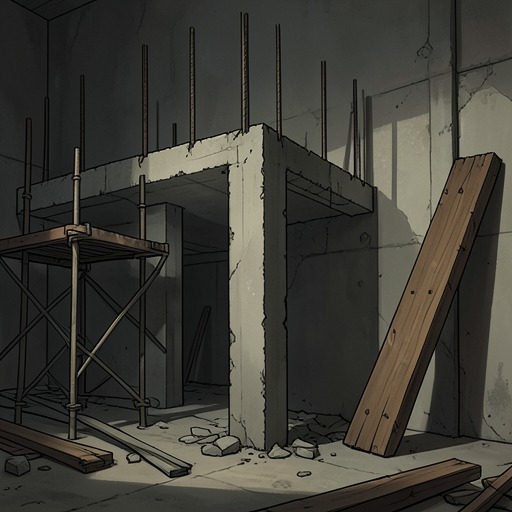
After the exhibition, Aza and Daisy continue through the tunnel. The odor grows worse, and when Daisy suggests turning back at an offshoot, Aza keeps going because she can see a small patch of gray light ahead. As they approach, the city’s sounds grow louder and the smell eases with the increasing proximity of open air. The tunnel ends at an open, unfinished section. Water that was supposed to be diverted from the White River instead drips down into it from two stories above.
The opening offers a view that contrasts with the cramped, foul passage. Past ten at night, Aza can see moss on the river’s boulders, frothy water beneath the fall, trees bent over the river, sagging power lines, a grain mill, and the neon signs of Speedway and Chase Bank. The city’s flatness usually denies its inhabitants a high overlook; here, the unfinished tunnel unexpectedly supplies one. The brightness is disorienting enough that Aza takes a moment to register that it is nighttime. The view is beautiful, but its position above the exposed water also keeps the project’s failure in sight: the scene’s unexpected grandeur depends on the very opening the unfinished work has left behind.
Recognition and Consequence
At the tunnel’s end, Aza’s recollection that Pogue’s Run is the waterway’s name prompts her to ask where it begins and where its mouth is. Daisy explains that a river’s mouth is where it ends. Looking at the tunnel’s opening, the two recognize that they are at the jogger’s mouth. The insight converts a place they visited for an art show into a possible lead in the mystery surrounding Russell Pickett. The tunnel’s physical course and its name now matter as evidence, not only as scenery.
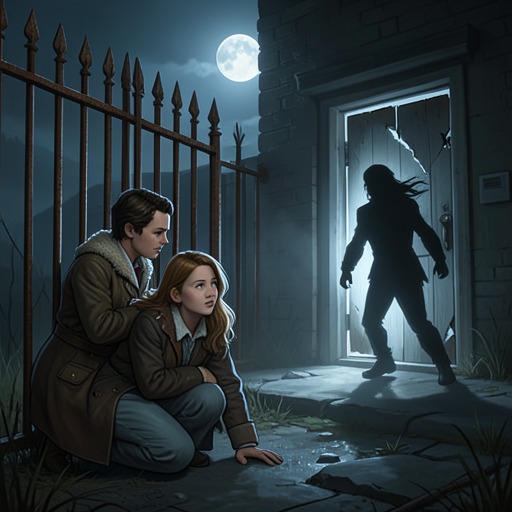
The discovery also changes how Aza experiences the site: she suddenly fears that Russell Pickett may be behind them and might push them over the edge into the river. The fear is not proof that he is there, but it marks the shift from observation to suspicion. Later, Aza tells Davis Pickett that she knows where the jogger’s mouth is, identifying it as the mouth of Pogue’s Run at the site of the unfinished company project. She says she thinks his father may be down there and explains that she and Daisy had visited the previous night. The tunnel therefore links the Pickett company’s abandoned work to the investigation while leaving the suspected location of Russell unresolved in this encounter.