Your life is a story told about you, not one that you tell
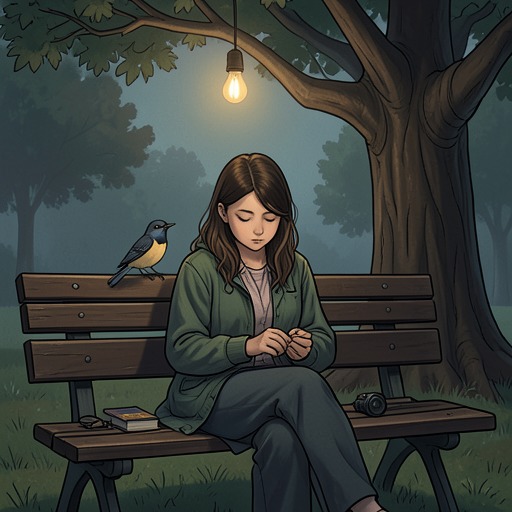
Turtles All the Way DownYour life is a story told about you, not one that you tell is an expression of Aza Holmes’s uneasy recognition that a person may experience life as authored from outside the self. Its force comes from the contrast between the feeling of making choices and the schedules, circumstances, and thoughts that shape what happens. The image of the painter and the canvas sharpens that contrast: the person who believes they are directing the picture may instead be the surface on which it is made.
Formulation and meaning
Aza first frames the idea through the apparently small structure of a school day. At White River High School, lunch is fixed between 12:37 P.M. and 1:14 P.M.; the bell, institutional routine, and the topic raised by her tablemates establish conditions she did not choose. She imagines that a different lunch period or conversation could have led to a different end—or at least a different middle. The expression therefore treats a life not as a sequence wholly directed by its subject, but as a story shaped by surrounding forces and contingencies.
The accompanying painter-and-canvas metaphor makes the apparent reversal explicit. A person may think they choose to go to lunch when the bell rings, yet the bell has already structured the choice. The metaphor does not claim that no action occurs; it draws attention to how the conditions and timing of action can precede any conscious sense of authorship.
An ordinary scene as evidence
The idea emerges amid the crowded cafeteria, where overlapping voices become a rush of sound and fluorescent lighting fills the room. Aza thinks of the students not as separate heroes of private epics but as organisms gathered in a windowless space that smells of Lysol and lard. The scene places the expression inside an ordinary, socially organized setting: each student may feel central to a personal story while sharing a room governed by schedules and common circumstances.
Even lunch becomes something Aza tries not to think about. She is eating a peanut butter and honey sandwich and drinking Dr Pepper, while finding the act of eating unpleasant to contemplate. Her effort not to think about it only brings the subject into thought again. This small contradiction echoes the expression’s larger concern: conscious intention does not necessarily control the experience that follows.
Thought, memory, and agency
Aza’s account of her thoughts gives the expression a more intimate meaning. She says she cannot choose her thoughts any more than she can choose her name, and describes them as something experienced like destiny rather than as a freely selected catalogue of consciousness. In childhood, her mother advised her not to think about her invasive thoughts; Davis understood that choosing not to think was not available to her in that simple way. The expression thus connects external circumstances with an inward limit on agency.
That limit also appears when Aza wants to speak to Daisy. She hopes to tell her that she likes her idea for Mychal’s art project and that she remembers Davis from when they were eleven. Instead, thoughts about her microbiome keep arriving, unbidden and unwanted. The memory she wants to share is specific: at camp, she and Davis lay beside each other on the edge of a dock, backs against the planks and legs dangling, looking at the same cloudless sky. Aza understands that shared attention as a form of intimacy, but in the present she cannot simply choose the thoughts that would let her voice it. The expression holds these two facts together: a life can contain meaningful attachments and memories while the person living it has only partial command over how they surface or are told.