Haven House Recovery Gardens
Unchosen By My CEO Husband: A Marriage In Crisis Second Chance RomanceHaven House Recovery Gardens is the recovery and wellness facility that becomes Jacinta Colt’s most complete act of self-definition. Conceived after her separation from Aaron Colt and built from the abandoned camp beside her grandmother’s home at Bellweather Cove, it turns the domestic systems once dismissed as evidence of instability into a public architecture of care. Its gardens, quiet rooms, labeled kitchen, four-color calendar, rails, and founder’s plaque make the place both a functioning refuge and a direct answer to the family and institutional structures that erased Jacinta’s name from the Renewal Centre.
Conception and Setting
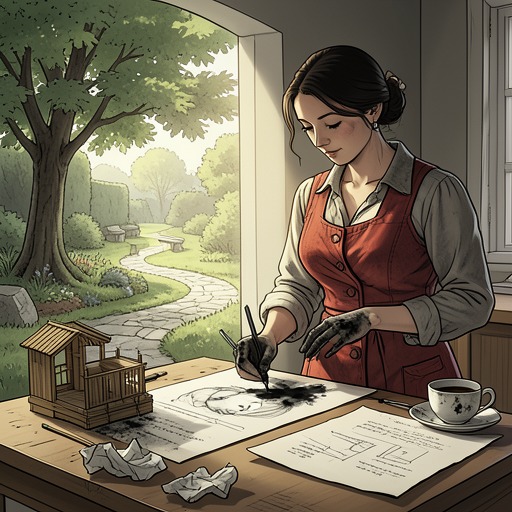
Haven House begins as a set of drawings rather than an approved institution. While staying at her grandmother’s place at Bellweather Cove, Jacinta sketches the old summer camp next door, shuttered for a decade, as a place that might be brought back into use. The recurring elements are gardens, quiet rooms, a kitchen, and a porch light left on. The camp’s derelict condition gives the project a physical starting point, but the design is driven by Jacinta’s memory of what helps a person whose mind can become overwhelmed: not abstract advice, but systems that make daily life navigable.
The design is unusually personal in its practical details. Jacinta places the gardens first because healing needs somewhere to walk. She imagines quiet rooms with soft light for days when the world is too loud, and a kitchen with labeled bins and a calendar in four colors. These are not ornamental features or generalized therapeutic symbols; they translate the domestic infrastructure she had already built into an environment meant to support other people. The porch light left on completes the design with an image of continued welcome, turning the former camp from a closed, unused property into a place that signals return and belonging.
Jacinta writes the name in the corner of her plan: “The Haven House Recovery Gardens.” Beneath it she identifies herself as “Founder and designer: Jacinta Colt.” The wording matters because the Renewal Centre had originated with her work but had been absorbed into a public structure that treated her as merely Aaron Colt’s wife. Haven House is planned from its first notation as a project in which the creator’s name is part of the institution’s foundation rather than an afterthought.
Transfer of the Renewal Centre Work
The new facility is connected directly to the professional injury surrounding the Renewal Centre. The Renewal Centre had grown from Jacinta’s first sketch on a takeout menu into a three-year project that received final board approval in May, yet the gala materials and social arrangements reduced her to a marital designation. At the pre-gala dinner, the place card reads “MRS. AARON COLT,” while Beatrice Colt, Celeste Colt, and Aaron each receive their own names. Even the empty seat reserved for Cassandra Vale bears her name. Jacinta is therefore denied not only credit but ordinary nominal presence.
Her response is investigative as well as emotional. In Aaron’s office she asks for the Vale contract and goes to the second drawer where he keeps important things. Beneath the contract she finds an unlabeled folder, the kind of concealed object she recognizes as a sign that someone is hiding information. This movement through the office and its drawers precedes the larger recovery of her work: the project’s paperwork, drawings, and plans are eventually removed from the custody of the foundation that had held them like collateral.
The transfer arrives in an envelope from an unfamiliar law firm while Jacinta is making bread with Theo Colt. It contains the Renewal Centre files, her drawings, her plans, and three years of her life. Everything has been transferred to Haven House Recovery Gardens irrevocably and without conditions. Jacinta reads the documents twice, searching for a hidden clause or a catch, but finds none. The project that once functioned as evidence of her erasure becomes material for the institution she controls.
Architecture of Care and Authorship
Haven House joins care to authorship. Its physical arrangement is designed around ordinary acts that protect people from needless confusion: labeled storage, a four-color calendar, quiet rooms with soft light, deep chairs, and paths broad enough for people to walk side by side. The facility does not separate emotional care from practical organization. Its design argues that reliable structures can be a form of compassion, especially for people whose behavior has been judged without attention to the environments in which they are expected to function.
The project also gives public value to work that had previously been treated as invisible. Jacinta had maintained a highly organized household, including labeled bins, children’s belongings prepared for school, and a color-coded calendar; nobody in that household had missed a dentist appointment since 2019. At Haven House, the same kind of labor is no longer absorbed into a wife’s presumed duties or used against her as a sign of disorder. It becomes intentional institutional design, recognized as professional knowledge and made available to others.
The question of credit is built into the walls. When the Gardens are completed, a plaque at child height reads “The Haven House Recovery Gardens. Founder and designer: Jacinta Colt.” The placement echoes Jacinta’s earlier work in the Bellweather Cove library reading room, where she installed a small brass plaque at a level young readers could touch: “Designed by Jacinta Colt.” In both places, authorship is made physically visible and placed within reach, not reserved for a ceremonial platform controlled by a dynasty.
Construction and Opening
The facility develops through local and professional cooperation. Noah works on the site, including the porch railing, rebuilding it one board at a time. The image becomes part of the project’s moral vocabulary: rails are promises because they offer support that must be dependable. Over the summer, Noah’s crew and half the town install beds of lavender, sage, and lake-country roses. They construct paths for walking side by side, add railings throughout the grounds, and finish the quiet rooms and kitchen according to Jacinta’s original plan.
The first public presentation takes place not in a grand gala room but at the Lake Counties Health Foundation’s grant day. The venue is a community hall with folding chairs and a projector older than Theo Colt. Sixty people attend. When Jacinta’s whole name is called—Jacinta Colt, founder and designer—something held tight for ten years finally loosens. She speaks for twenty minutes about reviving the old camp, the walking gardens, the soft-lit rooms, the organized kitchen, and the porch light. She also speaks about her brain deliberately and through her own account, taking control of a subject that others had used to define her publicly.
By ten o’clock on opening day, the old camp is full. Six women move in on Monday, six residents to begin with, and their names are to appear on everything they make. Jacinta has written that requirement into the charter in language a lawyer cannot undo. The institution therefore extends its authorship principle beyond its founder: residents are not anonymous recipients of care but people whose work and identities must remain attached to what they create.
Narrative Significance
Haven House is the spatial opposite of the settings in which Jacinta was diminished. The Colt household is governed by systems she maintains but does not fully receive credit for; the pre-gala dinner places her under a marital title; the gala’s gold wallpaper and service hallways surround the concealment of her work; and the foundation uses organizational authority to erase her name from her own project. Haven House reverses that arrangement by making design, naming, access, and care belong together.
Its importance is therefore not limited to the opening of a recovery facility. The Gardens convert the accusation that Jacinta is scattered or unstable into a challenge to the surrounding environment: perhaps the failure lies in systems that refuse to accommodate or recognize her, not in the person who has been carrying those systems. In Bellweather Cove, nobody calls her scattered or treats being overwhelmed as a diagnosis. At the library and later at Haven House, her ability to build workable spaces is seen as a contribution.
The completed Gardens also provide a durable answer to the earlier spectacle of public credit. Elliot Grant arrives from Chicago with Dana and gives Jacinta a frame containing the first page of the original Renewal Centre proposal, dated three years before any gala and marked with her initials. The document preserves the history that the foundation tried to absorb, while the finished building makes that history useful to people who now live there. Haven House thus becomes both archive and future: a place where Jacinta’s erased labor is restored to its creator and transformed into an ongoing structure of refuge.