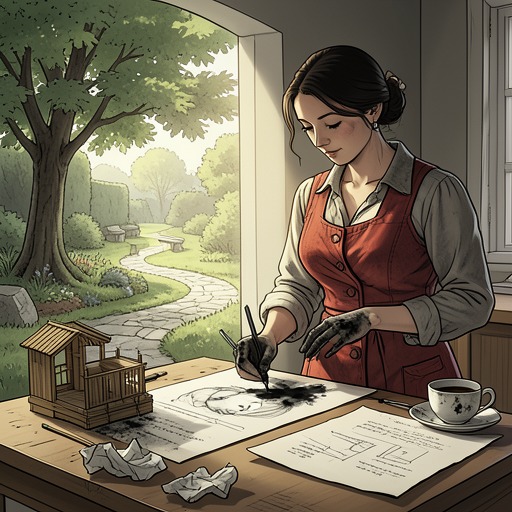
Haven House Recovery Gardens Grant Presentation
Unchosen By My CEO Husband: A Marriage In Crisis Second Chance RomanceThe Haven House Recovery Gardens Grant Presentation is the decisive public reclamation of Jacinta Colt’s authorship and civic identity. At the Lake Counties Health Foundation grant day, she presents a new recovery campus in her own name, explains its practical design, answers a question about the project once taken from her, and turns a history of erasure into a model of visible credit. The presentation also changes the meaning of Aaron Colt’s presence: he is no longer positioned as the man whose status can absorb her work, but as an audience member who stands and applauds her public ownership of it.
Preparation and Setting
The presentation is prepared in Jacinta Colt’s kitchen rather than in one of the formal spaces that have previously defined her life. On the night before, she lays out index cards in four colors while Willa Colt checks them against a whiteboard. Blue covers funding, green the gardens, and yellow the quiet rooms; red is reserved for questions about Jacinta’s husband. The color system gives the event a visible structure, but it also marks the pressure beneath the preparation: Jacinta must be ready to discuss not only a grant proposal but the marriage and institutional history that made her work disappear.
The grant day takes place in a community hall with folding chairs and an aging projector, attended by sixty people. Its plainness sharply contrasts with the chandeliered gala rooms, gold wallpaper, place cards, and carefully managed family spectacle associated with the Colt and Vale families. The room’s modest arrangement matters because it gives Jacinta a different kind of public space: one without dynastic staging, where the audience has come to evaluate a project rather than preserve a social hierarchy.
The Presentation and Its Design
When Jacinta Colt’s name is called in full, she is introduced as “Jacinta Colt, founder and designer.” That recognition releases a tension that has been held for ten years. She speaks for twenty minutes about the old camp brought back to life as Haven House Recovery Gardens: gardens that provide somewhere to walk during healing, quiet rooms with soft light for days when the world feels too loud, and a kitchen organized with labeled bins and a four-color calendar. These details translate her own methods of managing an overwhelming world into an environment intended to help other women.
Jacinta also chooses to explain her brain into a microphone, on purpose and in her own manner, before anyone else can define it for her. The act is not presented as a confession that excuses her work; it is an assertion of authorship over the conditions from which the design emerged. Her practical knowledge becomes institutional knowledge, and what her former family treated as evidence against her becomes part of the project’s intelligence.
The presentation culminates in a direct statement about credit. Jacinta explains that she built a similar project before, that public records show who received recognition for it, and that Haven House Recovery Gardens belongs to her and to the women who will work there. She makes the difference material by promising that their names will appear on everything they make. The grant request therefore carries a governance principle: recovery is not separated from dignity, and care is not allowed to reproduce the same authorship-erasure that damaged her first project.
The Question About the First Project
During questions, a woman at the back asks what happened to Jacinta’s first project, the one that appeared in the papers. The question activates the red stack of cards and the concern Willa Colt had identified the night before: how to speak about Aaron Colt without allowing the marriage to become the story again.
Jacinta answers that the project was taken by people who believed she would never leave, and that both she and those people learned otherwise. The answer is brief but structurally important. It identifies dispossession, names the assumption that made it possible, and joins departure to knowledge. The audience responds with laughter that is kind and slightly shocked, while Aaron Colt, seated in the third row, laughs too. His reaction does not erase what happened; instead, it places him inside the public reversal of the story he once helped manage.
The scene recalls the earlier gala, where Jacinta’s red dress and marital position were visible while her authorship was not. Here, the same public logic is inverted. She speaks in her own name, answers the question herself, and controls the proportion between personal history and professional accomplishment. The old project is acknowledged without being allowed to possess the new one.
Public Consequences
At the end of the presentation, Jacinta Colt finds Aaron Colt in the third row. He is the first person to stand, clapping before the others, and the memory of the earlier ballroom returns: a man who once rose halfway from his chair and then sat back down. This time he does not sit back down. The image gives the event its clearest value shift. A former public failure of courage is answered by an unmistakable public act of recognition.
The sixty people in the folding chairs eventually stand as well. Their response does not function as a substitute for the legal and institutional remedies that follow, but it makes Jacinta’s reclaimed identity socially visible. Her work is no longer dependent on a private acknowledgment from Aaron Colt or on the approval of the Colt family. It has an audience capable of repeating the truth beyond the marriage.
The presentation belongs to a larger sequence of repair. Aaron Colt has already released the security log and email registration connected with the Renewal Centre, issued a statement naming Jacinta Colt as its actual designer, and terminated the Vale arrangement. He later transfers every Renewal Centre design file, plan, and piece of intellectual property touched by the foundation to Jacinta Colt’s new nonprofit, irrevocably and without conditions or a reversion clause. The public grant presentation gives that material repair a human and institutional future: the work is not merely returned; it becomes the foundation for a new organization governed by explicit credit.
Institutional Legacy
The principles stated at the presentation become concrete when the old camp is filled and Haven House Recovery Gardens opens as a functioning place of care. Its gardens include beds of lavender, sage, and lake-country roses, paths wide enough for people to walk side by side, and railings throughout, understood as promises rather than decoration. The quiet rooms have soft light and deep chairs, while the kitchen retains the labeled bins and four-color calendar introduced in Jacinta Colt’s presentation.
A plaque at child height identifies the site as “The Haven House Recovery Gardens. Founder and designer: Jacinta Colt.” Six women move in at the beginning, and the charter requires that their names appear on everything they make. That rule extends Jacinta’s answer beyond her own case. The event does not simply restore one stolen credit; it changes the institution’s method of assigning visibility so that future residents cannot be separated from their work in the same way.
The presentation is therefore both a grant pitch and a constitutional moment. It transforms a folding-chair audience into witnesses, converts personal disclosure into design authority, and links the restoration of a place to the redistribution of naming power. Its deepest consequence is not that Jacinta Colt wins applause, but that she builds a setting in which recognition is written into the structure before anyone has to fight for it.