Noah
Unchosen By My CEO Husband: A Marriage In Crisis Second Chance RomanceNoah is a builder and the most materially reliable person in Jacinta Colt’s post-separation life. His importance lies less in a conventional romance than in the standard of conduct he makes visible: he arrives when he says he will, explains what his work costs, notices needs before they become emergencies, and asks for nothing in return. By repairing Jacinta’s porch and helping build Haven House Recovery Gardens, Noah turns dependability into an ethical practice and gives the novel one of its clearest contrasts between promises as language and promises as repeated action.
Identity and Introduction
Noah enters Jacinta’s life through ordinary work. He fixes the porch on the days he promises and at the times he promises, texts before knocking, and changes his invoices after seeing Jacinta’s whiteboard so that materials and labor appear in separate columns. His explanation that labels are respect expressed through a particular form makes administrative clarity part of his care rather than a bureaucratic nuisance.
His background deepens that practical intelligence. Noah’s sister has a brain that works like Jacinta’s, and he grew up translating for her in a family that called her lazy. At forty-six, he builds ramps before anyone has asked for them, anticipating access rather than waiting for a crisis to prove its necessity. The detail places him close to the novel’s critique of the way families and institutions misread cognitive difference: he understands adaptation as a responsibility of the environment, not a demand imposed solely on the person who needs support.
Noah’s presence is also defined by what he does not seek. Nothing about him wants something from Jacinta, and that absence of extraction is described as the most relaxing feeling she has experienced. His emotional significance therefore comes from steadiness rather than spectacle. He does not arrive with a grand declaration or attempt to become the solution to Jacinta’s life; he creates conditions in which she can hear her own unfinished ideas.
Work, Reliability, and Jacinta’s New Design
Noah notices that Jacinta is designing something before she has fully acknowledged it herself. Her drawings have begun to gather on the kitchen table, repeatedly returning to the shuttered summer camp next door: gardens, quiet rooms, and a porch light left on. When Jacinta says that she used to design recovery centers, Noah repeats the word “Used to,” then returns to his level and screws, leaving the observation in place rather than pressing her toward an answer.
That small intervention helps convert memory into purpose. Later, when the chairmanship news reaches Jacinta through the business page and no message comes from Aaron, Noah is rebuilding the porch railing one board at a time. The work draws Jacinta toward the connection between rails and promises, and toward a distinction between men who make assurances and men who do what they say. At two in the morning, unable to sleep, she develops the camp design: gardens for walking while healing, quiet rooms with soft light and deep chairs, and a kitchen with bins, labels, and a four-color calendar. The plan is not abstract benevolence; it is shaped by concrete knowledge of what helps a person like her.
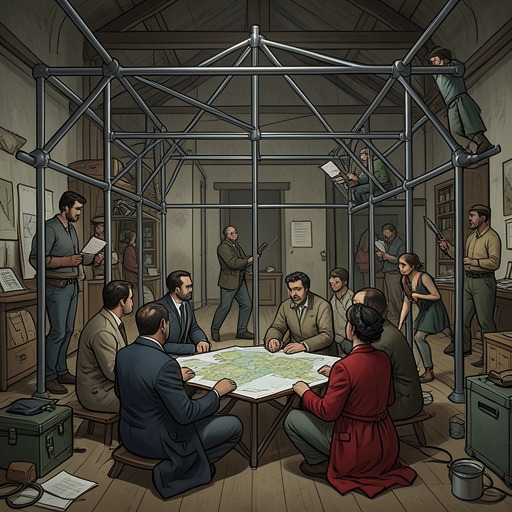
Noah’s labor then becomes part of the project’s physical realization. The gardens are installed over the summer by his crew and half the town, with lavender, sage, lake-country roses, wide paths for walking side by side, and railings throughout. The repeated idea that railings are promises gives his construction work a structural and moral force: accessibility is not decorative symbolism but something people can grasp, lean on, and trust.
Relations and Contrast with the Colt Marriage
Noah’s relationship with Jacinta is marked by respect for boundaries and by a lack of rivalry. He does not treat her drawings, house, or recovery project as territory to claim. His method is to notice, repair, clarify, and leave room. That conduct contrasts with the Colt family’s treatment of Jacinta, especially the attempt to seat her like a coat check, erase her name from her own project, and publicly diagnose her as unstable.
The wider family crisis makes the contrast sharper. Beatrice Colt’s management of the scandal depends on concealment and control; the Northlight Consulting file later shows ninety-five thousand dollars in consulting payments without contracts or deliverables, routed through a Delaware mailbox, with Celeste Colt approving every payment and Beatrice knowing about the arrangement. Aaron eventually names the larger pattern directly: Jacinta was not simply having a breakdown, but had been treated as unstable by professionals for a week while still finding the fraud that the family failed to see. Noah is not the investigator in that revelation, but his treatment of difference and documentation belongs to the opposite moral world. His itemized invoices and anticipatory ramps embody the transparency the Colt system resists.
Aaron’s knowledge of Noah becomes a test of the marriage’s changed terms. When Aaron asks to court Jacinta again, he offers conditions that are entirely hers: weekly or monthly meetings, rejection at any time, and no appeal. He explicitly says he will not ask about the house, the project, or Noah. Jacinta’s surprise that he knows Noah, and Aaron’s calm acknowledgment that he has heard the porch is being fixed, establish that the rebuilt relationship cannot depend on erasing other forms of support. Aaron even concedes that Noah is excellent, a small but important refusal of possessiveness.
Haven House and the Final Encounter
Noah’s role expands from private repairman to collaborator in Haven House Recovery Gardens. The completed site contains the features Jacinta drew: gardens, quiet rooms, a carefully organized kitchen, and a plaque naming Jacinta as founder and designer. Six women move in at the start, and their names are placed on everything they make because Jacinta has written that principle into a charter in language a lawyer cannot undo. Noah’s contribution is thus part of a larger redistribution of credit and agency. He helps build a place where support is concrete and authorship is protected.
The opening also places Noah in a community rather than a private attachment. He works with his crew and townspeople, while residents and local figures gather without the dynastic purpose that once organized Colt events. The project’s scale remains modest—six women to start—but its procedures are deliberate: accessible paths, labeled systems, soft-lit rooms, and visible authorship. Noah’s practical habits fit the project because they turn care into repeatable infrastructure.
The final encounter between Noah and Aaron is deliberately restrained. At the opening, Aaron, the former chairman of Colt Global, pours decaf at the coffee urn. Noah finds him there, and the two men briefly size each other up over the urns. Aaron finally praises the garden paths as having good railings. Noah answers that he knows, pours himself coffee, and lets the exchange stand as the whole treaty. The scene does not manufacture friendship or erase the history between them. Instead, it establishes a limited coexistence based on recognition: Aaron acknowledges the work, Noah neither competes for Jacinta nor demands a ceremony of repentance, and the community moves forward.
Narrative Role and Significance
Noah functions as a counterexample to the novel’s inherited definition of masculinity and commitment. Aaron once broke Jacinta’s heart and failed to protect her from the family system, whereas Noah fixes the porch at the agreed time, texts before arriving, separates materials from labor, and builds ramps for needs not yet voiced. His reliability is intentionally unglamorous. It is made of schedules, labels, screws, railings, and work completed without applause.
That ordinariness gives Noah unusual narrative weight. He helps Jacinta distinguish care from management and presence from possession. He also helps translate her private coping knowledge into a public institution without taking authorship away from her. His work does not replace Jacinta’s agency; it gives her designs a material setting in which they can function.
The final coffee-urn scene completes his arc without turning him into a romantic reward. Noah remains the man who builds what is needed and respects the boundaries around it. His brief treaty with Aaron makes the novel’s governing distinction visible: progress is not a grand gesture but a structure maintained over time, one board, path, label, and promise at a time.