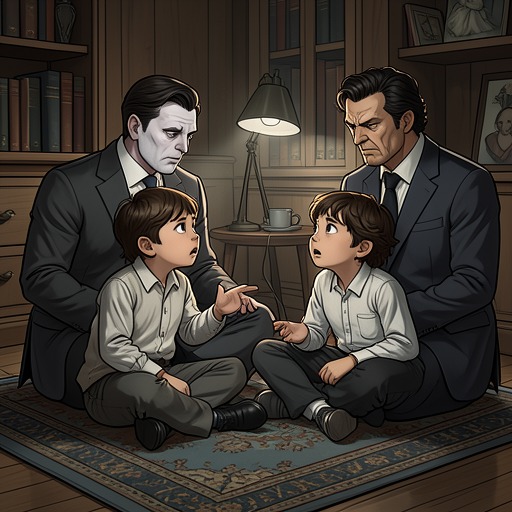
Theo Colt
Unchosen By My CEO Husband: A Marriage In Crisis Second Chance RomanceTheo Colt is the younger child of Aaron Colt and Jacinta Colt and a recurring presence whose apparent innocence gives the family conflict its clearest domestic scale. He is associated with dinosaurs, blueberries, pancakes, a suitcase of dinosaur shirts, and the practical routines of school and home, yet his questions repeatedly expose whether the adults around him are telling the truth. By the opening of the Haven House Recovery Gardens, Theo has become not a spokesman for the family’s transformation but one of its most persuasive witnesses: his trust, curiosity, and simple standards make adult evasions difficult to sustain.
Identity and Introduction
Theo is five years old during the family’s period of rupture and seven when the Haven House Recovery Gardens opens. His age is important to the way he functions in the narrative. He does not possess the institutional vocabulary used by the adults, but he notices consequences and asks direct questions about them. His response to trouble is neither strategic nor socially managed; it is immediate, concrete, and emotionally exact.
In the household’s organized morning system, Theo’s sneakers are paired and pointed toward the door, while his older sister Willa Colt’s purple backpack sits in its labeled bin. The whiteboard calendar governs the family in four colors, and the narrator notes that nobody has missed a dentist appointment since 2019. Theo therefore enters the story through a network of care that is both loving and highly managed. His shoes suggest readiness for school and the ordinary continuation of childhood, even as the adults’ marriage is already carrying concealed strain.
His material world is distinctly childlike. During a Saturday breakfast, while Aaron Colt makes pancakes, Theo places a blueberry on each finger and eats them one by one. The gesture occurs while the adults’ marriage is under pressure, but Theo and Willa continue eating as though nothing is wrong because, from their perspective, ordinary family life has not yet been fully displaced. Theo’s play preserves the difference between the children’s immediate experience and the adult crisis surrounding them.
Life Through the Family Crisis
When Jacinta Colt leaves the household, Theo travels with her and Willa Colt. Willa buckles herself in and then buckles Theo, who is humming with a suitcase of dinosaur shirts at his feet. The scene gives Theo a dependent but not passive place within the transition: he is still small enough to need help with the car, yet he participates in the departure through his presence, his humming, and the portable belongings that carry his ordinary identity into an unfamiliar arrangement.
The children’s Sunday-night calls become a recurring structure after the separation. They call at 6:30 sharp in what the narrator calls a court of appeals. Theo goes first and reports that he has found a rock resembling a dinosaur tooth before asking Aaron, “Dad, are you in trouble?” Aaron answers, “Yeah, buddy. I am,” and Theo accepts the reply in the uncomplicated way children accept statements from a parent. The exchange turns a public scandal and marital collapse into a question a five-year-old can understand: whether his father is in trouble, and whether the father will answer plainly.
Theo’s acceptance is not the same as indifference. His question places Aaron under a child’s form of moral scrutiny, while its simplicity prevents Aaron from hiding behind reputation, family strategy, or professional language. Willa later examines her father more critically, but Theo establishes the first demand for an honest answer. His role in the calls is thus both affectionate and evaluative: he remains a child seeking contact, while also requiring the adult to acknowledge reality.
Relationships and Moral Testing
Theo’s relationship with Aaron is marked by affection and direct accountability. During another Sunday call, Theo asks whether Aaron has learned his lesson. Aaron says that he is still learning it, and Theo accepts the answer after checking the idea against his own standard. The exchange makes learning, rather than a completed performance of repentance, the condition of renewed trust. Theo does not require Aaron to claim that the problem is solved; he requires him to admit that the process continues.
Theo’s relationship with Jacinta is conveyed through ordinary physical closeness rather than formal explanation. While Jacinta works at a table in flour and October light, Theo pats her arm with a doughy hand and tells her, “Mom, you’re leaking,” as she laughs and cries over the paperwork of her second life. He then pretends not to notice her emotion, a skill the narrator associates with Aaron in a gentler form. Theo’s response is protective without being intrusive: he registers her tears, names the visible fact, and gives her room to contain it.
That moment also places Theo inside the emotional inheritance of the family while distinguishing the versions of behavior that can be harmful from those that can be tender. Earlier, adult concealment helped sustain the Colt marriage’s false balance; here, Theo’s apparent pretending functions as kindness. He does not erase Jacinta’s emotion or force her to explain it. His childhood instinct becomes a form of tact, even as the scene shows that he has learned something about how people manage difficult feelings.
Repair, Play, and the New Household
Theo’s imagination becomes part of the family’s repair process. When Jacinta needs the speech cards for an important presentation, Aaron asks whether he should help or merely witness. Jacinta chooses help and sends him to check the dinosaur fort. The cards are there because Theo has decided that a speech about trauma recovery requires security. His play accidentally safeguards Jacinta’s work, but the incident is more than a comic interruption: a child’s private imaginative space becomes the place where the practical materials of the family’s new future are kept.
Aaron returns the cards without reviving the old arithmetic of obligation and eats the burnt half of Jacinta’s toast so she can have the good half. Theo is not the agent of this adult repair, but his dinosaur fort is the immediate setting through which cooperation is completed. The family’s new pattern is defined by a shorter repair cycle: the emergency takes four minutes, and nobody keeps a ledger. Theo’s world of forts and dinosaurs therefore sits beside the adults’ newly explicit commitments, showing how structural change enters domestic life through small, unceremonious acts.
The contrast with the former household is significant. The earlier home depended on labeled bins, calendars, and successful scheduling, but practical order could not prevent emotional avoidance. In the reconstructed household, Theo’s objects still matter, yet they no longer serve only as evidence that the family is functioning. They become shared points of contact through which adults ask what kind of help is needed and children’s play is treated as part of communal life rather than as background noise.
Ending and Narrative Significance
At the opening of the Haven House Recovery Gardens, Theo is seven. He misses the ribbon on his first attempt when the children cut the opening ribbon, tries again, and succeeds. The town cheers as if he has landed a plane. His mistake and second attempt give the ceremony an accidental emblem: the new institution does not require flawless performance at the first try, only the willingness to try again in public.
Willa’s speech states the family’s revised principle that everybody gets credited and everybody gets audited. Theo’s contribution is less verbal and more physical. He holds the ribbon, misses it, adjusts, and completes the act while the community watches. His participation places him within the family’s new culture of visible accountability without forcing him to become an adult symbol detached from childhood. He remains the boy who hums, collects dinosaur-shaped objects, builds forts, eats blueberries from his fingers, and asks whether his father is in trouble.
Theo’s final importance lies in the standards he applies without institutional power. He asks direct questions, accepts truthful answers, notices distress, protects what matters to his mother, and allows imperfect efforts to be repeated. Through him, the family’s transformation is measured not by declarations alone but by whether honesty can survive an ordinary phone call, whether repair can happen without a ledger, and whether a missed first snip can be followed by another attempt. He is the youngest member of the family, but his recurring presence makes its ethical changes legible: the adults are rebuilding a home in which children do not have to manage the truth for them.