Help or witness
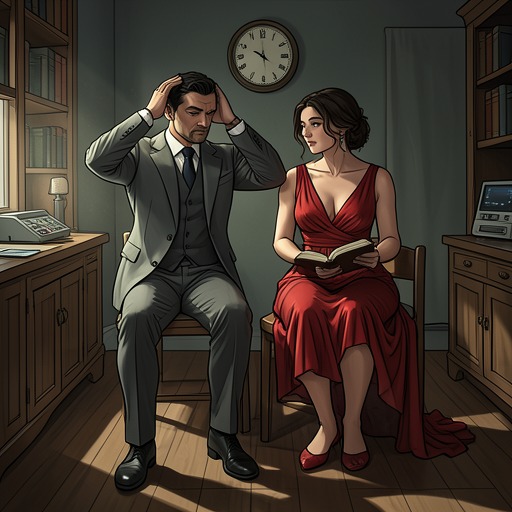
Unchosen By My CEO Husband: A Marriage In Crisis Second Chance Romance“Help or witness?” is the central expression of a rebuilt marital ethic between Aaron Colt and Jacinta Colt. Its decisive significance lies in how it replaces automatic management with consent: Aaron does not assume that Jacinta needs calming, rescuing, or direction, but asks which form of presence she wants. The question also echoes the book’s wider concern with witnessing erased labor and injustice without converting another person’s experience into an opportunity for control.
Origin and Immediate Context
The phrase appears after more than a year of Dr. Weiss’s work, Sunday coffees, and a marriage rebuilt “from the studs.” Jacinta is standing frozen in the kitchen with one hand on the counter, visited by the old voice associated with Beatrice Colt’s judgment that she is scattered or overwhelmed. The recurrence of that voice shows that therapeutic progress has not erased the past; the ghosts remain, but Jacinta no longer offers them a place to inhabit.
Aaron’s response is defined first by what he refuses to say. He does not tell Jacinta to calm down, and he does not claim that he has everything under control. Those omissions matter because they mark a break with the earlier pattern in which her competence and distress were interpreted by others, then used against her. Instead of imposing an explanation, Aaron asks the short, carefully limited question, “Help or witness?”
Meaning Within the Marriage
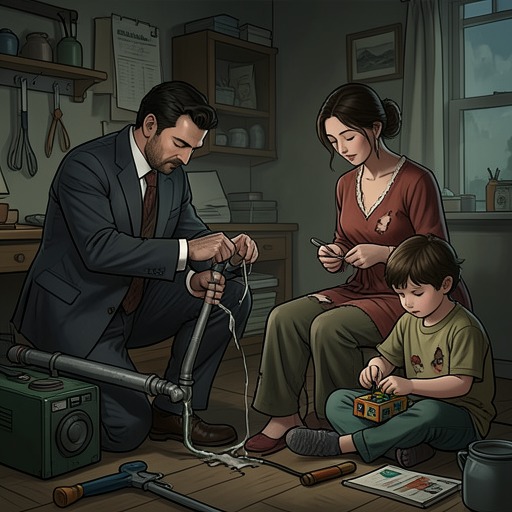
Jacinta answers “Help” and gives specific instructions: speech cards, all four stacks, and a check of the dinosaur fort. Aaron follows those instructions. The cards are found in the fort because Theo Colt has decided that Jacinta’s speech about trauma recovery requires security. The scene turns assistance into a task defined by Jacinta rather than by Aaron’s anxiety about her condition.
The phrase therefore separates help from possession. Aaron is present and useful, but he does not make himself the author of the emergency. He does not translate Jacinta’s frozen moment into a verdict about her capacity, nor does he substitute gifts or declarations for practical care. After checking the fort, he hands back the cards without a word or a flicker of the old calculation, then eats the burnt half of Jacinta’s toast so she can have the good half. The domestic gesture completes the principle: care is quiet, specific, and responsive rather than theatrical.
Earlier Forms of Witnessing
The question gains force from earlier scenes in which witnessing is uncertain, compromised, or belated. At the Renewal Centre gala, Aaron Colt watches Jacinta from ten feet away while calculating the venue, the Vale family, the contract, and the cameras. He rises half out of his chair and then sits back down. His physical hesitation makes watching an ethically inadequate substitute for action: he sees what is happening but remains governed by institutional and family calculations.
Elliot Grant offers a contrasting form of witness. He has worked in the building for eleven years and watched Jacinta’s name appear on the Renewal file every week for three years, attached to site plans, budgets, correspondence, and her initials. He tells her that what he has witnessed can be spoken aloud to people who matter. His testimony recognizes the material record of her work, but it still remains distinct from deciding what she should do. The distinction anticipates Aaron’s later question: a witness can affirm what occurred without taking command of the person whose story is at stake.
The same ethical structure appears when Elliot identifies Jacinta as the person who found the financial evidence before anyone else, through a finance portal, while the city was being told that she could not manage a lunch order. Aaron confirms that she did. Her discovery is not merely a plot mechanism; it exposes how public stigma can obscure precise, consequential competence. Witnessing becomes valuable when it restores the truth of what someone did and accepts the responsibility to say so.
Contrast With Aaron’s Earlier Conduct
Aaron’s earlier attempts at repair often confuse material provision with accountability. After Jacinta leaves with the children and drives north to Haven House, he sends two hundred stems of white peonies because a florist tells him that peonies mean apology. The flowers are an outsourced meaning, an object chosen in place of the labor of understanding. Dr. Feld later identifies the underlying mistake when Aaron admits that he treated the most expensive thing in his life like a fixed cost. Her answer is that fixed costs do not send invoices; they leave, and she warns him to stop buying Jacinta things because he is tendering an offer rather than apologizing.
That correction explains why “Help or witness?” is more than a memorable line. It is the verbal form of Aaron’s changed conduct. The question prevents him from turning Jacinta’s vulnerability into another field in which he can perform competence, pay a cost, or calculate an outcome. It requires him to accept either a defined request for assistance or the less controlling duty of remaining present while Jacinta retains the authority to speak and act.
Recurrence and Thematic Significance
The expression also belongs to a larger pattern of showing that dependable presence is repetitive rather than spectacular. Dru asks whether Aaron merely keeps showing up, and Jacinta answers that this is the whole thing, that there is nothing else. The phrase “Help or witness?” gives that repeated showing up a disciplined form: Aaron remains available, but the nature of his involvement is selected by Jacinta.
As a compact speech act, the question changes the situation the moment it is spoken. It names two possible roles, makes room for Jacinta’s choice, and limits Aaron’s authority. In the wider moral architecture of the book, it distinguishes seeing from judging, naming from erasing, and helping from taking over. Its final meaning is not that witnessing is passive or help is automatically superior. Both can become ethical, but only when the person most affected determines what is needed and the witness accepts responsibility without claiming ownership.