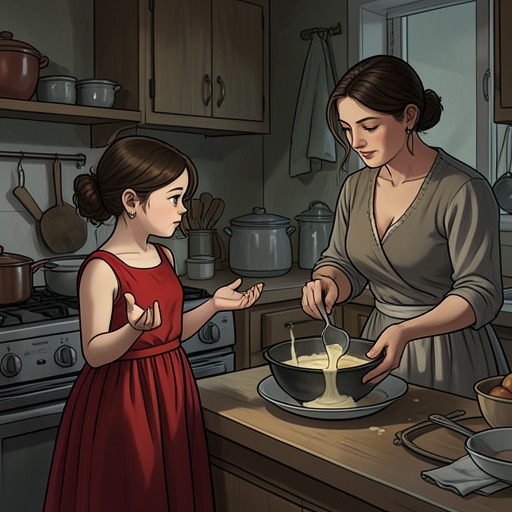
Jacinta leaves Aaron and moves to Haven House
Unchosen By My CEO Husband: A Marriage In Crisis Second Chance RomanceJacinta leaves Aaron and moves to Haven House at the decisive break in the Colt marriage. What appears at first to be a domestic departure becomes a refusal of the role she has been assigned: wife, organizer, caretaker, and supposedly unstable woman whose work can be used while her name is erased. With Willa and Theo, she drives north to her grandmother’s house at Bellweather Cove, carrying both practical evidence and the written record of the marriage that helped define her as someone who would always remain.
Causes and Background
The immediate conflict grows out of the Renewal Centre gala, the Colt Foundation’s largest annual event. The facility represents three years of Jacinta’s work, beginning with a sketch on a takeout menu and ending in final board approval. She expects Aaron to say her name publicly and identify the project as hers, especially after a decade in which society has introduced her as his wife and little else. The project therefore carries more than professional value: it is the promised public recognition of a life of planning, coordination, and invisible labor.
Jacinta’s organization of the household makes that labor concrete. Three labeled bins stand by the door, Willa’s purple backpack is in its place, Theo’s sneakers are paired and pointed toward school, and a four-color whiteboard calendar governs the family’s obligations. The system may look effortless from outside, but its success depends on constant advance planning; nobody has missed a dentist appointment since 2019. The same person who builds those domestic “rails” also built the Renewal Centre, yet the smoothness of her work allows others to mistake it for an absence of work.
The gala crisis converts that erasure into a direct attack on her credibility. Aaron acknowledges that the venue alone is worth two hundred thousand dollars and says he cannot go to war with the Vale family over a mistake during the week of the event. Jacinta rejects the description of the problem as a typo: her name has been erased, Cassandra has moved her walkthrough, and people at the foundation have been told that she is overwhelmed or experiencing some kind of episode. Aaron advises her to let Cassandra’s team handle the logistics and rest before Friday. His gentleness intensifies the injury because it treats exclusion as protection and asks Jacinta to surrender control of her own project.
The Departure
The move begins in the bedroom, where Aaron finds Jacinta with an open suitcase, a garment bag, and the children’s duffels waiting by the door. He immediately interprets the scene through the old written rule that has governed the marriage, offering a weekend at a hotel or elsewhere and suggesting that they will talk on Monday. Jacinta recognizes the response as another attempt to contain the crisis rather than understand it. Ten years into the marriage, Aaron is still reading from the same sheet of instructions.
Jacinta makes the destination and the scale of the decision explicit: she and the children are going to Haven House, her grandmother’s place at Bellweather Cove, and she has already emailed the school. This is not an impulsive disappearance or a temporary retreat arranged by someone else. The school message, the packed bags, and the chosen destination show a carefully prepared transition, consistent with the advance planning that has always been misread as effortless.
Aaron objects that taking the children is insane and warns that her disappearance will confirm what his mother has been saying about her. Jacinta answers that he is not asking her to stay; he is asking her to keep managing the story. That distinction defines the action’s central value shift. The departure is not simply from a house or a quarrel. It is a withdrawal from the unpaid labor of making the Colt family’s version of events appear coherent.
Before leaving, Jacinta confronts the document Aaron kept for ten years through three houses and two children. She quotes its governing principle, “She’ll never leave,” followed by “Choose the one who stays.” Aaron’s written policy has reduced loyalty to a fixed asset and treated her permanence as an assumption. Jacinta takes the ten-year stack of notes from his dresser and places it on his pillow, returning the paper archive of their marriage to the person who made it. Her statement that the “asset” is adjusting transforms the document from proof of love into evidence of the economic logic that has structured their relationship.
Haven House and the First Consequences
The physical departure is deliberately quiet. Jacinta backs out of the driveway slowly, without screeching or spectacle. The restraint matters because the family’s public narrative depends on drama: if she leaves loudly, her opponents can present the action as proof of instability. Instead, she leaves with a laptop containing a folder called Recipes, which she is keeping as evidence, and with the ten-year-old paper in her pocket against her skin. The digital folder and the handwritten notes form two records of the truth that the public story has attempted to suppress.
The road north leads toward the lake and toward Haven House, a property her grandmother left to the granddaughter whom everyone had counted out. The destination therefore joins refuge with inheritance. Jacinta is not entering an anonymous temporary shelter; she is returning to a place connected to a family judgment that she has survived. For the first time in ten years, she does not check the clock because she is not expected anywhere. Yet the departure is not framed as disappearance from responsibility: she is simply expected back, a formulation that replaces the Colt household’s demands with a different kind of belonging.
Aaron initially responds through substitution. Nine days after Jacinta leaves with the children, he sends two hundred stems of white peonies to Haven House because the florist says peonies signify apology. The gesture is revealing precisely because he outsources its meaning. It treats repair as a purchase and attempts to communicate through an object rather than through the accountability Jacinta has demanded. The flowers are returned on Thursday, not merely sent back but repurposed, turning the failed apology into another sign that material offerings cannot restore the relationship’s damaged terms.
The Wider Colt Family Reckoning
Jacinta’s departure also exposes the family system that made remaining seem mandatory. Beatrice arrives uninvited at Aaron’s office and accuses him of embarrassing the family because he has made no public statement or undertaken damage control while Jacinta appears in society pages at Haven House. Aaron now describes his conduct as damage inventory rather than damage control and confronts his mother with the accusation that she told Cassandra where he was staying. He identifies the gala’s actions plainly: his wife was seated like a coat check, her name was erased from her project, and she was publicly diagnosed onstage.
Beatrice insists that she merely managed an unfortunate situation and says Jacinta was never going to be easy. Her language reveals the family’s method: Jacinta’s resistance is converted into evidence of defect, allowing others to handle her “quietly” while claiming to protect the family. The departure breaks that arrangement by removing Jacinta from the space in which the family can supervise both her behavior and its interpretation.
The subsequent investigation gives institutional weight to what the departure had already signaled emotionally. Elliot brings Aaron the Northlight file, documenting ninety-five thousand dollars in consulting payments with no contracts, no deliverables, and only a Delaware mailbox; Celeste approved every payment, and the records show that Beatrice knew. The family’s manipulation is no longer only a matter of social presentation. It is connected to financial misconduct and to a structure in which responsibility has been distributed downward while authority remains protected.
At the foundation vote, Celeste resigns, the matter is referred to the state’s attorney, and Beatrice is removed as chair of the foundation her family built. Beatrice tells Aaron that he has chosen Jacinta over his own blood, although Jacinta is not present. Aaron’s answer reverses the family’s definition of presence: Jacinta was always there, but Beatrice taught him not to see her. Her physical absence at the vote consequently becomes proof of the influence she had long exercised through work, care, and truth rather than evidence that she was irrelevant.
Meaning and Continuing Change
The departure changes the marriage’s governing metaphor. Aaron later recognizes that he treated the most expensive thing in his life as a fixed cost, and that fixed costs do not send invoices; they leave. The statement connects Jacinta’s exit to the unpaid domestic and emotional labor that had been treated as permanent infrastructure. Dr. Feld identifies his recognition as the first honest thing he has said and warns him to stop buying things because he is not apologizing but tendering an offer. The distinction confirms that Jacinta’s leaving has forced him to understand the difference between possession, compensation, and repair.
The same change appears in Aaron’s later boundary with Beatrice. He states that Celeste stole from a charity, that the Vales staged a photograph of him, and that Jacinta was not having a breakdown; she had been treated as unstable by professionals for a week and still found the fraud none of them could see. He tells Beatrice that the lawyers will stand down or he will tell the school who sent the first calls. His refusal to yield is not a declaration that family no longer matters. He says he is present because she is his mother, that he loves her, and that he will return the next day, while making the answer no and maintaining it.
Jacinta’s move to Haven House therefore functions as both separation and redefinition. It removes her and the children from the household in which her competence was appropriated and her objections pathologized, while preserving her connection to a place that recognizes her as someone expected to return. The action does not solve the marriage through a dramatic apology or an immediate reconciliation. It establishes the condition under which any future relationship could be considered: Jacinta must no longer be treated as the person who stays by default, and Aaron must learn that remaining is not a fixed asset but a choice that has to be made honestly.