Reconstructed marriage
Unchosen By My CEO Husband: A Marriage In Crisis Second Chance RomanceReconstructed marriage names the relationship Aaron Colt and Jacinta Colt attempt to build after Jacinta leaves the Colt household and rejects the “whole paper marriage” that had converted years of devotion into evidence stored in a drawer. Its decisive significance is that reconciliation is not treated as restoration. The old marriage dies; any new one must be chosen, structured, and continuously tested under terms that protect Jacinta’s authorship and autonomy.
Definition and Conditions
Reconstructed marriage begins with a refusal to confuse proximity with repair. Jacinta leaves after the Renewal Centre scandal, in which her three years of design work were erased from public credit and Aaron Colt enabled the arrangement surrounding Cassandra Vale. The original domestic system had depended on Jacinta’s invisible labor: labeled bins, color-coded calendars, children’s routines, and a household in which nobody had missed a dentist appointment since 2019. That competence had been treated as background rather than as authorship. The rebuilt relationship therefore has to acknowledge that the apparently effortless order of the family was work, and that Aaron’s promises are insufficient unless they become enforceable changes.
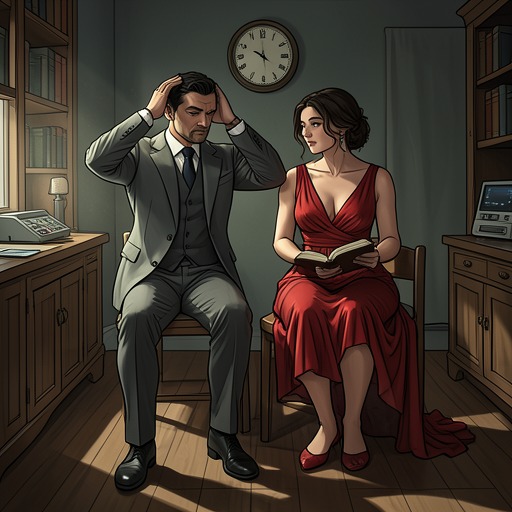
The first formal step is Couples therapy, proposed by Jacinta Colt rather than Aaron. In July, she calls Aaron Colt and says she wants a referee in the room before their children become referees themselves. She explicitly says the purpose is not reconciliation, and the arrangement begins with the couple living apart. The therapist is Dr. Weiss, whose office is an hour south of Bellweather Cove; Jacinta refuses to drive to Chicago, and Dr. Weiss does not ask her to. The physical distance and the ground rule of separate homes make the new relationship a process with boundaries rather than an automatic resumption of marital life.
Accountability Before Courtship
The therapy lasts six weeks, and Jacinta asks everything on her list. One question concerns whether Aaron knew about the word “overwhelmed” before Beatrice Colt used it onstage to characterize Jacinta publicly. Aaron says he did not; he believed it afterward, and considers that worse. The answers arrive without decoration, replacing the old practice of soothing ambiguity with direct information. This exchange matters because the new marriage is founded on the truth of what happened, not on a carefully managed version that preserves the family’s comfort.
Aaron’s accountability also becomes institutional. He confronts Beatrice Colt over telling Cassandra Vale where Jacinta was, seating Jacinta “like a coat check,” erasing her name from her own project, and diagnosing her in front of the gala audience. He later learns from Elliot Grant that Northlight Consulting received ninety-five thousand dollars in consulting payments without contracts or deliverables, through a Delaware mailbox, with Celeste Colt approving every payment and both Celeste Colt and Beatrice Colt countersigning the records. When Beatrice Colt pressures Aaron from a hospital bed, he states the relevant facts plainly: Celeste stole from a charity, the Vales staged a photograph involving her son, Jacinta was not having a breakdown, and lawyers will stop contacting the school or he will disclose who initiated those calls.
These actions distinguish repair from apology. Aaron Colt releases the security log and email registration, issues a statement naming Jacinta Colt as the actual Renewal Centre designer, and signs a termination notice ending the Vale venue arrangement despite Cassandra Vale’s warning that the decision will damage the board, the foundation, and the Vale family’s account. At the foundation vote, Celeste resigns and the matter is referred to the state’s attorney; Beatrice Colt is removed as chair of the foundation her family built. When Beatrice says Aaron chose Jacinta over his own blood, he answers that Jacinta was always the one who was there, but that Beatrice taught him not to see her.
Courtship as a New Agreement
After the seventh therapy session, in August, Aaron Colt asks Jacinta Colt for permission to court her. The request takes place in a parking lot beside a used Subaru Jacinta has purchased. Aaron does not ask for forgiveness; he says forgiveness belongs to Jacinta, whether she gives it, keeps it, or spends it elsewhere. His request is narrower and more demanding: permission to begin pursuing her again. Jacinta’s laughter at the age of the request underscores how unfamiliar the arrangement is. He is not claiming the rights of a husband; he is asking to earn access to a relationship that no longer belongs to the past.
The new terms become concrete. Jacinta says she will not return to the old marriage. She watched it die and buried it, and does not want it resurrected. Instead, she wants a new marriage with a new house and new rails, in Bellweather Cove rather than on Aaron’s terms. She requires total information, including the same-day disclosure of every ugly fact and no deleted texts for the rest of their lives. She requires therapy until Dr. Weiss retires, and permanent ownership of the name on everything she makes. Aaron accepts every condition without a counteroffer; the intellectual-property condition is already secured in law.
Aaron’s material restitution is the transfer of all Renewal Centre intellectual property. His lawyers sign over every design file, plan, and scrap of intellectual property the foundation ever touched to Jacinta’s new nonprofit, irrevocably, without conditions or a reversion clause. Elliot Grant witnesses the signatures and reads the transfer three times. Aaron knows Jacinta has not yet decided what he means to her, and proceeds without treating the transfer as a purchase of forgiveness. The gesture changes the power structure beneath the relationship: Jacinta’s work is no longer held at the pleasure of Aaron’s family, and her future authorship cannot be reclaimed as marital property.
Rebuilding the Shared World
The reconstructed marriage remains connected to family life without making family access a substitute for trust. Willa Colt overhears enough of the conversation to understand that the adults are negotiating an entirely new arrangement. Her filing-system mind cross-references the year’s events, and she gives Aaron an “A-minus” because he is learning. The assessment is comic but also structural: Aaron is being evaluated by the child who has watched his conduct over time, not rewarded for a single declaration.
The new world also takes institutional shape through Haven House Recovery Gardens. Over the summer, Noah’s crew and half the town install beds of lavender, sage, and lake-country roses, with paths wide enough for people to walk side by side and railings throughout. The kitchen uses bins, labels, and a four-color calendar, carrying forward the practical systems Jacinta once maintained inside the household while placing them in a public recovery setting. A plaque identifies the founder and designer as Jacinta Colt. Six women move in at the opening, and Jacinta writes into the charter that their names will appear on everything they make. The principle is the opposite of the Renewal Centre erasure: everybody receives credit, and credit is protected by language a lawyer cannot unpick.
This reconstruction therefore joins domestic and public repair. Aaron’s family loses control of the foundation through the board purge; Jacinta gains legal control over her intellectual property; and the new nonprofit makes recognition part of its operating rules. The marriage cannot be separated from these institutional changes because the first marriage failed through the same system that erased Jacinta’s professional identity. A private promise becomes credible only when the surrounding structures stop reproducing the original injury.
Continuing Choice and Ending
The relationship’s final ritual replaces the drawer of ten years of notes. At night, after the children are asleep and the house is quiet, a note waits on Jacinta’s pillow. There has been one every night for a year, but the notes are no longer love notes in the old sense. They are ballots. Each asks the same question: “Still?” Aaron leaves a pen beside the note, having learned Jacinta’s systems like a second language, and Jacinta writes her answer beneath it.
The repetition is essential. The question is not whether Jacinta owes Aaron permanence because he apologized, transferred property, or accepted her conditions. It is whether she chooses the relationship again, in the present, without surrendering the right to choose differently later. The rebuilt marriage is consequently a continuing state rather than a completed reward: separate homes and therapy lead to courtship, courtship leads to conditional consent, and consent is renewed through a daily practice that remains meaningful precisely because it is never owed. Reconciliation survives only as a new structure of information, credit, boundaries, and freely repeated choice.