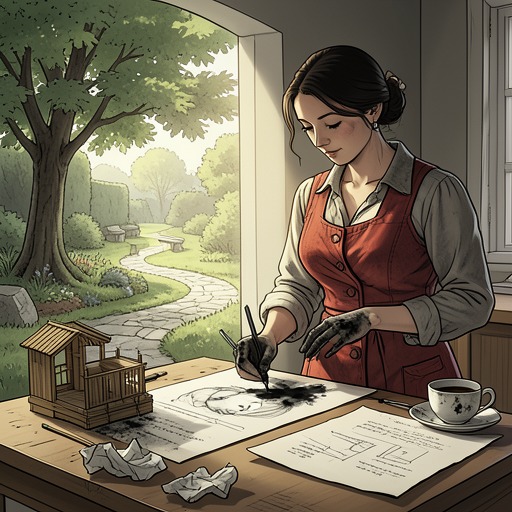
Signature and Credit Competition
Unchosen By My CEO Husband: A Marriage In Crisis Second Chance RomanceThe struggle over credit and authorship is the novel’s governing conflict: Jacinta Colt creates the Renewal Centre, sustains the systems that make her household and project function, and is then removed from the public record while others present her work as their own. What begins as a missing name becomes an organized campaign of minimization, in which family authority, corporate prestige, and claims about Jacinta’s mental state reinforce one another. The eventual answer is not merely an apology or a corrected program, but a new distribution of authorship in which Jacinta’s name is made visible and the women who use her second project will have their own names attached to everything they make.
Authorship Before the Erasure
Jacinta’s claim to the Renewal Centre is concrete and longstanding. The Colt Foundation gala is presented as the organization’s largest night of the year, but the center belongs to a project she has developed for three years, from an initial sketch on a takeout menu through sensory-room designs, site plans, grant applications, and final board approval in May. Aaron Colt has promised that her name will be spoken onstage, an acknowledgment that matters because she has spent a decade being introduced as his wife rather than as a designer or founder.
The book places this professional authorship beside Jacinta’s extensive domestic systems. At home, three labeled bins, Willa Colt’s purple backpack, Theo Colt’s paired sneakers, and a four-color whiteboard calendar turn daily life into something reliable; nobody has missed a dentist appointment since 2019. Jacinta explains that this apparent effortlessness is produced by constant advance planning. Her rails make the household look easy, and that invisibility becomes an emblem of the larger injustice: labor that succeeds is treated as natural, while the person who designed and maintained it disappears.
The Name Removed from the Record
The erasure first becomes visible in the revised gala program. For three years, Renewal Centre documents have come through Jacinta, yet the new material calls the facility “A bold new vision in recovery care, proudly presented by the Colt Foundation” without naming her. The omission is repeated in the final printed program, where the Renewal Centre is credited to the Colt Foundation and event direction is assigned to Cassandra Vale. The absence is therefore not confined to a provisional draft; it survives multiple revisions and reaches the version intended for public circulation.
The surrounding language makes the omission more than an administrative mistake. Beatrice Colt asks whether Jacinta is sleeping, describes her as scattered, and says that Aaron is worried about her. She tells Jacinta to leave the gala to professionals because she has done enough. Aaron likewise calls the missing credit a typo and argues that the venue, worth two hundred thousand dollars, makes a confrontation with the Vale family too risky before the event. Jacinta rejects that description directly: the problem is an erasure, compounded by Cassandra’s moved walkthrough and the rumor that Jacinta is overwhelmed.
The accusation of instability functions as a shield around the stolen authorship. An anonymous message tells Jacinta to ask Aaron about the hotel while warning that everyone will call her unstable. At the gala, Beatrice publicly describes Jacinta as struggling with mental health immediately after the Renewal Centre is celebrated, turning a private insinuation into a room-wide judgment. The center appears in gold animation on the screen behind the stage, displaying Jacinta’s building, sight lines, and sensory rooms while her name is absent. The audience is invited to admire the work precisely as its creator is made socially unreliable.
Public Recovery of Credit
The reversal begins when the record of the erasure becomes evidence rather than rumor. A security log and a fake email address, traced through a vendor on the Vale events payroll, help establish how Jacinta was excluded and how the surrounding manipulation was organized. The resulting article names her as the designer who discovered the discrepancy and identifies her as the woman the file should have been named for. Aaron’s public statement accepts responsibility: the work was always hers, and the erasure happened while he was responsible for stopping it.
That disclosure carries material consequences. The Vale Group deal, reported at forty-one million dollars, is terminated. Jacinta’s authorship is no longer only a private insistence against her husband’s reassurance or his family’s social power; it becomes part of the public account of the scandal. The story’s significance lies in the connection between naming and accountability: once the work is correctly attributed, the corporate arrangement that benefited from its misattribution cannot continue unchanged.
Jacinta later speaks under her own full name as founder and designer. At the presentation for Haven House Recovery Gardens, she describes the revived old camp, its gardens, quiet rooms, soft lighting, kitchen labels, and four-color calendar. She also speaks about her brain deliberately and through her own microphone, refusing to let others define her condition before she can define her experience. Her account of the first project is concise but decisive: she built one of these before, the published record shows who received credit, and the new project belongs to her.
From Individual Recognition to Institutional Rule
The struggle does not end with Jacinta receiving a corrected description. An envelope from an unfamiliar law firm contains the Renewal Centre files, including her drawings and plans, transferred to Haven House Recovery Gardens irrevocably and without conditions. She searches the documents for a hidden clause and finds none. The transfer converts recognition into control over the work itself: the materials that had been held by the foundation as collateral are returned to the project that Jacinta can direct under her own name.
At the opening of Haven House Recovery Gardens, the plaque states, “The Haven House Recovery Gardens. Founder and designer: Jacinta Colt.” The project’s public identity therefore records both roles that had been separated or concealed in the earlier center. The original proposal is also preserved in a frame: Elliot Grant brings page one, dated three years earlier and marked with Jacinta’s initials. He calls himself a witness rather than a sentimental participant, and the document is placed in the front hall so every visitor can see whose name appeared first.
Jacinta extends the principle beyond herself. Six women move into Haven House at the beginning, and the charter requires that their names appear on everything they make. Credit becomes a structural guarantee rather than a favor granted by a family, foundation, spouse, or event director. The new institution is designed to prevent the same pattern from recurring: creation is linked to the creator, and the record of contribution cannot be quietly detached from the person who did the work.
Meaning and Narrative Function
Credit in the novel is not ornamental praise. It determines who is believed, who controls resources, who can speak about a project, and whose account survives after a public event. The missing name on the program is therefore the visible form of a wider power arrangement. Jacinta’s planning, design, childcare, emotional regulation, and reputation management are treated as support work until their removal produces a crisis; meanwhile, the Colt Foundation and Cassandra Vale’s event machinery claim the prestige generated by her labor.
The novel also distinguishes recognition from repair. Aaron’s early promise that Jacinta’s name will be spoken cannot protect her when he chooses delay, family containment, and the preservation of the gala over immediate intervention. A later public admission matters because it accepts responsibility, but the deeper remedy requires evidence, termination of the Vale alliance, transfer of the files, preservation of the original proposal, and a credit charter for future residents. Authorship is recovered most securely when it is embedded in procedure.
The final image joins memory to accountability. The framed proposal, with Jacinta’s initials visible before the gala ever existed, answers the polished screen on which her building appeared without her name. One record demonstrates how prestige can erase a maker; the other keeps the maker present at the entrance to a new institution. Through that contrast, the struggle over credit becomes the novel’s larger argument about visibility: a name is not merely a label attached after the work is finished, but part of the work’s ownership, history, and ethical future.