Abbot plantation
Under Your Spell: A Romance Boxed Set of Masked Balls, Haunted Gardens, Magic, and MoreAbbot plantation is the inherited Southern estate at the heart of the Abbot–Moriarty family curse. Once a beautiful venue for parties attended by politicians, actors, wealthy guests, and other respected figures, it has become a boarded-up ruin whose landscape and hidden architecture preserve the consequences of an old family crime. The plantation is not merely where the curse is discussed; its decay, secrecy, and uncanny passages make the property an active agent in revealing the past and threatening the last surviving Abbot.
Appearance and Setting
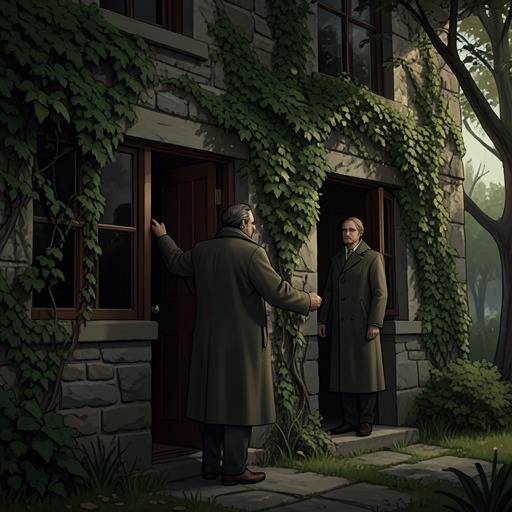
Abbot plantation first appears as a place already being reclaimed by the bayou. The plantation home is boarded up, its facade more than half covered in ivy, its weeds overwhelming the few flowers left in the front bushes. There is no visible path to the front door, the front lawn has become largely swamp, and the paint is peeling from a house described as a wreck. The property is remote enough that a handyman approaching in a rustic pickup feels cut off from civilization, and its isolation gives the job a double character: repairing it could earn good money, but the house presents a handyman’s worst nightmare as readily as his biggest opportunity.
The estate’s exterior also establishes its Gothic contrast between grandeur and ruin. In the darkness, stone walls and a turret make it resemble a real castle, while an old third-floor balcony, with chipped and worn railings, appears ready to collapse beneath anyone who might stand on it. Light still comes from the main windows and faint music can be heard inside, so the house is not an empty ruin in the ordinary sense. Its apparent abandonment coexists with signs of occupation and menace, making the threshold a point at which fear becomes a practical choice: Jade Abbot tells herself that she can still turn back before entering.
History and the Family Curse
According to the family history, the Abbots acquired the plantation in the 1800s, when it was still beautiful and well maintained. The property hosted numerous parties, drawing local politicians, actors, wealthy people, and other important guests. That prosperous social life ended when members of the Abbot family began to die. Over time, the deaths formed a pattern: the Abbots repeatedly died in October, including Jade Abbot’s parents and grandparents. The family’s inherited fear is therefore tied not only to a house but to a calendar, with October becoming a recurring period of loss.
The plantation’s ownership conceals the decisive cause of the curse. Ryder Warren initially asks whether the supernatural trouble concerns the former owners, the Moriartys, because the Moriartys sold the house to the Abbots on October tenth. Gertrude Snodgrass corrects that account: the Abbots did not honestly buy the plantation from the Moriartys but acquired it through trickery, possibly through a card game. The Moriartys had moved south from Salem, Massachusetts, in the early 1800s, and after losing the plantation they placed a curse on the Abbots. The estate thus functions as a disputed inheritance whose legal or material transfer never settled the underlying conflict.
The property’s history also explains why Jade’s inheritance is inseparable from bereavement. When the handyman arrives, Jade is preparing for her grandparents’ funeral, which is to take place in two days on October thirteenth, the anniversary of her parents’ funeral as well. She recognizes the pattern as part of the Abbot family’s broader history and identifies herself as the sole living Abbot left. The plantation is consequently both her possession and the scene of her family’s near-erasure: inheriting it means inheriting the burden that appears to have killed everyone else.
Hidden Architecture and Buried Evidence
The plantation’s interior actively resists ordinary movement and knowledge. While pulling up carpet, Jade loses her balance and passes straight through a wall. The discovery is physically impossible by normal architectural standards, but it opens onto a tight, small space that is cleaner than most of the house. A dangling string releases a rickety ladder, which groans under her weight yet holds long enough to lead her to another small room.
That concealed room contains a circular table and folders of historical documents concerning the plantation. The documents indicate that ownership passed to the Abbots from a Moriarty in the 1800s, while yellow, faded, gossip-filled reports describe fights between the two families. The conflict continued even after the Abbots who acquired the house had died. The secret room therefore stores more than paperwork: it is a physical archive of the rivalry, hidden behind the visible fabric of the decaying home and discovered only when the building itself gives way.
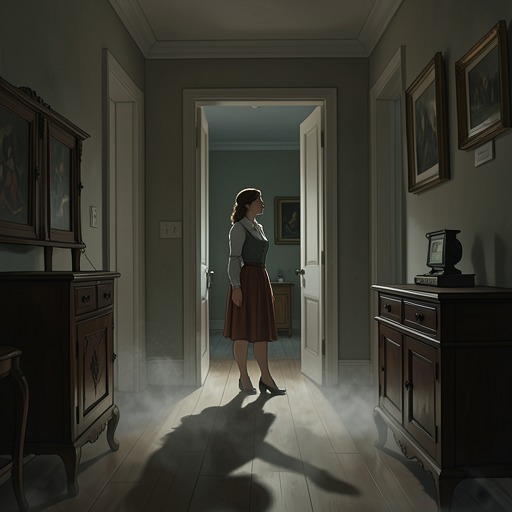
The plantation repeatedly makes concealed history surface through physical irregularity. Its hidden room turns a construction anomaly into an instrument of revelation, while its rooms and passages imply that the estate has never been fully available to the people who claim ownership of it. The house’s boundaries can fail in one direction—allowing Jade to pass through a wall—yet remain threatening in another, since the discovery gives her no control over what else the building may contain.
Encounters and Supernatural Atmosphere
Jade’s relationship to the plantation begins in denial as much as fear. She tells Ryder Warren that rumor describes the house as haunted, then immediately dismisses the idea that ghosts exist. This contradiction captures the estate’s power over her: she has inherited a reputation she does not wish to believe, but the house keeps turning rumor into a pressure that cannot be dismissed by ordinary skepticism.
The plantation is also linked to the wider supernatural geography of the story. Ryder carries Jade away from danger and drives her toward another grand plantation beyond a long, winding path, a movement that places Abbot plantation within a network of estates shaped by family histories, curses, and concealed violence. The property’s isolated bayou setting and its deteriorating grounds give the supernatural a material form before any explanation is complete. Environmental decay is gradual rather than spectacular: ivy, weeds, swamp, and peeling paint mark a slow reclamation that mirrors the long accumulation of family damage.
Other houses in the narrative echo Abbot plantation’s combination of architectural beauty and threat. A mansion with stone walls, a turret, and a failing balcony produces the same castle-like unease, while Willingdon Manor appears as an imposing nineteenth-century structure of grey stone, leaded-glass oriel windows, a dark slate roof, ivy, and four smoking chimneys. These parallels place Abbot plantation within the book’s larger Gothic pattern, in which houses preserve social history and make the past perceptible through their surfaces, rooms, and atmospheres.
Narrative Significance
Abbot plantation concentrates the book’s themes of inheritance, family memory, and the afterlife of wrongdoing. The Abbots’ prosperity and social prominence cannot be separated from the trickery by which they obtained the estate, and the curse transforms that concealed injustice into a repeated historical consequence. The October deaths make the family’s past recur through bodies and dates, while Jade’s status as the last living Abbot turns the plantation into a test of whether inherited history must end in repetition.
The house also joins material inheritance to emotional and supernatural inheritance. Jade receives not a secure family home but a wreck that demands labor, an archive that withholds its contents, and a curse that has already claimed her relatives. Her insistence that ghosts are ridiculous is set against a building whose hidden room and impossible wall passage undermine the categories by which she has tried to understand it. Abbot plantation’s decisive function is therefore revelatory: it converts a property dispute into a living family catastrophe and forces the surviving heir to recognize that the estate’s decay is the visible form of a much older violence.