Anna Williams
Under Your Spell: A Romance Boxed Set of Masked Balls, Haunted Gardens, Magic, and MoreAnna Williams, initially identified as Anna Crane, is the daughter of the family that owns the general store in Sturgeon Bay. Her introduction places her within a recognizable frontier community and establishes both her social position and the curiosity she arouses in Robert Williams. She is in the area while accompanying her sister back to Chicago, a circumstance that brings her into Robert’s orbit and begins a relationship shaped from the outset by travel, family duty, and distance.
Identity and Early Introduction
Anna’s first appearance is filtered through the attention of others, but the narrative soon gives her an interior life of her own. Robert notices the quality of her dress and wonders whether she made it herself, while Anna’s return to Sturgeon Bay is dominated by thoughts of him. She remembers the strength of his shoulders, his muscular build, his quick smile, and his combination of ruggedness and tenderness. The memory becomes physical when she traces her right wrist, reliving the pressure of his lips there and the promise that he would visit her that weekend.
Her life is rooted in practical family work. She helps at her father’s store, attempts to make the perfect loaf of bread, and observes the travelers who pass through town. These details place her affection within an ordinary domestic world rather than separating romance from labor. Even while excited to tell her parents about Chicago, her sister Nettie’s new home, and the library she visited there, Anna is most eager to tell her mother about Robert.
Love, Hesitation, and Marriage
After Robert returns to Williamsonville, Anna writes to him for several minutes each day. Their correspondence continues for months, and Robert reinforces his devotion by sending gifts and making the long ride to see her as often as possible. Yet Anna cannot answer his love with the same certainty. She likes him, and perhaps loves him, but recognizes that her feeling resembles the love she has for Nettie, her father, and her friends. The distinction troubles her because Robert’s last letter has made clear that his love is romantic rather than merely affectionate.
Anna decides that she must tell Robert the truth in person. When she travels toward Williamsonville in the autumn, her courage weakens as the shinglemill comes into view. Her hesitation is not indifference; it is the difficulty of separating companionship, gratitude, desire, and romantic commitment. The relationship therefore develops through an emotional asymmetry: Robert is open in his devotion, while Anna must determine whether the intensity he feels has a true counterpart in her.
The later narrative identifies her as Anna Williams and as Charles Williams’s wife, while Robert remains Charles’s brother and the man who has continued to love her. This change gives her earlier uncertainty a lasting consequence. Anna’s romantic decision is no longer an isolated courtship question; it becomes part of a family structure in which affection, loyalty, marriage, and unresolved attachment coexist under the pressure of catastrophe.
Fire, Bereavement, and Motherhood
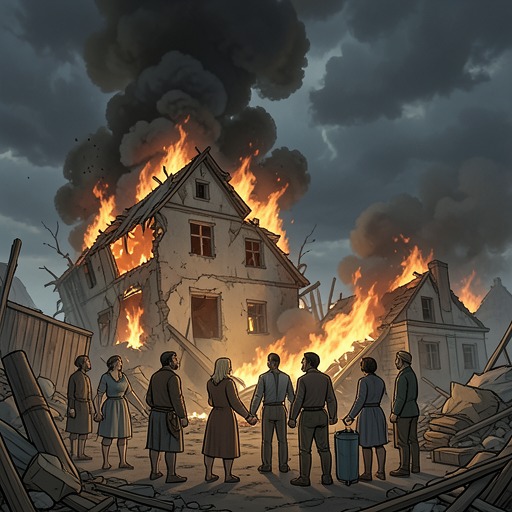
Near dawn after the terrible frontier fire, Anna stands at the door with one hand on the frame and the other protecting her swollen stomach. Charles normally leaves on Sunday afternoon and spends the week in Williamsonville with Robert, so she expects him to return that morning. The mill can wait, but she cannot: her immediate concern is to see Charles, touch him, and determine whether he has survived the fire.
Her perception is marked by the image of a sky bleeding red, gold, and brilliant white, an image that remains stamped behind her eyelids. Robert’s house is closest to the bay, making his location a point of anxious attention as Anna waits for news. The scene joins impending motherhood to communal disaster. Her unborn child intensifies the stakes of Charles’s possible absence, while the fire turns the ordinary weekly movement between home and mill into a question of life and death.
At the memorial, Anna is guided home by her parents and withdraws behind closed doors. Grief makes her imagine Robert standing beside her, yet she cannot understand why her mind summons him instead of Charles. She wishes she could conjure Charles’s voice, tender eyes, or quick smile, but the imagined presence that returns is Robert’s. Her grief is consequently doubled: she mourns her husband while confronting the persistence of the man who loved her before her marriage.
Anna’s pregnancy also prevents grief from becoming purely private. In bed, with a cool cloth over her eyes, she feels the baby kicking and scrambling in her womb as though urging her to rise and move. Her parents offer her a home in which she can raise the child, and Nettie offers another possible refuge in Chicago, where she has married well and has two children. Anna has practical options, but each feels painfully inadequate. The availability of shelter does not lessen the loss; it only shows how thoroughly her future has been reorganized by it.
Robert’s Return and the Unresolved Bond
After the disaster, Robert is injured and exhausted, and the thought of Charles brings him a painful vision in which his brother’s life becomes his own. When Robert next awakens, he finds a blonde woman kneeling beside him. He recognizes Anna’s heart-shaped face and hears the remembered trill of her laughter before feeling the warmth of her hand in his. Her touch produces an immediate physical response, a sizzle that passes through him and reveals that the old bond has not disappeared.
Robert hates that he still loves Anna after she chose Charles over him. Anna’s presence therefore reopens a conflict that marriage and death have not resolved. The encounter is not presented as a clean romantic restoration. It is charged instead with the collision of past desire, present bereavement, family loyalty, and the strange conditions surrounding Robert’s survival and perception after the fire.
Anna also believes that Robert may have been near her during childbirth. After giving birth to a son, she experiences pure joy at the sight of the baby’s pink skin and scrunched face, yet the happiness cannot erase Charles’s absence or Robert’s absence. She has given up hope that Charles will know his son, but she clings to the idea that Robert might. During the agony of waiting for the doctor, she feels him nearby and thinks she hears his voice in her mind, though she has not yet seen him.
The baby’s arrival does not close Anna’s story. Instead, it creates a new emotional arrangement: Charles is absent as father, Robert remains an uncertain but powerful presence, and Anna must hold together the demands of motherhood while living with memories and perceptions that do not fit ordinary mourning. The tiny room becomes unnaturally large after the doctor and her mother leave, making solitude itself a visible expression of her altered life.
Agency, Care, and Narrative Significance
Anna’s actions repeatedly combine emotional intensity with practical judgment. She returns to Sturgeon Bay, helps with the store, writes about bread and travelers, travels to visit Nettie, and makes the difficult decision to confront Robert personally rather than answer his declaration at a distance. Even in crisis, she thinks through where she and her child might live. Her grief is therefore not passivity; it is the labor of continuing when every available future feels like an injury.
Her pregnancy and childbirth also give her a distinctive form of agency within a story shaped by male movement, fire, and fraternal conflict. Men ride between settlements, work at the mill, and confront the disaster directly, while Anna waits, protects the life inside her, seeks confirmation of Charles’s survival, and then gives birth into the aftermath. The narrative does not reduce her to a bereaved wife: it makes her the person who carries the family’s future through catastrophe.
Anna’s significance lies in the way she connects the story’s romantic and supernatural registers. Her earlier uncertainty between Robert and Charles becomes inseparable from the fire, the memorial, Robert’s altered condition, and the sensations that suggest he may still be present when others cannot see him. She is at once the object of Robert’s enduring love, the widow trying to distinguish hallucination from visitation, and the mother whose newborn son embodies both continuation and absence. Through Anna Williams, the story treats love not as a feeling settled by choice, but as an attachment that survives decisions, marriage, death, and the limits of ordinary perception.