Chicago
Under Your Spell: A Romance Boxed Set of Masked Balls, Haunted Gardens, Magic, and MoreChicago functions as a crossroads where domestic hopes meet public disaster. It is linked to Nettie’s pregnancy, Robert’s self-imposed exile, the wider devastation of the 1871 fires, and the possibility of rebuilding through practical work. The city therefore enlarges the book’s romantic conflicts into a geography of family obligation, loss, communication, and recovery.
Family Connection and Seasonal Distance
Chicago first enters the story through Anna Williams’s relationship with her sister Nettie Crane. As autumn begins, Anna travels to Chicago to see Nettie, who is pregnant and will not be able to visit until spring. The journey is arranged through Anna’s father, who hires a young man from Sturgeon Bay to accompany her; the trip also becomes an indirect detour through Williamsonville, bringing Anna closer to Robert Williams at the very moment she must decide what his love means to her.
Chicago is thus not merely a destination on a map. It is the place where Nettie’s pregnancy makes family time concrete: Anna can visit now, but afterward the sisters will be separated until spring. That temporary distance intensifies Anna’s hesitation about Robert. She loves Robert, perhaps even romantically, but she recognizes that her feeling also resembles the love she has for Nettie, her father, and her friends. Her connection to Chicago exposes the competing claims of romantic attachment and family belonging rather than resolving them.
The Firestorm and Broken Communication
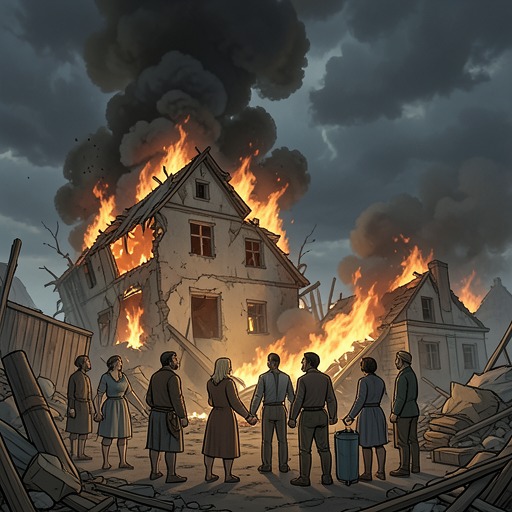
The city becomes inseparable from catastrophe when a fire ravages Chicago on the same night as the firestorm around Williamsonville and Sturgeon Bay. In Williamsonville, Robert’s house stands near the bay and is especially exposed; embers from the recent forest fires have already damaged roofs on both sides of the water. The surrounding Lower and Upper Sugar Bushes contain millions of acres of trees, dried by a summer without rainfall, turning the landscape into fuel for a disaster whose reach extends across communities.
The emergency also reveals the fragility of distance and infrastructure. The telegraph line out of Sturgeon Bay sends dozens of messages without receiving a response, and Anna assumes that the fire has consumed both the people and the only means of communicating over distance. Chicago’s simultaneous destruction makes the disaster regional rather than private, while the silence of the telegraph converts uncertainty into a separate form of danger: those waiting cannot know who has survived, where anyone has gone, or whether reunion remains possible.
Robert’s Exile and Reconstruction
Near December 1871, Robert walks for days toward Chicago, sleeping in barns when exhaustion overcomes him. The farther he travels from Anna and Sturgeon Bay, the less often he sleeps; by the time he sees the Chicago skyline, he has gone forty-eight hours without sleep, has lost his hunger, and can neither smell, taste, nor cry. His journey is physical, but its deeper movement is away from the life he believes he cannot claim.
Robert’s arrival does not restore him. The separation from Anna feels worse than the fiery debris that struck his back or her declaration that she loved him only in friendship. He considers returning, then rejects the thought because he refuses to steal Anna’s life from her. She has a family, and Chicago contains her sister and his brother’s baby; his desire for Anna therefore collides with his sense of responsibility toward the family network surrounding her. The city becomes a place where he can disappear into crowds by day and work through the night while avoiding the emotional consequences of going back.
Chicago nevertheless offers Robert a form of purpose. Because the city has also been ravaged by fire, he can help clear debris and unpack supplies during the cleanup and restoration. His labor cannot undo the loss of the fire, his parents, or Anna, but it gives his grief an outward direction. Reconstruction becomes the only available answer to devastation: he cannot repair his romantic life, yet he can help rebuild a burned hospital and contribute the skill that defines him.
Work, Identity, and Renewal
When Nathan asks Robert what he does for a living, Robert answers that he is a carpenter and proudly explains that he is helping rebuild one of the hospitals burned in the fire. Chicago consequently becomes the setting in which his identity is expressed through constructive work. The carpenter’s trade carries practical value in a city needing restoration, and Robert’s pride in it contrasts with the emotional condition that brought him there: he feels empty, exhausted, and incorrectly stitched together without Anna, yet he can still make and repair.
The city’s significance also depends on the difference between escape and renewal. Robert initially uses Chicago to lose himself among crowds and to distance himself from Anna, but the same place enables him to serve others and to establish a new role. The movement from burned buildings to hospital reconstruction does not erase his grief; instead, it shows recovery as an incomplete practice carried out amid damage.
A Recurring Geography of Separation
Chicago recurs across the book’s supernatural and romantic narratives as a place connected with departures, delayed returns, and altered family circumstances. The Sweet Lavvy’s voyage to the West Indies is followed by months without letters and rumors that the vessel has been lost, while Chicago remains part of the family geography through Nettie and the child of Robert’s brother. In another storyline, a baby is revealed as the daughter of a relationship that has unfolded through supernatural distortions of time, demonstrating again how pregnancy, kinship, and separation reorganize the meaning of place.
The city’s broader role is therefore structural rather than merely scenic. It links private rooms to public disaster, sisters to absent husbands, lovers to impossible distances, and bereaved people to the work of rebuilding. Against later scenes of violent confinement and supernatural threat elsewhere, Chicago represents a less enchanted but still unstable refuge: a city damaged enough to absorb Robert’s despair, yet active enough to give him labor, anonymity, and the first conditions of a different future.