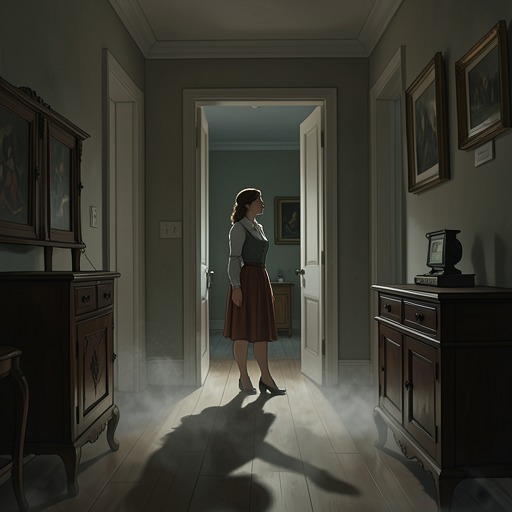
Francie’s house
Under Your Spell: A Romance Boxed Set of Masked Balls, Haunted Gardens, Magic, and MoreFrancie’s house is a two-story Victorian home in Savannah that initially offers Nicole Sherry a temporary base after her move from Chicago, but quickly becomes a site where domestic familiarity gives way to supernatural disturbance. Its defining significance lies in the contrast between a cared-for residence and the hostile, inexplicable signs that surface within it: flowers remain in bloom, the rooms retain formal order, yet foulness, decay, and altered space make the house impossible to experience as merely shelter.
Setting and Domestic Appearance
Nicole Sherry housesits Francie’s house for a month before Halloween, which is also to be her first day at a new job; she plans to find a home of her own afterward. The arrangement places her in a transitional position, neither owner nor permanent resident. She arrives from Chicago after a two-day drive toward the Georgia coast, having spent a night in a Knoxville motel, and sends her mother a photograph of one of the property’s creamy white camellias. The garden’s beauty, still flourishing in October when Chicago’s flowers have mostly faded, gives the house an initial image of seasonal abundance and Southern difference.
The residence is substantial but not described as a grand manor. It is a two-story Victorian with a formal interior, dark shining hardwood floors, and a grandfather clock ticking in the front entry. Those details establish a house organized by age, polish, and inherited domestic order. Nicole’s exploration of every room after finding the key beneath a flowerpot makes the property feel temporarily available to her, yet the house remains someone else’s space, full of objects and histories she has not learned to read.
The First Disturbances
The house’s unease begins through sensation rather than explanation. While descending the stairs to find water, Nicole feels as though a hidden camera is filming her. At the bottom, she encounters the smell of a dead, rotting animal, a stench so strong in the spotless kitchen that she expects to find a squirrel or raccoon inside a cabinet. The contrast is crucial: cleanliness does not dispel corruption but conceals it, making the ordinary kitchen an instrument of delayed recognition.
The disturbance becomes visible in the dining room when Aaron Cavanaugh visits to investigate. He remembers the interior as formal and unchanged, but sees a blackened bouquet on the table and calls it bizarre. Nicole is relieved that Aaron sees it too, because the house’s strangeness is no longer reducible to her exhaustion, isolation, or imagination. Their retreat toward the porch registers the building as an oppressive interior from which the body instinctively seeks release.
Thresholds, Hidden Spaces, and Impossible Architecture
Francie’s house repeatedly turns boundaries into sources of danger. In another episode associated with the house, a person tears up the carpet, loses balance, and passes straight through a wall rather than striking it. The resulting room is not the expected adjoining room but a tight, unusually clean space containing a dangling string and a rickety ladder. Pulling the string releases the ladder from above, revealing a concealed vertical passage within the supposedly familiar house.
This breach changes the house from a container into an active force. Walls no longer guarantee separation, and a floor no longer guarantees that what lies beneath it belongs to the visible plan of the building. The clean hidden area and the ladder suggest that the house preserves a private architecture outside ordinary domestic access. Its corners and concealed routes hold not comfort but withheld knowledge, while movement through them exposes characters to spaces they did not know existed.
Gothic Function and Narrative Significance
Francie’s house participates in the book’s broader Gothic pattern of making architecture carry emotional and supernatural pressure. Like the imposing castle-like house encountered behind a wrought-iron fence, with stone walls, a turret, a decaying balcony, lit windows, and faint music, it transforms arrival into hesitation: a character may still turn back, but the building has already begun to govern the encounter. The house’s menace comes not solely from what is seen; darkness, unexplained smells, a blackened bouquet, and the possibility of an unseen observer extend fear before any cause is identified.
The residence also stands in contrast with Willingdon Manor, which appears later as a nineteenth-century stone manor seemingly impervious to a lashing storm, with oriel windows, leaded glass, a sharply peaked slate roof, ivy, and smoke rising from four chimneys. Francie’s house is more intimate and deceptively ordinary. Its horror grows from the corruption of domestic scale: the kitchen, dining room, stairs, carpet, and wall become unstable. In that sense, it is not simply a haunted backdrop but a threshold between everyday independence and a supernatural world that repeatedly refuses to remain outside.
Human Passage Through the House
The house is connected to several forms of transition in the surrounding narrative. Nicole’s housesitting places her between cities, jobs, and dependence on her worried mother; her first exploration of the property is therefore also an attempt to inhabit a new life. The visit from Aaron Cavanaugh converts private apprehension into shared evidence, while the hidden passage converts architecture into an agent of discovery. Elsewhere, pregnancy, accelerated infancy, forced rescue, and family life show that houses in this world can contain extraordinary changes in identity and kinship as readily as they contain rooms.
Francie’s house consequently remains memorable because it makes shelter conditional. It promises privacy but produces surveillance, offers cleanliness but releases the odor of death, and presents solid walls that can be crossed without warning. Its most important narrative action is to unsettle the meaning of home: the familiar house is precisely where the familiar rules of space, safety, and perception begin to fail.