Gertrude Snodgrass
Under Your Spell: A Romance Boxed Set of Masked Balls, Haunted Gardens, Magic, and MoreGertrude Snodgrass is a knowledgeable neighbor and custodian of local memory whose brief appearance substantially widens the Abbot family curse beyond the plantation itself. Her warmth, domestic hospitality, and apparently ordinary family life contrast with the disturbing history she discloses: the Moriartys were rumored to be witches, and their transfer of the property to the Abbots was not the straightforward sale Jade Abbot had been led to believe. Gertrude therefore functions as both hostess and threshold figure, admitting Jade and Ryder Warren into her home while ushering them toward a more dangerous understanding of the past.
Identity and Introduction
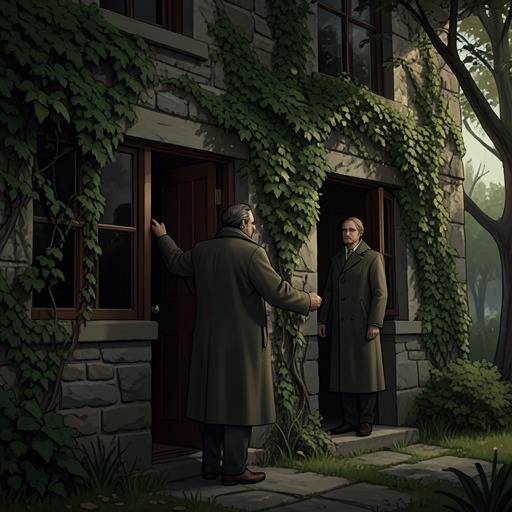
Gertrude first appears when Jade Abbot and Ryder Warren visit her house after confronting the curse surrounding the plantation. The front door opens before Jade can knock, but the opening is caused by Gertrude herself rather than by supernatural interference. She is presented through sharply observed domestic details: dangling earrings, perfectly styled short gray hair, and piercing gray eyes that move between the two visitors. Her appearance combines polish with alertness, suggesting someone accustomed to reading people and circumstances quickly.
Her first response establishes both her familiarity with the danger and her refusal to treat it as mere gossip. When Jade hesitates over the subject of the plantation, Gertrude immediately acknowledges the curse and invites both visitors inside. She has just prepared biscuits and gravy and insists that they remain for breakfast because they look as though they need a proper meal. The offer is practical and intimate, but it also creates a pause in the investigation: before supplying answers, Gertrude gives the frightened pair food, shelter, and a momentary experience of ordinary community.
Household and Family Background
Gertrude identifies herself as belonging to a family that has lived in the area for a very long time, longer than the Abbots. She does not present that longevity as a boast alone; it establishes her family as a local archive with knowledge that predates the plantation’s Abbot ownership. She promises that the broader history will be discussed, while simultaneously making clear that the house is large enough to feel excessive when occupied by only one person.
Her household is temporarily quiet. Her husband has gone to visit his mother, whom he has never liked, while her son and daughter-in-law are away arranging a baby registry for their first child. These details place Gertrude within a multigenerational family network and give her hospitality a social context: she is not an isolated recluse, but the momentary keeper of a house whose other rooms and relationships remain just beyond the visitors’ view. The unborn grandchild also provides a pointed contrast to the curse’s inheritance of death and fear. Around Gertrude, family continuity appears possible, even while the Abbot line faces a hereditary threat.
Gertrude’s cooking is described as excellent, and she speaks about her family through entertaining anecdotes rather than immediately delivering the supernatural history Jade and Ryder want. That conversational ease briefly frustrates Jade, who wants information about the curse, but it also makes Gertrude more than a mechanical exposition figure. She controls the pace of disclosure, allowing comfort and suspense to coexist. Her ordinary talk makes the later revelation about witches and property deception more unsettling because it emerges from a credible domestic setting rather than from an obviously ominous encounter.
Knowledge of the Curse and the Moriartys
Ryder asks directly whether the curse is connected to the plantation’s former owners, the Moriartys. Gertrude confirms that the Moriartys transferred the house to the Abbots on October tenth. The date immediately acquires personal horror for Jade: both her parents and her grandparents died on October tenth, fourteen years apart, and she was eight when her parents died. Gertrude’s information thus turns a family pattern that Jade already fears into a potentially historical mechanism.
Gertrude then corrects the apparent account of the transaction. She says that the Moriartys did not simply sell the house to the Abbots and insists that they were not ordinary people. According to local rumor, they were witches. This distinction is decisive. The plantation’s history is no longer a neutral transfer of ownership; it is bound to secrecy, supernatural power, and a conflict between the Abbot and Moriarty families. Gertrude does not yet provide the whole explanation, but her correction changes the interpretive frame through which Jade’s inherited deaths must be understood.
Her statement also gives the curse a human and genealogical origin. The threat is not merely attached to an old building, despite Jade’s wish that it might be confined to the house. Her parents and grandparents demonstrate that it can strike away from the plantation, while Gertrude’s testimony links that mobility to the former owners and to the date on which the property changed hands. Gertrude’s knowledge therefore bridges space and time: it connects present bodily danger, family memory, and the disputed history of the land.
The Living Moriarty Connection
When Jade asks whether any Moriartys are still alive, Gertrude answers that one woman remains known to her: Katrina Moriarty, who lives in North Carolina. Gertrude leaves the room and returns with Katrina’s address written on a piece of paper, explaining that the information was found on the Internet. The act is strikingly concrete. A curse that has seemed ancient and inaccessible suddenly produces a modern line of inquiry, carried in the form of an address that Jade can use.
Gertrude’s comment that it is amazing, and somewhat frightening, what can be learned online creates a small but meaningful contrast between technological research and supernatural knowledge. The Internet supplies a trace of the Moriarty family, but Gertrude supplies the interpretive significance of that trace. Her help transforms the investigation from a search through inherited stories into the possibility of contacting a living descendant. Katrina becomes not just a name from local rumor but a reachable person who may possess the missing account of the curse.
Narrative Role and Significance
Gertrude occupies the threshold between safe domestic life and dangerous historical revelation. The doorway of her house opens without a knock, yet she makes clear that a person, not a curse, is responsible; this distinction momentarily reassures Jade while emphasizing how closely ordinary hospitality now borders on supernatural threat. Her breakfast table offers refuge, but the conversation at that table exposes a history capable of following the visitors anywhere.
As a character, Gertrude is defined by the productive tension between caretaking and withheld knowledge. She feeds Jade and Ryder, shares family anecdotes, and notices that they look as though they have seen a ghost. At the same time, she delays the information they most urgently need, retaining control over the family history until Ryder asks the correct question. Her response is neither a full confession nor evasive silence. Instead, she supplies successive thresholds of knowledge: the curse is real, the Moriartys are central, the October tenth transfer is suspect, witchcraft is part of the rumor, and Katrina Moriarty is still alive.
Her significance lies in making the curse legible as a social inheritance rather than an isolated haunting. Gertrude’s family predates the Abbots in the area, her house preserves local continuity, and her research identifies a surviving Moriarty branch. Through her, the plot’s supernatural mystery becomes an investigation into ownership, ancestry, and concealed obligations. She does not resolve the curse, but she gives Jade and Ryder the first credible route toward its source, turning hospitality into the beginning of pursuit.