Great Peshtigo Fire
Under Your Spell: A Romance Boxed Set of Masked Balls, Haunted Gardens, Magic, and MoreThe Great Peshtigo Fire is the decisive historical catastrophe in Robert Williams and Anna Williams’s story: a firestorm driven across an exceptionally dry landscape that destroys forests, homes, workplaces, communications, and much of the community around Williamsonville. Its importance lies not only in the scale of the physical devastation but also in the way the disaster converts ordinary family life into an encounter with collective death, leaves Robert Williams bereaved and injured, and becomes an event preserved through testimony, ceremony, and memory.
Causes and Environmental Conditions
The fire begins in an environment already primed for extreme destruction. A full summer without rainfall has left the forests of the Upper Sugar Bushes and Lower Sugar Bushes—millions of acres of trees west of the bay—drier than a desert. When wind carries embers from recent forest fires across the bay, Robert Williams’s unfinished roof is among the structures damaged. The same dry, windy autumn has endangered communities on both sides of the water, showing that the catastrophe is not an isolated house fire but the violent convergence of drought, combustible woodland, and weather.
Rain arrives only after the worst has passed. Anna Williams’s father later observes that the drought must have contributed to the fire’s severity, making the belated rainfall an image of both relief and inadequacy: water finally comes, but it cannot restore the people, buildings, forests, or lines of communication already consumed. The surrounding landscape therefore functions as an active condition of the disaster rather than a passive backdrop.
The Firestorm in Williamsonville
Robert Williams first encounters the emergency through the fire siren, waking in absolute darkness and struggling free of his blankets. Smoke and burning leaves have entered the cabin, and he calls for Charles Williams because the danger has already crossed the boundary of the house. When Charles Williams descends from the loft, panic is visible on his face; outside, the night is illuminated by fire, and Robert Williams experiences terror as something overwhelming and bodily rather than as a distant report.
The brothers initially confront the problem of shelter while the firestorm moves around them. Robert Williams refuses to follow men who lead their families into a field, believing the open ground offers no protection. The fire twists overhead as an opaque tornado of gold, red, and orange, while debris falls through the air and the storm drowns out attempts to call to relatives and neighbors. The disaster destroys the ordinary social geography of the settlement: people with whom Robert Williams worked, worshiped, and shared picnics become figures separated by smoke, wind, and lethal heat.
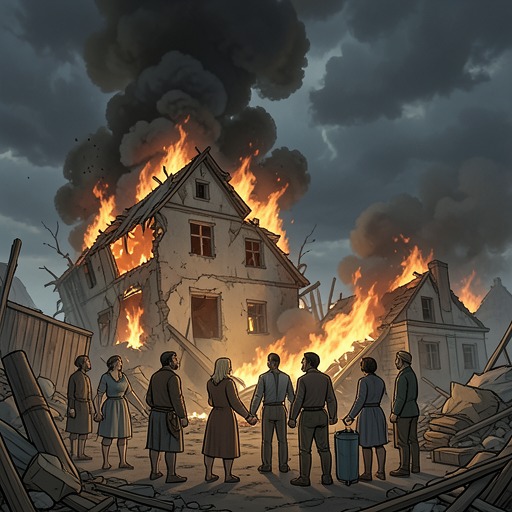
At the town center, flames lick buildings on both sides of the dirt lane. Robert Williams forces himself forward despite the burn in his lungs and finds his parents’ house ablaze. Smoke pours from the windows, the front door hangs open, and flames rise through the holes in the roof he had been repairing. A piece of blue calico draws his attention to a body outside the house, and he recognizes it as his mother. Charles Williams restrains him, preventing him from rushing into the burning structure, then insists that they find shelter.
Robert Williams identifies the bay as their only chance. Charles Williams pulls him back toward the cabin and leads him through heat, ash, and the smell of burnt hair and flesh. The bay offers no comforting boundary: people already wade into water that appears to burn beneath the falling fire. Robert Williams enters at a run, and the cold climbs through his legs into his gut, yet he continues because the water is the only available refuge from the firestorm above. In the bay he encounters the body of Joseph Alder, a man he knew from unloading maple logs and whose wife had recently given birth to their third son. That recognition makes the death personal and communal at once.
Death, Isolation, and Survival
The fire also isolates Sturgeon Bay from the surrounding world. The telegraph line out of Sturgeon Bay sends dozens of messages without receiving a response, and Anna Williams assumes that the fire has destroyed the means of communication as well as the communities beyond it. Sirens continue to fill the air even though the funnel does not directly strike Sturgeon Bay, leaving residents suspended between warning and uncertainty. Anna Williams waits by the front door, imagining that Charles Williams may have survived because Robert Williams’s house stands near the bay, but she has no reliable information.
The first reports that reach Anna Williams are devastatingly incomplete. Her father says that the entire town of Peshtigo is gone and that hundreds may be dead, with bodies scattered from the Sugar Bushes to the bay on the western side. The fire has raged until it reaches the water, turning the bay into the apparent endpoint of a destruction that has erased the intervening landscape. Because the telegraph is down and no survivors have been seen from the other side, rumor and silence become the only available forms of knowledge.
Robert Williams survives but remains unconscious for three days. When he awakens, Anna Williams tells him that Charles Williams is not coming: her father has found his body on the shore. She also reports that more than sixty people from the settlement have died, some unidentified, and that bodies have been found near or within the settlement. The mill is gone, every building has been destroyed, and the entire forest in the Sugar Bushes across the bay has burned. Williamsonville has suffered the greatest casualties after Peshtigo, making Robert Williams’s survival miraculous but leaving him alive amid the remains of his family, workplace, and community.
Grief and Communal Memory
The disaster’s aftermath is organized through both uncertainty and ritual. A mass ceremony in Williamsonville is planned for the following day so that the dead can be honored together, including those whose identities cannot be established. The ceremony cannot undo the losses, but it gives the devastated settlement a public form in which to acknowledge them. Robert Williams’s question about how many parents, cousins, friends, and mill workers he has lost reveals the scale of grief as an accounting that cannot yet be completed.
Anna Williams’s care for Robert Williams links private mourning to shared trauma. She has suffered the same destruction, and her gentle touch communicates an understanding that ordinary consolation cannot. Yet the scene also introduces an uncanny consequence of survival: Robert Williams feels drawn toward the life force pulsing from her, with an urge to hold her until he absorbs it, an impulse sharply different from his earlier desire for intimate closeness. The fire has therefore altered not only the external world but also the meaning of bodily contact, life, and attachment.
The event is preserved through later retelling alongside other stories of death, haunting, and survival. The book repeatedly places natural spaces and damaged human environments beside memory: a cemetery on a Maine island keeps generations of ordinary fishermen and war veterans within a living forest; Lavinia Lockett Sewall’s account of the lost Sweet Lavvy turns disappearance at sea into a story that may outlast proof; and later supernatural encounters make the dead speak across gaps in ordinary knowledge. Against that wider pattern, the Great Peshtigo Fire becomes both documented catastrophe and remembered haunting, an event whose victims remain present through the survivors’ narratives.
Narrative Significance
The Great Peshtigo Fire concentrates several of the book’s central oppositions. Fire is destructive yet revealing: it strips away buildings, family security, and assumptions of permanence, while exposing the dependence of isolated communities on forests, water, shelter, and communication. The bay is simultaneously danger and refuge, the telegraph simultaneously a promise of connection and a symbol of its sudden failure, and rain arrives as both rescue and evidence that rescue has come too late.
Its historical force also contrasts with the apparently ordinary details that surround it. Robert Williams has been repairing a roof, cooking stew, asking after Anna Williams, and living within a family house made by hand; then the siren transforms these domestic acts into the prelude to flight. The fire’s violence is measured not only by the number of dead or the loss of the mill, but by the destruction of the routines that made the settlement recognizable as home.
The event’s lasting significance lies in the collision between environmental vulnerability and human memory. Drought and wind create the conditions for the fire, but survivors supply its emotional and moral record. Robert Williams carries the catastrophe through physical survival, bereavement, and an altered relationship to life itself; Anna Williams carries it through waiting, uncertainty, and care. In this way, the Great Peshtigo Fire is not merely a disaster in the plot. It is the wound around which family history, communal ritual, ecological destruction, and the book’s larger preoccupation with the persistence of the dead are arranged.