Hell
Under Your Spell: A Romance Boxed Set of Masked Balls, Haunted Gardens, Magic, and MoreHell is the supernatural destination Daisy pursues when ordinary means can no longer bring her to the man she is trying to find. Reached through occult knowledge rather than physical travel, it is both a literal realm and the decisive threshold of her quest: entering it requires her to accept danger, confront the unknown, and move beyond the boundaries of human experience.
Access and Threshold
The route to Hell is first presented as forbidden knowledge. A bookstore owner claims that a man who made a deal with the devil bears recognizable signs, including the presence of a demon, and then offers Daisy a way to reach Hell. The owner opens a book filled with strange symbols—giant eyes, triangles, and interlocking circles—making the passage depend on a written occult system rather than a conventional map. Daisy’s question about whom she could find reveals that her purpose is not abstract curiosity: Hell is a destination she intends to use in pursuit of a specific person.
The threshold is confirmed when Daisy encounters Will. She asks whether the route before her is the way to Hell, and his startled reaction establishes that the question is both startlingly direct and correct. His reply also distinguishes the realm from a simple afterlife metaphor: Daisy is human, not undead, yet she has crossed into a place where supernatural categories are ordinary. Her arrival therefore carries the danger of a living person entering a domain not designed for her.
Landscape and Passage
Hell is connected to the River Acheron and to Charon, whose function is that of a ferryman between shores. After the boat reaches the opposite bank, Charon lowers his hood, rows away without looking back, and offers Daisy neither farewell nor explanation. On the shore she has left behind, another solitary figure in gray tatters waits for passage, suggesting a continuing traffic of the dead and a realm structured by repetitive crossings rather than by Daisy’s individual needs.
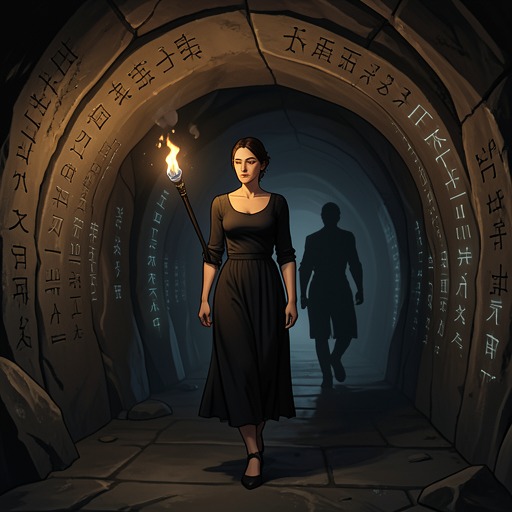
The entrance itself is hostile. Daisy fights nausea, plucks a bunch of red flowers from the ground with a sickening popping sound, and takes care not to look into their eyes before entering the tunnel. The flowers are not passive decoration: their apparent eyes turn the threshold into a landscape that watches the traveler. Daisy carries the stems with her as she proceeds, preserving a physical reminder of the danger she has already touched.
Beyond the river and the tunnel, the air grows increasingly warm, distant howls become audible, and the passage descends into jagged earthen steps. Daisy follows the staircase for roughly half an hour or more while the flower stems grow moist in her hands. Hell is thus represented through bodily pressure, sound, downward movement, and unsettling organic detail. Its geography is less a stable vista than a progressive loss of ordinary orientation, a descent whose physical sensations make the supernatural destination immediate.
Encounters and Boundaries
The realm is not empty after Daisy crosses its threshold. Will has indicated that a woman named Hecate lies ahead, and Daisy continues toward that uncertain encounter while carrying the flowers she gathered at the entrance. The expectation of meeting Hecate gives the descent a provisional direction, but it does not make the route safe; the tunnel’s warmth, howls, and jagged staircase keep the destination threatening even when a possible guide or authority is known to be nearby.
Hell also contains controlled spaces and explicit boundaries. At the beginning of chapter thirteen, a handsome man in a three-piece suit waits at the back of an elevator as though preparing to enter a business meeting. His composure contrasts sharply with Daisy’s hazardous descent, suggesting that the realm can present itself not only as a cavernous underworld but also through bureaucratic or institutional forms. When he tries to move into a room, a strong green vine blocks his path, while a faceless woman announces that Mr. Hades is available to see him. The scene places access under supernatural administration: identity, ownership, and physical barriers determine who may enter and who may be received.
Daisy’s own passage is marked by a similar uncertainty over possession and authority. The statement that one woman is “mine” and the subsequent announcement of Hades’s availability imply competing claims over Daisy and a hierarchy in which Hades controls audiences and access. Hell therefore functions not merely as a landscape of punishment but as a governed domain in which supernatural figures regulate movement, meetings, and claims upon the living.
Narrative Significance
Hell gives concrete form to Daisy’s determination to recover someone who cannot be reached in the ordinary world. The bookstore owner’s occult book opens the possibility of a route, the ferryman enforces the transition, and the tunnel tests Daisy’s courage before she reaches the deeper realm. Each stage converts an emotional objective into an external ordeal: knowledge must be obtained, passage must be survived, and fear must be endured.
The setting also combines the familiar with the impossible. A ferryman, a river, a descending tunnel, red flowers, howls, and a faceless woman belong to an unmistakably mythic underworld, yet the elevator, business suit, and appointment with Hades introduce the language of modern administration. That contrast makes Hell feel less like a distant myth than a parallel institution with its own offices, gatekeepers, and rules. Daisy’s entry exposes the cost of crossing into it, while the later elevator scene suggests that even in this realm, power is expressed through controlled access and denied passage.
Hell’s decisive importance lies in the way it changes the scale of Daisy’s story. What begins with an inquiry into a suspected devil’s bargain becomes a journey through a supernatural order inhabited by demons, ferrymen, Hecate, and Hades. The descent tests Daisy physically and psychologically, but it also establishes that her search has entered a world where human bravery alone cannot guarantee safety. Hell is consequently both destination and ordeal: the place she must reach to find the person she seeks, and the environment that reveals how much she is willing to risk in order to do so.