Lower Sugar Bushes
Under Your Spell: A Romance Boxed Set of Masked Balls, Haunted Gardens, Magic, and MoreLower Sugar Bushes is the forested region west of the bay, a landscape measured in millions of acres and defined by the same timber wealth that sustains Williamsonville and by the extreme dryness that makes that wealth dangerous. Its decisive significance lies in this double identity: it is both the material foundation of a working community and the source from which a recent fire sends destruction across the water.
Definition and Setting
Lower Sugar Bushes extends alongside Upper Sugar Bushes to the west of the bay. After a full summer without rainfall, its trees are described as drier than a desert, turning the forest into an immense reservoir of fuel. The recent forest fires are not treated as an isolated disturbance; wind carries their embers across the bay, linking the wooded region directly to homes, workplaces, and families on the opposite shore.
The setting also establishes a seasonal pressure. The events occur in a dry, windy autumn, with October already giving way toward winter. Smoke remains in the air even after the fire sirens have been silent for almost a week, and the atmosphere leaves a sticky coating in the lungs. The forest’s danger therefore persists beyond the visible flames, registering as altered air, damaged structures, and an approaching winter that allows little time for repair.
Timber Economy and Community
Lower Sugar Bushes is inseparable from the shinglemill economy of Williamsonville. The mill requires a continual supply of lumber, while workers spend long days hauling sticky logs and weeks pressing tacky wood pulp into shingles. Robert’s father, a Belgian emigrant, founded the small mill settlement in the town of Brussels, and the enterprise’s success enables the family to begin building the nicest house in Williamsonville.
The mill’s reach is communal rather than merely individual. Robert’s brothers, cousins, and nephews benefit from it, and roughly seventy-five men employed there live and flourish in Williamsonville. The forest thus appears as a source of work, family advancement, and collective settlement. Yet the same resource system places workers and their homes near the combustible landscape, making prosperity dependent on an environment whose accumulated dryness can reverse the community’s fortunes with terrifying speed.
Fire and Human Exposure
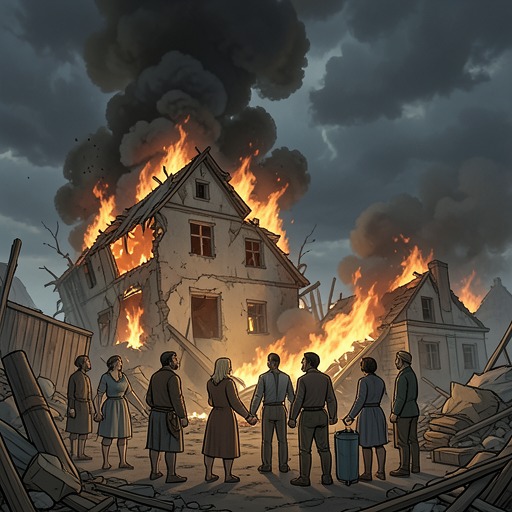
Wind-blown embers from the fires in Lower Sugar Bushes damage Robert’s roof, one of many roofs affected on both sides of the bay. Robert is already anxious to complete the repairs before winter, and the chill entering through gaps in the cabin’s logs makes the practical consequences immediate. The damaged roof is not only property loss; it is a sign that the forest fire has entered domestic life and has narrowed the time available for survival and recovery.
When the fire intensifies, the landscape becomes nearly impossible to cross. Charles pulls Robert along the path toward shelter while flames and wind overwhelm ordinary speech. Heat sears Robert’s mouth and nose, and ash, burnt hair, and flesh fill the air. The brothers finally reach the bay, which appears to offer the only possible refuge from the burning sky. Other people are already wading into the water, but even the bay seems threatened, its surface reflecting the fire’s life-stealing force.
The crossing exposes the unequal human cost hidden inside the forest economy. In the water, Robert encounters the body of Joseph Alder, a coworker with whom he had spent many lunch breaks while unloading maple logs. Joseph’s death gives the disaster a personal and social scale: the fire does not merely consume trees or damage buildings but destroys members of the tightly connected laboring community, including people with families and recently born children.
Narrative Significance
Lower Sugar Bushes functions as more than background. Its ecological condition drives the fire, its timber supports Williamsonville, and its embers connect a remote forest to the intimate spaces of a cabin, a roof, a workplace, and a family network. The location embodies a form of environmental violence that accumulates quietly through drought, smoke, and combustible vegetation before becoming spectacular in its effects.
The contrast between the forest’s economic usefulness and its destructive potential gives the setting its lasting force. Lower Sugar Bushes sustains the settlement’s prosperity while exposing its workers to the consequences of that prosperity. In the fire sequence, the usual direction of labor—from forest to mill, from mill to household—reverses: the forest’s stored energy travels back toward the people who depend on it, transforming a source of livelihood into a threat to life itself.