Peshtigo
Under Your Spell: A Romance Boxed Set of Masked Balls, Haunted Gardens, Magic, and MorePeshtigo is the Wisconsin settlement at the center of the book’s most devastating historical catastrophe: the Great Peshtigo Fire. It is remembered not as an ordinary town but as a place nearly erased by drought, flame, and the loss of hundreds of lives. Through reports of the disaster, the deaths of Robert Williams’s family and community, and the later circulation of stories about survival, Peshtigo becomes a landscape where private grief and collective memory are inseparable.
Setting and Historical Catastrophe
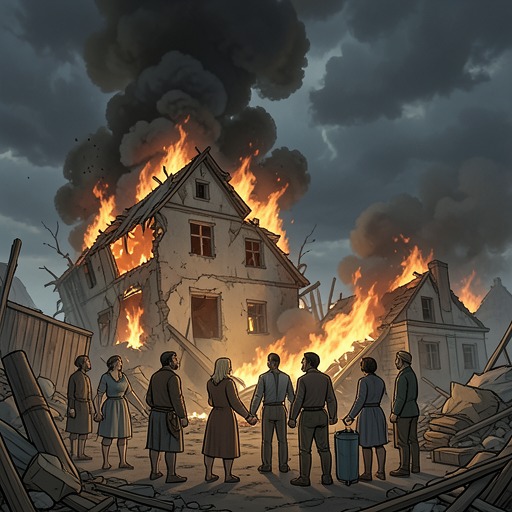
Peshtigo appears in the aftermath of a fire whose severity was linked to a prolonged drought. When rain finally arrived, Robert Williams’s father explained that the dry conditions had contributed to the intensity of the flames, but the rain came too late to protect the settlement. The fire consumed the town and continued through the surrounding country until it reached the water on the western bay. The reported scale of destruction is immense. Word reaches Anna Williams that the entire town of Peshtigo is gone, while bodies lie across the region from the Sugar Bushes to the bay. The telegraph line is down, survivors have not been seen, and the absence of communication makes the catastrophe feel both geographically vast and terrifyingly incomplete: the living cannot yet determine who has escaped, and the dead cannot yet be individually named.
Death and Destruction
Peshtigo is associated with a death toll described in hundreds, with bodies found throughout the burned landscape. The settlement’s destruction is not limited to homes or public buildings; the surrounding forest in the Sugar Bushes is also gone, extending the fire’s reach beyond the built environment and making the town’s loss part of a larger ecological ruin. The fire’s violence is especially concentrated in Williamsonville, which is said to have suffered the most casualties after Peshtigo itself. The report that the entire forest on the other side of the bay has burned places the town within a chain of connected losses rather than treating it as an isolated tragedy. Peshtigo is therefore both a community that has vanished and the central point from which the destruction radiates outward.
Survivors and Communal Mourning
Robert Williams survives, but his survival is presented as miraculous against the scale of the disaster. He has been unconscious for three days when Anna tells him that the mill is gone, every building has been destroyed, and more than sixty people from the settlement have died. Some of the bodies remain unidentified, although they have been found near or within the settlement. The language of survival is consequently inseparable from the knowledge that almost everything familiar has disappeared. The dead include people Robert knew personally: his parents, cousins, friends at the mill, and the man Anna tells him will not return because her father found his body on the shore. Their deaths turn Peshtigo from a geographic name into a map of intimate absences. A mass ceremony in Williamsonville is planned for the following day, giving the community a public form for grief even when individual identities cannot be recovered. Mourning becomes an act of reconstruction after the town’s physical structures have been destroyed.
Memory, Place, and Narrative Significance
Peshtigo’s significance lies in the tension between historical catastrophe and the stories used to preserve it. The telegraph failure and the lack of confirmed survivors delay knowledge of what happened, while later testimony gathers scattered deaths, burned buildings, ruined forests, and shoreline discoveries into a communal account. The town’s history therefore survives through witnessing: one person reports what has been heard, another identifies what has been lost, and the survivor carries the catastrophe in the body and memory. The place also establishes a recurring contrast between death and continuing life. The surrounding natural world is capable of sustaining forests, settlements, and families, yet in the fire it becomes the medium of destruction. Peshtigo’s ruin is not presented as an abstract historical statistic; it is experienced through soot, silence, failed communication, unidentified bodies, and the shock of a survivor who must imagine the dead before learning their names. In that form, Peshtigo functions as a lasting emblem of collective trauma: a town reduced to absence, but kept present by ceremony, testimony, and the miraculous fact of those who lived.