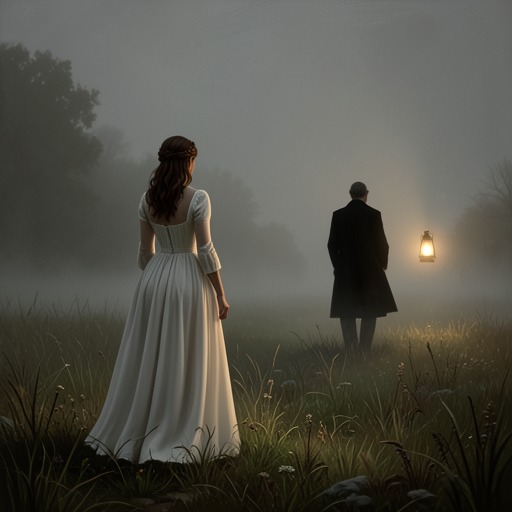
Polly Shepps's Restless Ghost State
Under Your Spell: A Romance Boxed Set of Masked Balls, Haunted Gardens, Magic, and MorePolly Shepps's Restless Ghost State transforms an apparently cheerful house and garden into the physical territory of an unresolved death. Polly does not haunt as a vague, silent presence: she returns through corpse-like odors, a recurring love song, damaged apparitions, accusations, and flowers that become emblems of injury and death. Her haunting is therefore both a supernatural condition and a repeated demand that the living acknowledge what happened to her and release her from the rage that prevents her from moving on.
Definition and First Manifestations
The state first announces itself through the camellias in the spotless kitchen and dining room. Nicole finds no animal carcass or other ordinary source for the smell, yet the flowers exude the stench of putrefying corpses. Their beauty becomes intolerably unfamiliar: camellias should smell pleasant, but these blooms make Nicole gag and associate the house with concealed death. The flowers also connect the haunting to sound and memory. Nicole recognizes that Polly made her sing the song heard in her dream, an impossible compulsion that links the garden's cultivated beauty to Polly's history and to Nicole's own vulnerable inner life.
Nicole's bodily response makes the haunting real before she can explain it. She cannot bring herself to open the back door or even look toward it, and she carries the camellias through the house with all her self-control engaged, resisting the urge to run. Once outside in the hazy golden sunlight, she briefly doubts her fear because the neighborhood appears cheerful, with narrow houses and ornate iron railings standing close together. That contrast is central to the ghost state: the setting looks ordinary and sociable while the garden conceals an experience of rot, fear, and historical violence.
Apparition and Recognition
Aaron becomes the first independent witness to Polly's presence. Looking toward the garden from his balcony, he initially mistakes the figure for Nicole, then sees a different woman with short, wavy blond hair and a pale dress. The apparition flickers in and out of view before revealing blood and gore covering half her face, running down her neck and soaking the left side of her dress. She bends to smell a rose and shimmers in a manner that neither streetlight nor moonlight can explain; when Aaron looks again, the garden is empty.
Aaron considers several explanations, including that he may have seen Nicole in a distorted form or imagined a figure like a character from an old horror film. His conclusion is that he saw a ghost, a possibility compatible with his lifelong belief in ghosts and the stories he heard from his grandmother while growing up in Savannah. Nicole then tells Aaron directly that there is a ghost in Francie's house, expecting skepticism or dismissal. Instead, Aaron confirms that he believes her because he saw one himself. He describes the spirit as a young woman dressed as though she belonged to the era of the Depression and notes that she was crying before disappearing. Nicole realizes that the apparition is the woman from her dream, turning a private nightmare into shared evidence.
Aaron and Nicole infer that Polly's husband may have buried her in the garden. The theory explains the flowers' disturbing behavior as well as Nicole's instinctive fear of going outside. Aaron agrees that Polly must still be there, not necessarily as a body visible to the living but as a presence bound to the place where her death and concealment remain unresolved. The garden thus operates as both burial ground and psychic enclosure.
The Bound Spirit's Accusations
When mist gathers from several directions, it forms a pillar and then the shape of a body and head before becoming Polly. Her appearance makes the violence of her death impossible to evade: one side of her blond hair falls in glamorous marcelled waves, while the other side of her head is smashed, leaving an unseeing eye precariously lodged in its broken socket. Blood covers half her face, neck, gingham housedress, and apron. The ghost is simultaneously insubstantial and undeniable, a visual embodiment of a death that has not been properly witnessed or settled.
Aaron addresses Polly with controlled compassion, telling her that they know what happened and asking her to stop bothering them and move on to a better place. Polly rejects the appeal. Her face contracts with loathing and fury, and she says that she will not move on after what Aaron and Nicole did to them. The plural pronoun widens the haunting beyond a single corpse: Polly treats the living pair as participants in a pattern of injury, abandonment, or emotional damage that binds their histories to hers even though they did not cause her murder.
Polly's knowledge is disturbingly intimate. Nicole feels that the ghost knows everything about her, including the man who planned to marry her and then abandoned her, as well as the earlier boyfriend whose words and wounds still shape her. Polly appears linked to Nicole's memories, perhaps even to her soul. The spirit also recognizes the fears haunting Aaron and tells him that he knows what he did, though Aaron denies ever hurting anyone. Polly's accusation remains deliberately unresolved in the encounter, but its force lies in her ability to identify the emotional injuries the living attempt to leave behind.
The ghost's claim that all people are the same and that none of them can move on defines the condition as a cycle rather than a single manifestation. Polly's restlessness is sustained by rage, grief, and the conviction that the living repeat the abandonment suffered by the dead. Her scream, animal-like in its agony, ends the confrontation temporarily. After Polly vanishes, a pristine camellia blurs into a grinning skull, and the white roses rearrange themselves into more skulls. The garden becomes an explicit landscape of death, making visible the horror that had previously been displaced into odor, instinct, and uncertain glimpses.
Release Through Shared Letting Go
Polly's state changes when she returns to the garden with Aaron and Nicole. Fragrant camellias and roses fill the air with an unnatural intensity, as though the pair were standing in a greenhouse containing thousands of blooms. Mist again gathers in the center, and Aaron places himself in front of Nicole before standing beside her, ready to face the apparition rather than flee from it.
This time Polly appears in the same housedress with the same pale, marcelled hair, but her face is symmetrical and uninjured. Nicole immediately notices the change in her head. Polly touches the side of it and finds no damage or gore, then looks between Aaron and Nicole in bewilderment. The restored face signifies more than a cosmetic alteration: the ghost is no longer forced to repeat the visual instant of her murder. Her identity is beginning to separate from the wound that has defined her return.
Nicole tells Polly that she could not hold on to her own hurt and that Polly cannot hold on to hers either. The words establish a reciprocal recognition rather than an order imposed by the living. Polly looks around the fragrant garden and nods while becoming increasingly transparent. Aaron understands that she is letting go, and Nicole recognizes that Polly's release may be connected to her own decision to relinquish pain. The haunting therefore ends through emotional change as well as supernatural intervention; Polly is not exorcised by force, but met at the point where grief can cease to be the sole structure of her existence.
Nicole tells Polly that she should move on and deserves to have some fun, realizing as she speaks that the wish is sincere. Polly smiles as a young and lovely woman rather than a corpse marked by rage. She walks toward the garden gate humming the beautiful love-song melody that had appeared in Nicole's dream, converting the earlier compulsion into a final act of self-directed movement. The recurring song no longer traps Nicole in fear; it accompanies Polly toward departure.
Ending and Significance
Polly disappears at the garden gate. When Aaron counts to ten to test whether she has truly gone, nothing interrupts the count until the number nine, when glimmering flecks of light fill the air above the garden. The lights spiral upward like sparks from a campfire, rise until they resemble stars, and melt into the violet-blue sky. The sign confirms that Polly has moved beyond the house and garden rather than merely withdrawing from sight. Aaron and Nicole both recognize that the atmosphere has changed; the place no longer carries the same oppressive presence.
The completed release gives Polly Shepps's Restless Ghost State a clear arc: hidden death produces a sensory disturbance, the disturbance becomes an apparition, the apparition confronts the living with their wounds and evasions, and recognition permits transformation. The flowers trace that movement from putrefaction and skull images to fragrance and beauty. Polly's damaged face first makes violence visible, while her restored face allows her to appear as a young woman with a future-like possibility rather than as the fixed image of her death. Her disappearance does not erase the murder, but it ends the repetition that had made the garden a prison.
Polly's haunting also functions as a dark mirror for Nicole and Aaron. She exposes Nicole's unresolved experience of abandonment and confronts Aaron with guilt or fear that he cannot articulate. Yet the final encounter does not collapse their stories into Polly's. Nicole can acknowledge shared pain without accepting the claim that everyone is the same or that no one can move on. In that distinction, the ghost state becomes a narrative test of whether suffering must be repeated in order to remain real. Polly is released when her death is recognized, her wound is no longer made to define her, and the living answer her demand with compassion instead of denial.