Ryder Warren
Under Your Spell: A Romance Boxed Set of Masked Balls, Haunted Gardens, Magic, and MoreRyder Warren is introduced as a man standing at the edge of an unwanted but necessary new beginning. Driving a rustic pickup along remote gravel roads toward a potentially well-paying job, he feels unsettled rather than hopeful, even though it is his first job in a long time. His unease is not simple reluctance: the work represents a life assembled after the collapse of the future he once expected to inherit. The journey therefore carries both practical stakes and personal displacement.
Identity and Background
Ryder Warren grew up on a ranch and had assumed that he would eventually take it over for his father. That plan ended when his father sold the ranch a few years earlier, leaving Ryder without the education or professional credentials that the wider world appears to demand. He never went to college because he had expected the ranch to be his place, and he consequently sees handyman work as one of the few occupations available to him in a world organized around degrees and papers. Yet the narrative does not present this absence of formal education as an absence of ability. Ryder likes using his hands, knows that he is good at repairing things, and approaches difficult physical work with confidence grounded in experience rather than certification.
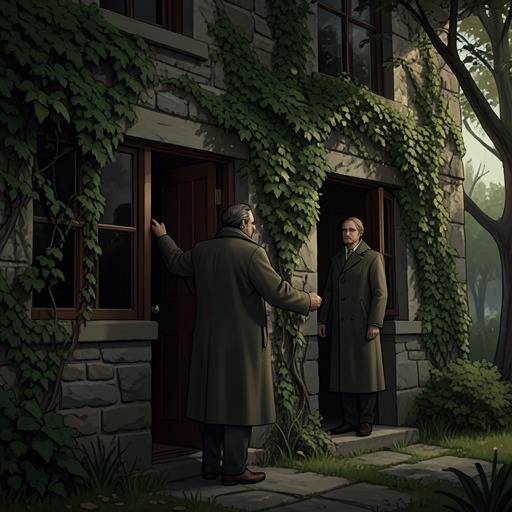
His first view of the new job makes the scale of that challenge unmistakable. The plantation home is boarded up and being reclaimed by the bayou: ivy covers more than half the facade, weeds overwhelm the struggling flowers, the lawn has become mostly swampland, and peeling paint reinforces the impression of total neglect. There is not even a visible path to the front door. Ryder recognizes the property as a handyman's worst nightmare, but also as a potentially lucrative opportunity. The same ruin that promises exhausting labor offers him the chance to earn a substantial amount of money and prove the value of his practical skills.
Entry into the Supernatural Plot
Ryder's initial role is that of an outsider arriving to repair a place he does not yet understand. His question about what happened to the house marks the beginning of an investigation as much as a work assignment. The property is physically damaged before its history is explained, and Ryder's impulse is to approach the mystery through observable problems: the overgrowth, the mud, the inaccessible windows, and the work required to restore the building. His material competence becomes the ordinary-world perspective against which the supernatural elements acquire force.
That practical entrance is immediately undercut by a humiliating accident. Ryder creeps toward an unboarded window to look inside, hooks his fingers over the ledge, and then slips in the mud. He falls onto his back, smears himself with mud, and strikes his head against a rock, leaving him dazed. The arrival of a woman while he is on the ground makes the scene both comic and exposing. When Jade Abbot approaches with a displeased frown, her hands on her hips, and asks whether he is Ryder in a tone that suggests she hopes he is not, he answers easily and tries to appear relaxed despite being covered in mud. His self-possession is not invulnerability; it is a social defense that lets him preserve dignity when the job has made him look ridiculous before it has even begun.
The apparent repair assignment soon becomes entangled with the plantation's curse. By the fifth chapter, Ryder recognizes that ghosts explain much of what has happened, including Jade gasping for air with her hands at her neck as though she were choking. His understanding shifts from uncertainty about a damaged house to recognition that the danger is supernatural and active. This is a decisive change in his position: the man who arrived to fix a building must now respond to forces that cannot be handled with tools, lumber, or paint.
Relationship with Jade Abbot
Ryder's connection with Jade Abbot develops through shared exposure to danger and through the disclosure of their pasts. The curse attack gives their relationship an immediate seriousness, but it does not erase the attraction between them. After they have survived the attack and spoken about their histories, Ryder finds himself wanting to know more about Jade. Knowledge becomes part of desire: the more of herself she reveals, the more deeply his interest grows.
Their physical intimacy is presented from Ryder's perspective as both passionate and unexpectedly tender. He loves kissing Jade because she gives so much of herself with each touch, yet the experience also makes him want to be gentle. That impulse matters because it shows Ryder moving beyond the role of the resilient laborer or flirtatious outsider. His response to Jade is not merely appetite; it is care shaped by what they have endured together and by the emotional trust created through sharing their pasts. He also concludes that she is an exceptionally good kisser, allowing humor and warmth to remain present within the frightening circumstances.
Jade's response confirms that their intimacy has altered her attitude toward the house and the work surrounding it. After kissing Ryder, she pulls back with a beaming expression and says, “Maybe I won’t level the place after all.” The exact remark connects romance to the physical fate of the plantation. What Ryder initially sees as a damaged property requiring his labor becomes a place whose destruction or preservation is bound up with Jade's feelings and their developing bond. The exchange also gives their relationship a playful register without diminishing the curse that brought them together.
Transformation and Ending
Ryder's arc moves from professional uncertainty and personal disappointment toward emotional fulfillment. At the beginning, he is unsettled on the way to his first job in ages, irritated that the ranch his father had sold will not become his inheritance, and aware that his lack of college credentials limits his choices. He is capable, but he begins from a position of reduced opportunity, trying to turn manual skill into a viable future.
The plantation job forces him to confront a threat outside his practical frame of reference, and the curse attack places Jade's safety alongside his own. His recognition of the ghosts does not end the danger; it deepens his obligation to understand what is happening. The work consequently becomes a passage from repair in the physical sense to participation in a struggle over the house, the curse, and the people bound to them. Ryder's hands remain part of his identity, but survival and love require forms of knowledge and commitment that cannot be measured by a job description.
By the epilogue, Ryder looks back on how much his life has changed over the previous two years and finds the transformation astonishing as well as wonderful. He states that he has never been happier, while Jade calls to him from out front and asks whether he is ready to go. The scene supplies a clear emotional endpoint: the isolated, unsettled handyman who arrived at a ruined plantation now possesses a future he can affirm. His happiness is not presented as a return to the abandoned ranching plan. It is a new life produced by the job, the supernatural ordeal, and his relationship with Jade Abbot.
Narrative Role and Significance
Ryder Warren functions as the reader's practical point of entry into the plantation's mysteries. He arrives without specialized academic credentials or prior command of the supernatural, so the house first registers through labor, decay, and financial possibility. His viewpoint makes the transition from ordinary employment to ghostly danger legible: the same man who assesses ivy, swampland, and peeling paint must eventually accept that the property is also governed by a curse.
His characterization depends on the contrast between rough circumstances and emotional responsiveness. The mud-covered fall reveals vulnerability beneath his relaxed manner; the loss of the ranch explains why a difficult handyman job matters; the choking manifestation and curse attack test his assumptions; and his tenderness toward Jade reveals a capacity that his practical self-description does not initially advertise. Ryder is therefore more than a worker assigned to a haunted building. He is a displaced man who converts competence into a second chance, then discovers that repairing a ruined place can lead to the repair and enlargement of his own life.