Sturgeon Bay
Under Your Spell: A Romance Boxed Set of Masked Balls, Haunted Gardens, Magic, and MoreSturgeon Bay is the Wisconsin settlement and waterway around which several decisive movements of the story gather. It first appears as the home of Anna Crane’s family and the location of their general store, linking the place to ordinary commerce, family identity, and the beginning of Anna’s relationship with Robert Williams. Later, during the Great Peshtigo Fire, the bay becomes the nearest possible shelter for Robert and Charles Williams, even as fire appears to consume the water’s surface as well. Sturgeon Bay therefore holds two opposed narrative values: it is a destination associated with return and domestic hope, and an elemental refuge reached only through catastrophe.
Setting and Community
Sturgeon Bay is identified through Anna’s family rather than through an abstract description. Mary explains that Anna Crane’s family owns the general store there, making the settlement a recognizable center of local trade and social knowledge. Anna is also associated with travel between Sturgeon Bay and Chicago: she has been in the city with her sister, Nettie Crane, and returns home with news of Nettie’s new home, the library she visited, and, most importantly, her growing feelings for Robert Williams.
The distance between Sturgeon Bay and Williamsonville is measured in practical frontier terms. Anna travels the ten miles on horseback, with Henry helping her down when she reaches the general store. That journey is presented as swift because her thoughts are fixed on Robert, but it also establishes the physical relationship between the two communities. Sturgeon Bay is close enough for courtship and family visits, yet separate enough that travel remains an intentional undertaking rather than an incidental commute.
Courtship and Return
Sturgeon Bay becomes the place Anna carries Robert Williams toward in imagination before he arrives there in person. After meeting him, she remembers the pressure of his lips on her right wrist and the promise in his voice that he would come to Sturgeon Bay that weekend. Her return is thus not merely a change of location after her time in Chicago; it is a movement back into family space while anticipating a new romantic future.
Anna’s feelings give the settlement an intimate emotional geography. She admires Robert’s strength, muscular build, dark rugged appearance, and quick smile, interpreting him as a frontier man shaped by hard work but capable of tenderness. The general store, which publicly represents her family’s place in the community, becomes the private destination of her anticipation: she wants to tell her parents about Chicago and Nettie, but above all she wants to tell her mother about Robert.
The Bay During the Fire
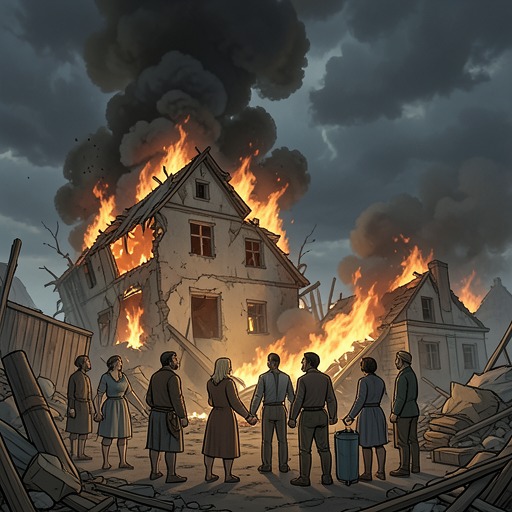
The meaning of Sturgeon Bay changes during the Great Peshtigo Fire. As flames, wind, ash, and burning debris overtake the settlement, Charles Williams urges Robert to find shelter. Robert identifies the bay as the only possible refuge and points back toward it. Charles pulls him along the path toward the water while heat sears Robert’s mouth and nose, and the pair move through the smoke and the smell of burnt hair and flesh.
Reaching the bay does not restore safety immediately. Other people are already wading into the water, yet the surface seems to Robert to be alight with the same life-stealing force that fills the sky. When he runs into it, the cold rises through his legs and reaches his gut, creating a violent contrast with the fire above and around him. The bay offers relief precisely because it is cold and enveloping, but the scene refuses to make it a simple sanctuary: Robert encounters Joseph Alder’s body in the water, confronting the human cost carried into the place of refuge.
Loss and Remembrance
Sturgeon Bay also becomes the point from which the disaster is measured. Anna Williams waits near dawn for Charles to return, one hand on the door frame and the other protecting her swollen stomach. She knows that Charles usually leaves on Sunday afternoon to spend the week in Williamsonville with Robert, and she expects him to come home after the terrible night. Robert’s house, situated closest to the bay, makes the water the natural route through which she imagines news might arrive.
When Robert wakes after being unconscious for three days, Anna tells him that Charles will not return: her father found his body on the shore. The shore therefore becomes the final boundary of Charles’s life, while the bay remains the place where Robert survived. Anna also reports that more than sixty people from the settlement died, some unidentified, and that Williamsonville suffered the most casualties after Peshtigo. The mill, every building, and the forest in the Sugar Bushes across the bay are gone. In this aftermath, the bay is connected not only with survival but with the mass scale of destruction and with the ceremony planned in Williamsonville to honor the dead.
Narrative Significance
Sturgeon Bay operates as a threshold between social life and elemental violence. Before the fire, it is a home reached by horseback, a family business, and the setting toward which Anna directs her romantic hopes. During the fire, it becomes a narrowing line of possibility: Robert must reach it because the land and sky have become lethal. Afterward, its shore holds the evidence that survival is uneven and that refuge cannot protect everyone who reaches it.
The broader narrative repeatedly contrasts destructive and restorative environments. In later scenes, flowers and water carry gentler emotional associations: Nicole encounters living camellias in the South, watches the sunset at a beach with Aaron, and receives a camellia glowing in moonlight. Sturgeon Bay’s fire sequence is harsher, but it belongs to the same environmental pattern in which landscape is never passive. The bay shelters, carries bodies, defines distance, and preserves memory. Its decisive significance lies in that doubleness: it is at once the place Anna hopes Robert will visit and the place Robert reaches when almost everything else has been destroyed.