The Solstice
Under Your Spell: A Romance Boxed Set of Masked Balls, Haunted Gardens, Magic, and MoreThe Solstice is a painting by Paul E. Willingdon depicting Julia at Willingdon Manor in the exact circumstances of a vision she experienced two years earlier, on June 22, the summer solstice. Its decisive significance is that it converts an apparently private, possibly inexplicable sight into a painted record and then into evidence of a hereditary phenomenon: Paul dreamed of Julia on the same day she saw the manor, just as members of the Willingdon family had experienced visions of their future partners across several generations.
Discovery and Physical Description
Julia discovers The Solstice after an emotionally disorienting encounter with Paul. Left alone in the library, she feels dazed by the knowledge that Jason has a girlfriend and by the certainty surrounding her kiss with Paul. While trying to repair her dishevelled chignon using the glass of a framed picture as a mirror, she looks beyond her reflection and notices the painting itself. The discovery is therefore tied to a moment when ordinary romantic confusion gives way to recognition: the image does not merely resemble her experience but appears to return it to her in a fixed, visible form.
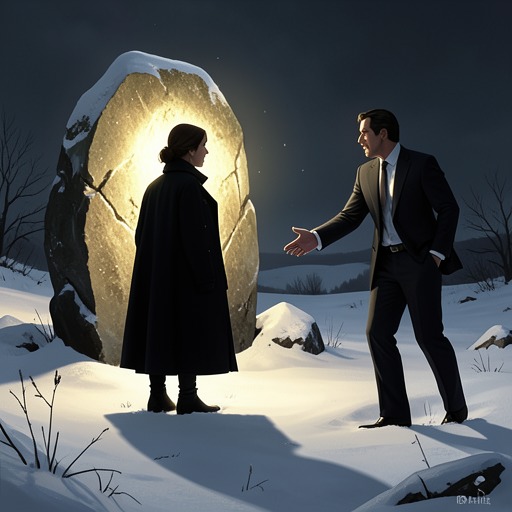
The work shows a lush, forested valley under a clear, brilliant summer sky. Across a river stands a stately manor house, identified as Willingdon Manor, while in the foreground a woman sits with her back to the artist on a large rocky outcrop. The woman has windswept blond hair and wears large brown hiking boots, khaki shorts, and a white T-shirt. Those are precisely the clothes Julia wore on the day she saw the manor. The painting’s composition thus joins landscape, house, river, rock, and figure into a scene that functions less like an imaginative portrait than a visual reconstruction of an event.
At the bottom of the canvas, the artist has written the title The Solstice and signed it Paul E. Willingdon. The signature identifies Paul as both witness and maker: he is not simply explaining an old family story to Julia but presenting an object that he himself created. When Julia asks whether he painted it, he confirms that he did. His academic background helps clarify the dual nature of the work; he studied history, art history, art, and business, making the painting simultaneously an artistic production and a document through which inherited memory can be examined.
From Summer Vision to Painted Record
Before the painting is explained, Julia recalls that she saw Willingdon Manor two years earlier, in summertime, on June 22. She does not initially disclose that the date is her birthday. Paul immediately recognizes another implication of the date: it is the solstice. His response links the temporal circumstance of Julia’s experience to the title written on the painting, so that the work’s name is not decorative but a clue to the conditions under which the vision occurred.
Julia’s earlier sight of the house had no reliable worldly explanation. She had learned only rumors: one person claimed that the house belonged to an Italian fashion designer, another that it belonged to a reclusive Hollywood star, and several people said that it was haunted. No one, according to what she had been told, had actually been inside. The rumors establish a gap between the house’s public mythology and Julia’s direct perception of it. The Solstice enters that gap as a new kind of testimony. It does not resolve every mystery about the manor, but it confirms that Julia’s vision corresponds to something known, remembered, and represented within the Willingdon family.
The painting also exposes the impossibility at the heart of the scene. Paul points out that no trail leads to the view shown in the work. A 100-foot rock face blocks the approach, and beyond it lies forest; he knows this because he has been there himself. Julia’s image therefore cannot be explained as the result of an ordinary hike to a scenic overlook. The painting preserves a view that should not have been accessible, making the artwork an index of a supernatural or otherwise extraordinary connection rather than a conventional landscape made from observation.
Paul’s Dream and the Willingdon Tradition
The painting’s meaning changes when Paul tells Julia that he dreamed about her on the same day she saw the house. Julia asks directly whether he is saying that he dreamed about her, and Paul carefully confirms it while acknowledging that the revelation may frighten her. The coincidence creates a reciprocal structure: Julia saw a place she could not physically reach, while Paul dreamed of the woman who would later stand before the painting. The work is consequently the meeting point of two experiences that occurred separately but on the same date.
Paul places this connection within a family history extending at least five generations, or six if his own experience is counted. In the Willingdon family, an extraordinarily vivid dream of a future spouse is not presented as an isolated fantasy but as a recurring inheritance. The recurrence gives The Solstice a historical dimension. Its subject is Julia, yet its underlying subject is repetition: the same kind of recognition returns through successive generations, carrying private visions into family legend and then into the lives of people who may not have sought such a destiny.
Paul’s account of Lord Willingdon Senior deepens the pattern through a story of disbelief and delayed confirmation. At roughly the same age as his son, Lord Willingdon Senior dreamed vividly of the woman he felt certain would become his future wife. He told no one, persuaded himself that the dream was merely a trick of the subconscious, and accepted a marriage arranged by his parents. Three years after that marriage, he met the woman from his dream. His experience gives the family tradition an uneasy authority: skepticism can postpone recognition, but it cannot prevent the event from occurring. The older generation’s silence and later confirmation also explain why Paul treats his own dream with caution rather than casual certainty.
Recognition, Impossibility, and Narrative Function
When Paul approaches Julia and stands beside her before the painting, both stare at the image. Julia asks whether the painted woman is her, and Paul answers yes. This exchange supplies the central act of recognition in the scene. Julia is not merely learning that Paul has painted a woman who resembles her; she is seeing her own past experience, clothing, and position in the landscape reproduced by someone who claims to have dreamed of her. The painting changes the value of the earlier vision from isolated bewilderment to shared, material evidence.
The Solstice also makes the boundary between art and prophecy unstable. A painting ordinarily represents what an artist has seen, imagined, or constructed; this one represents a scene whose vantage point has no physical route and whose figure corresponds exactly to Julia before Paul could ordinarily have known her. Its title binds image to the solstice, while Paul’s signature binds the image to the family tradition. Together, these elements make the work operate as portrait, landscape, record, and revelation at once.
Its importance is therefore not limited to romance. The Solstice provides a concrete object around which questions of memory, fate, inheritance, and supernatural knowledge gather. Julia’s uncertainty about what she saw at Willingdon Manor is answered not by a complete explanation but by a stronger contradiction of ordinary logic: Paul has painted the inaccessible view, and he says that he dreamed of her when she saw it. The painting’s lasting narrative power lies in that combination of exact detail and unresolved mechanism. It proves that the connection works, while leaving Julia—and the reader—to confront what that connection demands.