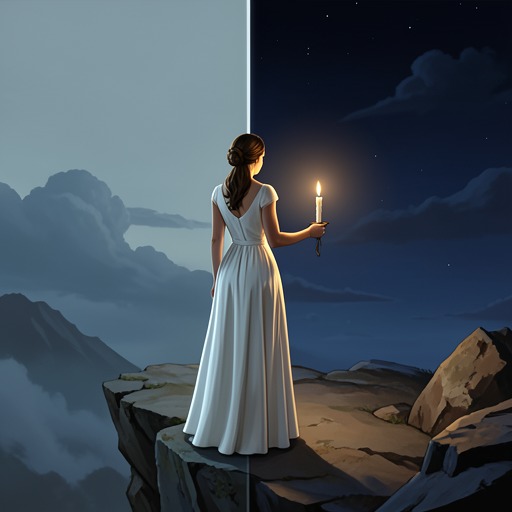
The Willingdon Manor power outage
Under Your Spell: A Romance Boxed Set of Masked Balls, Haunted Gardens, Magic, and MoreThe Willingdon Manor power outage is the decisive interruption that turns a polished party preparation into an improvised supernatural-gothic crisis. A severe storm strikes just as the dining area and bar are ready, plunging the manor into darkness and silence. The event does more than remove electricity: it isolates the household, cuts Paul off from outside assistance, intensifies Julia’s unease, and forces the planned social occasion to be reimagined under pressure.
Causes and Immediate Setting
The outage arrives after the interior preparations have acquired a deliberately cheerful rhythm. Angela puts on upbeat music while Doyle adds another log to the crackling fire, and the team works efficiently until the dining area and bar are set up. Outside, however, hammering rain and howling wind have already made Julia uneasy. The contrast between the welcoming interior and the hostile weather establishes the storm as more than background atmosphere: the manor’s apparent readiness rests against an environment that is becoming increasingly unmanageable.
Doyle identifies the wind as a warning only after the interruption, muttering that he had a bad feeling about it and taking some comfort from the fact that the group finished setting up before the failure. Angela immediately worries about her equipment, because the electrical surge was intense. The outage therefore begins with a double disruption: the party’s practical infrastructure fails, and the specialist equipment on which the evening may depend is placed in doubt. The material systems that had seemed transparent and dependable suddenly become visible as vulnerable conditions of the gathering.
The Blackout
A massive crack of lightning produces the turning point. The house plunges into darkness and silence, with only the fire’s popping and cracking continuing through the stunned quiet. Julia must blink and wait for her eyes to adjust, a small bodily reaction that makes the loss of light immediate rather than abstract. The darkness is not merely announced; it is experienced as a temporary impairment of perception, leaving the people inside dependent on incomplete illumination and uncertain movement.
Footsteps then pound through the hallways before a beam of light swings into the room and flashes around, blinding Julia. The sudden beam does not restore ordinary visibility. Instead, it replaces darkness with another unstable form of perception, one that disorients as much as it helps. Carly asks whether everyone is all right, while the group attempts to establish basic safety in a building whose familiar spaces have abruptly become difficult to read.
Paul’s Failed Plan
Paul’s first response is administrative and defeatist. After looking away from Julia, he explains that the power is gone and that he cannot determine whether the failure is regional or confined to the manor. He cannot reach the fire department, and he doubts that the department would treat the party as a priority in weather of this severity. The storm has therefore severed both communication and institutional support: even an appeal to emergency services cannot guarantee assistance.
Paul concludes that the party cannot be hosted under these conditions and begins trying to contact the group to tell them so. His judgment treats electricity as a prerequisite for the event, and his defeat marks the first value shift of the scene: the evening moves from confident preparation to apparent cancellation. The party, which had been organized as a controlled social performance, becomes a problem of whether the original plan can survive the loss of its expected infrastructure.
Julia’s Intervention and Aftermath
Julia interrupts Paul’s conclusion by challenging the assumption that the absence of electricity makes the party impossible. Her response does not deny the darkness; it questions its authority over the evening. Paul is bewildered because the people are literally standing in the dark, yet Julia’s intervention separates the fact of the outage from the interpretation that the gathering must end. The immediate consequence is a conflict between logistical resignation and imaginative improvisation.
The outage also changes the social and emotional atmosphere inside the manor. The upbeat music is gone, the fire becomes the only continuing source of warmth and sound, Angela’s equipment may have been damaged by the surge, and Paul has disappeared for part of the preparations before returning to confront the failure. Julia’s unease, already awakened by the storm, now meets a practical crisis and a leadership vacuum. The darkness makes the manor’s isolation tangible while giving Julia an opportunity to oppose Paul’s defeated logic.
Narrative Significance
As a scene, the blackout functions as a reversal rather than a simple inconvenience. The staff have completed the visible work of preparation, but the event they prepared for is threatened at the exact moment of apparent readiness. The storm converts completion into vulnerability, and the loss of electricity reveals how much the party depends on systems that had previously gone unnoticed.
The interruption also establishes the conditions for the improvised Willingdon Manor party. Paul reads the outage as the end of the occasion; Julia treats it as a challenge to the occasion’s definition. That contrast gives the event its narrative significance. Darkness produces uncertainty, but it does not settle the question of what the night will become. Instead, it creates the pressure under which Julia’s practical independence and refusal to accept defeat can redirect the gathering.