Will
Under Your Spell: A Romance Boxed Set of Masked Balls, Haunted Gardens, Magic, and MoreWill, also known as Charon, is the temporary ferryman who rows Daisy across the River Acheron toward Hell and then becomes the emotional center of her supernatural journey. His decisive significance lies in the reversal he embodies: a figure associated with death and passage proves capable of tenderness, domestic intimacy, and parenthood, while the woman he guides across the boundary between worlds becomes the person who helps restore his soul.
Identity and Introduction
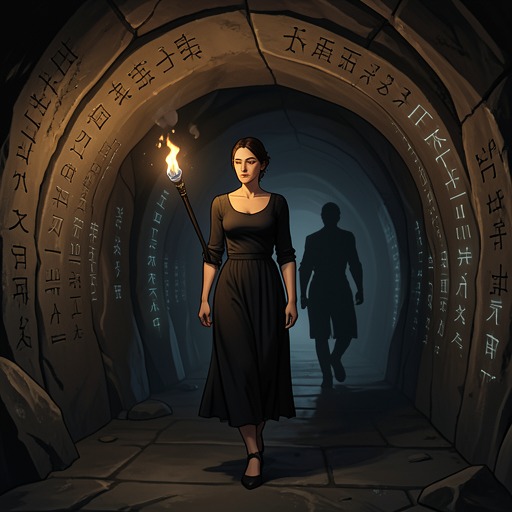
Will initially appears beneath a hood as a young human man with short auburn hair and a confused expression, a presentation that sharply contrasts with Daisy’s expectations of a mythic underworld ferryman. He identifies himself as Charon, the person who rows people to Hell, but explains that he is only the second Charon. The first ferryman retired and moved to Florida, while Will accepted the position temporarily to earn money while completing medical school. His arrangement is explicitly provisional: he expects to do the work for a year, and he regards the compensation as unusually good.
This combination of ordinary ambition and infernal employment makes Will a deliberately unstable threshold figure. He belongs to the supernatural geography of Hell, yet speaks and behaves like a young man taking an unpleasant job to solve a financial problem. His appearance reinforces that incongruity: Daisy thinks he looks barely older than someone selling drinks at a lemonade stand, while Will insists that he is not a child. The humor does not erase the danger of his occupation, but it makes the boundary between the human world and the underworld unexpectedly conversational.
The Ferryman and the Threshold Journey
When Daisy asks to be taken to Hell, Will questions her decision and warns that it is a bad place. His caution establishes that he understands the risks of the route better than she does, but he nevertheless continues rowing when she orders him to keep going. He is therefore both guide and reluctant threshold guardian: he possesses practical knowledge of the underworld, yet cannot simply prevent Daisy from crossing into it.
Daisy also tries to use his position to obtain information. She asks for his real name, and he answers that it is Will. The exchange shifts him from an office or mythological title into an individual with a recognizable identity. His warm brown eyes, light freckles, auburn hair, and playful insistence on his adulthood further humanize him while he remains the person responsible for carrying the living toward Hell.
The journey does not leave Will behind as a purely functional guide. After Daisy encounters the underworld, he reappears in the human world wearing dark jeans and a red-and-black flannel shirt. The ferryman’s return transforms the crossing from an isolated supernatural episode into the foundation of an ongoing relationship. His identity as Charon remains important, but it no longer exhausts who he is.
Relationship with Daisy
Will’s attraction to Daisy develops through bodily immediacy before it becomes a fully articulated relationship. When he approaches her, his words produce a rush of pleasure that Daisy feels physically, as a warm tingling sensation extending through her body. The scene makes attraction an affective force that precedes explanation: Will’s presence changes her bodily state before the relationship has been named or understood.
Their intimacy then becomes explicitly reciprocal. Will tells Daisy that she is the most beautiful creature he has ever seen, and they kiss in her kitchen until drowsiness overtakes her. He leads her to the bedroom, holds her while she falls asleep, and keeps their hands interlocked as he sees her safely into dreams. His role as ferryman is echoed in this gentler act of escorting: he once guided her across a dangerous passage toward Hell, and now he watches over her passage into sleep.
Will’s disappearance the following morning introduces uncertainty into the romance. Daisy wakes to an empty bed with the pleasant remnants of a dream still lingering in her mind, leaving the encounter suspended between supernatural reality and apparent unreality. Yet his later return establishes that the connection was not merely a dream. Will’s movement between realms makes absence part of his character: he is repeatedly associated with departures, crossings, and the possibility that intimacy may vanish when the threshold closes.
Fatherhood, Separation, and Return
Will is present when Daisy gives birth. As contractions intensify and a plant grows unnaturally across the room and up the walls, the elevator doors open and Will rushes into the white room. His arrival places him inside the most physically dangerous and emotionally decisive moment of Daisy’s story. The ferryman is no longer transporting another person toward death; his hands are helping bring their child into the world.
The birth also prompts Daisy’s emotional recognition. Watching the hands that had touched and comforted her and had rowed her into the underworld now bring the baby into the world, she finally admits that she has fallen for Will. He swaddles the child in his shirt and offers her to Daisy, who places the tiny, crying girl against her chest. The scene reverses the symbolic direction of his work: Will’s contact with Daisy no longer signifies a passage downward into Hell, but participation in the creation of a shared life.
Their family is shaped by the strange time of the supernatural realms. Will initially struggles to remember their encounter, but Daisy explains that although they slept together only a few weeks earlier in ordinary time, many months have somehow passed for them. Their daughter, who was newborn at birth, has already become the size of a child several months old through an unexplained magic. Will therefore confronts not only unexpected fatherhood but also a distorted chronology that makes ordinary explanations inadequate.
Daisy’s journey to recover his soul has consequences for their relationship. When she explains that she went to Hell to restore it, Will recognizes that her intervention is why the situation has ended. He remains glum and worried, and Daisy leaves him with the underworld swans rather than forcing a conventional reunion. She tells him that she and their daughter will be at the bookstore if he wants to see the child, defining the bookstore as a continuing point of contact and offering him a place in their lives without pretending that the supernatural rupture has been erased.
Will nevertheless chooses not to remain wholly separated. Before Daisy has left the park, she sees him waiting beside a tree in clean flannel and jeans, his red hair catching the sunlight. The image returns him to the human world and confirms that his connection with Daisy survives the crisis. He is still her Charon, the man who once saw her safely across an unknown world, but he is now also someone prepared to row with her into the future rather than merely deliver her to an ending.
Narrative Role and Significance
Will’s narrative function depends on the contrast between title and person. “Charon” suggests an impersonal mythic office, while Will is a medical student earning money through a temporary position. The contrast allows the story to make the underworld strange without making its inhabitants unreachable. Hell has bureaucracy, employment, retirement, and financial incentives, but it also contains a ferryman capable of flirtation, care, fear, and familial attachment.
His relationship with Daisy gives the threshold journey a return movement. Daisy crosses into Hell seeking something beyond the ordinary human world, but the person who enables that crossing follows her back into intimacy, childbirth, and the possibility of a shared future. Will’s arc thus moves from interim worker to named individual, from reluctant guide to lover and father, and from a figure associated with one-way passage to a participant in return. The final image of him waiting in the sunlight preserves the tension rather than resolving it: Will remains connected to the underworld, but he is no longer defined by separation from the living.