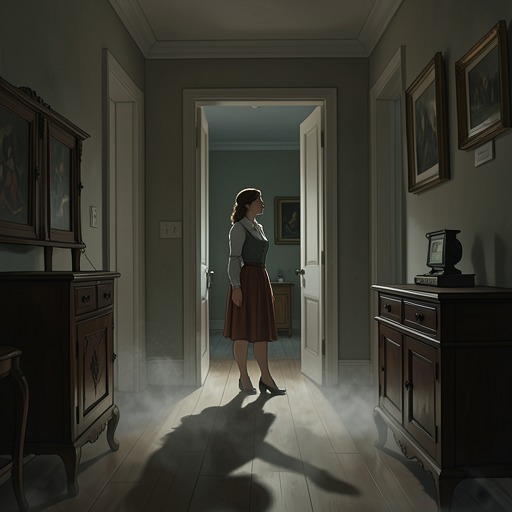
Willingdon Manor's Hidden State
Under Your Spell: A Romance Boxed Set of Masked Balls, Haunted Gardens, Magic, and MoreWillingdon Manor's Hidden State is the condition that makes the house simultaneously visible, inaccessible, and psychologically magnetic. For Julia, the manor is not merely a remote residence but an architectural absence that has governed her imagination for two years: she once saw the great house while hiking, yet could never find it again. Its concealment turns a physical building into a private mystery and helps explain why finally entering it feels like a decisive threshold in her life.
Definition and First Encounter
Willingdon Manor is known to Julia as a place that briefly revealed itself and then disappeared from reach. The remembered sighting occurred during a hike, but no subsequent search restored the route. The house therefore exists in a strange interval between proof and uncertainty: Julia knows that it is real because she has seen it, yet ordinary experience cannot return her to it. That contradiction is the foundation of the manor's hidden state.
The effect is not simple forgetfulness. Julia has remained captivated by the building for two years, and the attraction has become bound to her identity. When Carly announces that the Halloween party will take place there, Julia repeats the name in awe and stresses the significance of finally seeing the inside. She even explains that the place was the whole reason she majored in history. The hidden manor has thus shaped not only her curiosity but the direction of her education, converting an inaccessible building into a long-term intellectual and emotional fixation.
Failed Searches and the Geography of Secrecy
Julia and Carly had spent many Sundays hunting for a driveway to Willingdon Manor. Their repeated efforts ended with the conclusion that there was no way in. The missing entrance is crucial: the manor is not described as merely difficult to reach, but as a place whose ordinary point of access appears not to exist. The road network seems to exclude it, making the house feel detached from the familiar landscape even before any supernatural explanation is supplied.
That concealment is reinforced by the contrast between the manor's apparent grandeur and the modesty of its physical sign. Carly's directions eventually identify a metal gate, but the entrance is hidden behind a stand of pine trees and overgrown holly bushes. Julia would have driven past it if Carly had not pointed it out. The open wrought-iron gate does not cancel the manor's secrecy; it reveals how effectively the surrounding landscape has absorbed and masked the threshold. Access becomes possible only when someone possesses precise directions and recognizes the nearly invisible opening.
The Route to Revelation
The manor's hidden state begins to change when Carly receives the directions for the Clavis Security Halloween party. The discovery is presented as a reversal of the women's earlier searches: the driveway that had seemed impossible is now printed into a usable route. Carly is astonished that they are actually driving to Willingdon Manor and that a driveway exists at all, while Julia's attention is divided between the approaching house and the emotional disturbance caused by Jason and their kiss.
The journey itself preserves the atmosphere of difficulty rather than becoming an ordinary arrival. Heavy clouds gather, rainwater gushes across the road, and trees whip in the wind as Julia drives. Carly reads the directions in stages, first identifying the turn and then instructing Julia to continue for about half a mile before mentioning the metal gate. The approach therefore moves through delay, uncertainty, and partial recognition. Even after the route has been disclosed, the manor does not present itself immediately; it must still be found within hostile weather and obstructing growth.
When Carly finally points out the entrance, Julia steers through the open gate. This is the decisive physical change in the hidden state: the women cross from searching for the manor to entering its property. Yet the scene retains the wonder of an impossible recovery. Carly says that the place changed Julia's life and recalls how excited Julia was when she first saw it. Julia's smile and inability to forget that first sight confirm that the recovered route does not resolve the mystery so much as bring its emotional force into the present.
Emotional and Gothic Significance
The manor's concealment gives architecture the power usually reserved for a person or an event. It withholds itself from Julia, invites pursuit through the memory of a single sighting, and makes access feel earned without explaining the mechanism that prevented it. The house's hiddenness creates anticipation rather than immediate revelation: the unseen interior matters because the exterior has already resisted ordinary attempts to know it.
The effect is distinctly Gothic in structure. Pine trees, overgrown holly, an iron gate, storm-driven rain, and a building glimpsed and then lost combine beauty with obstruction. The route is both a practical set of directions and a passage into a space that has seemed to exist outside normal geography. The manor's grandeur intensifies the contrast: a place important enough to redirect Julia's academic life is concealed behind vegetation so dense that a driver could miss the entrance entirely.
Its secrecy also distinguishes private desire from public access. Julia has treated Willingdon Manor as a solitary historical obsession, while the Halloween party suddenly supplies an official reason to enter and a set of directions that others can use. Clavis Security's event converts the forbidden-looking house into a destination on a work assignment, but Julia's awe shows that bureaucratic access has not made it ordinary. The building remains, for her, the lost object that has finally returned.
Transformation and Narrative Function
By the time Julia and Carly pass through the gate, Willingdon Manor's hidden state has shifted from total inaccessibility to conditional visibility. The manor is still concealed from casual travelers, still dependent on secret or specialized directions, and still visually screened by trees and bushes; nevertheless, the women now possess the knowledge required to reach it. Hiddenness has become selective rather than absolute.
This transformation functions as a threshold in the narrative. Julia moves from years of recollection and failed searching into direct contact with the house she has imagined. The crossing also joins several strands of her life: her history major, her friendship with Carly, the Clavis Security party, the Halloween setting, and the unresolved emotional charge surrounding Jason. Willingdon Manor's disappearance and reappearance therefore operate as more than a location puzzle. They organize a passage from fascination to encounter, making the house's elusive geography the outward form of a larger movement from anticipation toward revelation.